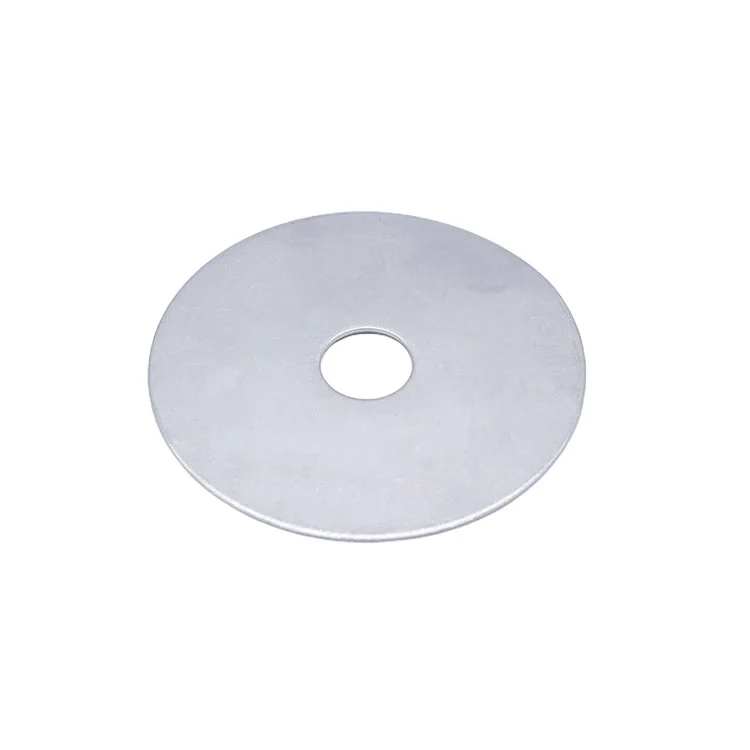
Buy flat washers from Ningbo Yinzhou Zhenhua Stamping Co., Ltd. when the joint needs a clean bearing surface rather than a locking feature. A flat washer does not stop a fastener from loosening — it spreads the clamp load over a wider area, protects a soft or coated surface from the nut face, and covers an oversized or slotted hole.
Choosing the right flat washer comes down to three inputs: the bolt size, the hole diameter it has to cover, and the hardness of the material it will sit against. Get those wrong and the washer either deforms into the joint or lets the nut pull through the panel.
More joints fail from a flat washer being asked to do a job it cannot do than from the washer itself being wrong. This is the honest distinction.
Where the joint needs any of the following, a flat washer is the correct part — and the right standard is the one that matches the job.
A flat washer is not an anti-loosening device. Where the joint needs one of the following, a different part is required — and adding a flat washer on top will not substitute for it.
The same joint, the same bolt, and the same torque. The difference is where the force meets the material.
The illustration is a mechanism diagram, not a specific test result. Bearing pressure is inversely proportional to contact area, and the washer adds area.
The full clamp load lands on a narrow ring under the nut face. On hard steel this is fine. On aluminium, plastic or a coated panel, the material yields at the contact edge and the joint loses preload as the surface deforms.
The same load now spreads across a much larger area, so bearing pressure at any point is lower. The panel stays flat, the coating stays intact, and the joint keeps the preload it was torqued to.
The same nominal bolt size is produced to different standards because the joint requirements differ. Picking the wrong one is the most common flat washer specification error.
The standard flat washer for most industrial joints. Outer diameter scales with bolt size to a fixed ratio, so the bearing area is consistent across the range. Grade A for smaller sizes, B for larger.
The same standard thickness as DIN 125, but with a noticeably larger outer diameter. The extra area brings bearing pressure down on soft materials where a standard washer would indent the surface.
A thicker, hardened washer matched to the bolt grade rather than to the hole size. Specified where the joint carries shear alongside tension and where the washer has to resist deformation under high preload without cupping.
Four joint conditions where a flat washer is the wrong part, and which family is correct instead. Zhenhua produces all four, so the recommendation follows the joint rather than the catalogue page.
A flat washer adds no resistance to rotation. Where the joint sees sustained vibration, the correct part is a wedge lock washer pair, which converts slip into additional tension rather than letting the nut walk off.
Where the failure mode is the joint losing its clamp load through thermal cycling or gasket creep, a flat washer cannot help. An elastic washer is needed — a Belleville for high force or a wave spring for even distribution.
Where the mating face is hardened steel and the joint needs positive resistance to rotation, a tooth lock washer adds serration bite. A flat washer underneath can still provide a bearing surface, but the locking action comes from the serrations.
Where a structural joint carries shear and the washer has to resist cupping, the correct part is a safety lock washer or a hardened DIN 6916 flat washer, matched to the bolt grade rather than to the hole size.
Those three inputs confirm the standard, thickness and finish. Flat washers are stamped on the same progressive-die lines as our lock and spring washers, from standard sizes to made-to-drawing parts, with material traceability recorded from incoming coil to packed carton. Where the joint needs a locking or elastic function rather than a bearing surface, our engineers will say so and point you to the lock washers or spring washers that fit better.
✅ Get free sample!! Contact us today
✅ We will contact you within 24 hours