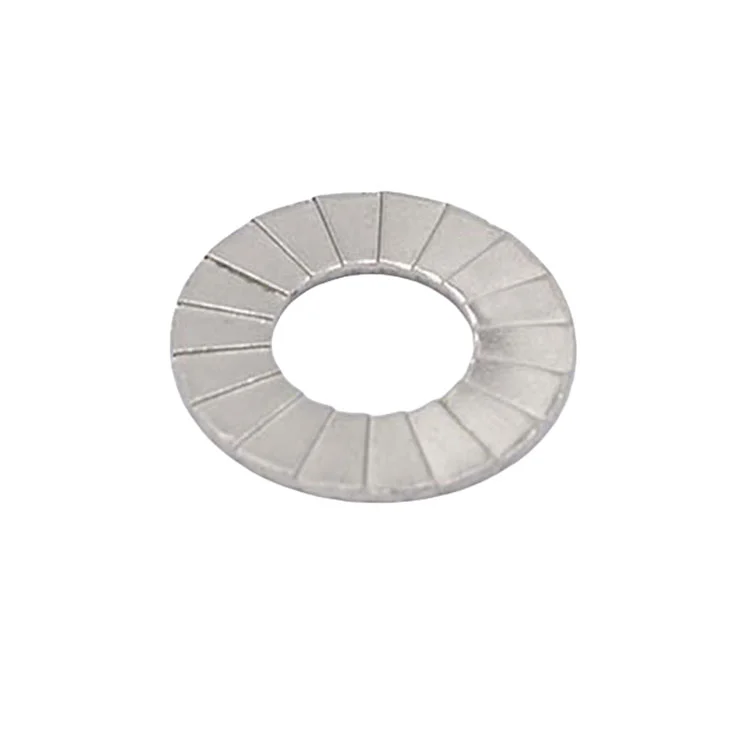
Material
Spring steel 65Mn
- Hardness
- HRC 42-50 (quench & temper)
- Surface Treatment
- Black oxide / phosphate / Dacromet
- Notes
- Most common in China; best cost-performance

Wedge lock washers are the most distinctive branch of the Lock Washers family. They are not a single washer, but a matched system of two identical washers facing opposite directions. The governing standard is DIN 25201 , positioned for heavy-duty, high-vibration, safety-critical bolted joints. Zhenhua backs the range with in-house tooling and 30–400 t pressing under IATF 16949 , supplying automotive Tier-2/Tier-3 chains and export programs worldwide.
Wedge lock washers are the most distinctive branch of the Lock Washers family. They are not a single washer, but a matched system of two identical washers facing opposite directions. Stacked together, their inner cam faces engage, while the outer radial serrations bite into the bolt head (or nut) bearing face and the mating part respectively.
The governing standard is DIN 25201 (with paired wedge-locking washers also specified under other national and OEM standards). Compared with tooth lock washers (DIN 6797) and spring washers (DIN 127), the wedge washer is positioned for heavy-duty, high-vibration, safety-critical bolted joints: wind energy, construction machinery, rail vehicles, automotive chassis and powertrain, and mining equipment.
One point must be stated clearly: wedge washers must be used as a pair, and pairs must never be split or mixed. A single washer cannot produce the wedge lock, and installing the pair the wrong way round removes the locking function entirely - this is the most common misuse in both purchasing and assembly.
| Comparison | Wedge Lock Washer (DIN 25201) | Tooth Lock Washer (DIN 6797) | Spring Washer (DIN 127) |
|---|---|---|---|
| Locking mechanism | One-way wedge cam self-locking | Teeth bite into bearing face | Elastic split provides axial preload |
| Supplied as a pair | Yes - mandatory, opposing | Single washer | Single washer |
| Reusable | Yes (while cam faces stay intact) | Generally not reused | Generally not reused |
| Locking grade | High (heavy duty / high vibration) | Medium | Low to medium |
| Typical use | Wind, construction, rail, chassis | Electrical, appliance, general machinery | General machinery, hardware |
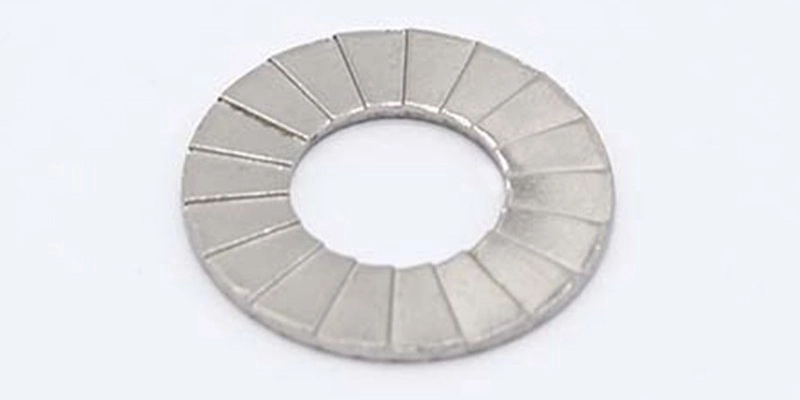
Two angles explain everything: the bite angle of the outer serrations and the wedge rise angle of the inner cam faces.
Step one - outer serrations bite. Each washer carries a ring of hardened radial serrations on its outer face. During tightening, these serrations press shallow marks into the bolt head bearing face and into the mating part, forming a mechanical interlock. The washer can no longer rotate relative to the bolt or to the work piece. The rotational degree of freedom is eliminated first.
Step two - the cam faces lock one way. The inner faces of the two washers form a symmetrical pair of ramps. As the bolt is tightened, the cams ride up the rise angle, converting bolt tension into normal pressure on the cam faces.
Because the cam rise angle is greater than the equivalent thread lead angle, any rotation that would loosen the bolt must first lift the cams to a higher position - while the clamp load keeps pushing them back down. The loosening direction is therefore blocked, while the tightening direction remains free.
Why this is the highest locking grade. A conventional elastic washer compensates preload loss with springback, which decays as the material relaxes. A wedge washer locks geometrically: it consumes no elasticity and does not relax over time. In transverse vibration testing (Junker test), paired wedge washers retain far more residual preload than other common locking methods.
Versus threadlocker or nylon-insert nuts. Threadlockers and nylon inserts add friction or fill the gap; they still depend on friction, so their effectiveness drops after high temperature, heavy vibration or repeated re-torquing. A wedge washer is a geometric solution and is reusable - which matters greatly for joints that are inspected on a schedule, such as wind turbine towers and hubs.
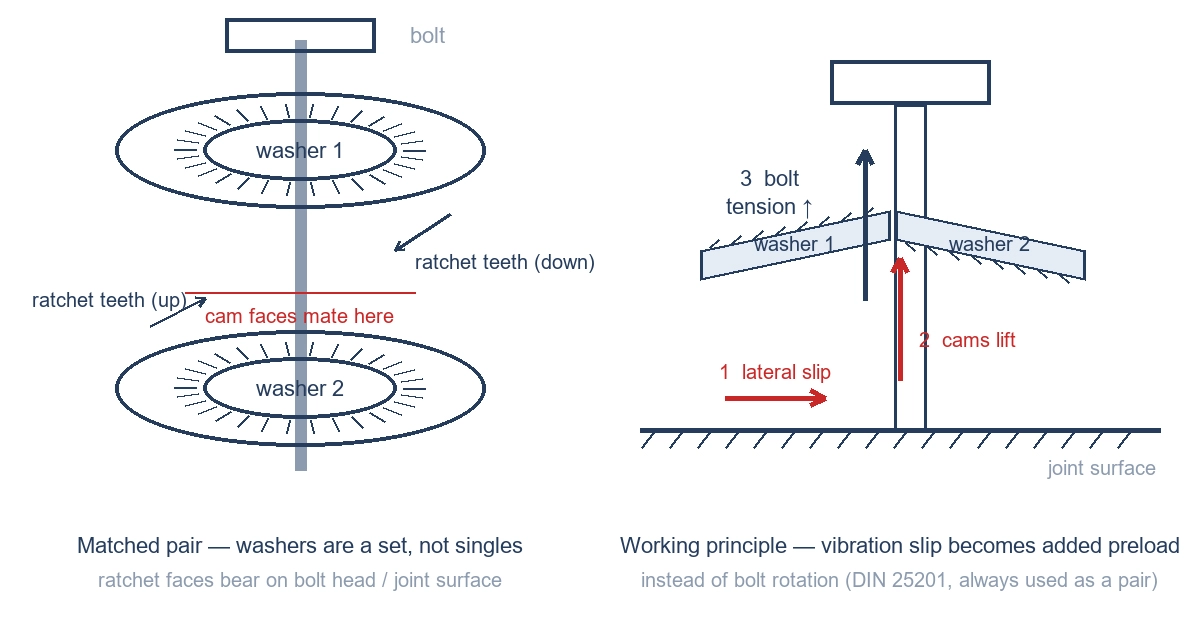
Zhenhua supplies the following configurations under DIN 25201 and common market practice:
| Configuration | Description | Typical Use |
|---|---|---|
| Standard pair (DIN 25201) | Two identical washers supplied as a pair; outer serrations, inner cam faces | General bolted joints, wind, chassis |
| Tabbed / hex-edge | Hex or lug geometry on the outer edge for location and tool access | Tight spaces, anti-rotation location |
| Nut-assembled set | Supplied with a lock or flange nut as one kit | High-volume assembly lines, fewer pairing errors |
| Sealing version | Washer combined with a sealing ring | Interfaces with leak-tightness requirements |
| Custom cam angle | Cam rise angle, OD and serration count built to drawing | Special preload or envelope requirements |
Common sizes: based on nominal thread, covering M3 to M30 (including M6/M8/M10/M12/M14/M16/M20), with ID, OD and thickness per DIN 25201 or customer drawing. Larger sizes (M24 and above) and inch (UNC/UNF) sizes can be quoted on request.
Four things to confirm before ordering: (1) whether the parts are supplied as a pair; (2) whether the pair comes from a single production batch in matched orientation (mixing batches can cause poor cam contact); (3) whether the OD clears the bolt head and the socket; (4) whether the serration type suits the surface hardness of the mating part.
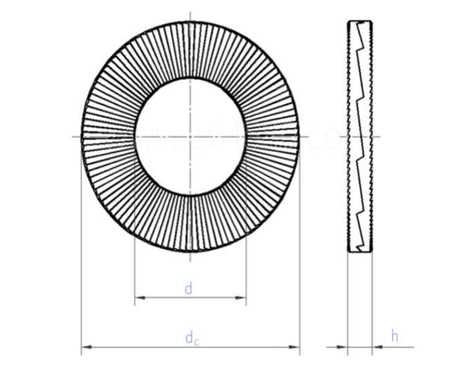
*All measurements in millimeters (mm)*
| SIZE | d | dC | T | Kgs/1000pcs | For screws of | ||||
|---|---|---|---|---|---|---|---|---|---|
| min | max | min | max | min | max | mm | inch | ||
| S3 | 3.3 | 3.5 | 6.8 | 7.2 | 1.55 | 2.05 | 0.3 | M3 | #5 |
| S4 | 4.3 | 4.5 | 7.4 | 7.8 | 1.55 | 2.05 | 0.4 | M4 | #8 |
| S5 | 5.3 | 5.5 | 8.8 | 9.2 | 1.55 | 2.05 | 0.5 | M5 | #10 |
| S6 | 6.4 | 6.6 | 10.6 | 11 | 1.55 | 2.05 | 0.7 | M6 | — |
| S8 | 8.6 | 8.8 | 13.3 | 13.7 | 2.25 | 2.75 | 1.5 | M8 | 5/16" |
| S10 | 10.5 | 10.9 | 16.4 | 16.8 | 2.25 | 2.75 | 2.2 | M10 | — |
| S12 | 12.8 | 13.2 | 19.3 | 19.7 | 2.25 | 2.75 | 2.9 | M12 | — |
| S16 | 16.8 | 17.2 | 25.2 | 25.6 | 3.15 | 3.65 | 6.7 | M16 | 5/8" |
| S20 | 21.2 | 21.6 | 30.5 | 30.9 | 3.15 | 3.65 | 9.3 | M20 | — |
Wedge washer performance depends mainly on material hardness - the serrations must be harder than the mating surface so they can press in and hold their bite.
Surface treatment notes:
- Dacromet (zinc-aluminium flake) is the preferred coating for wedge washers - no hydrogen embrittlement risk, salt-spray resistance beyond 1000 h, and a thin film (typically 6-10 um) that does not noticeably reduce serration bite depth.
- Black oxide / phosphate gives the thinnest film (1-3 um) and the least effect on bite, but limited corrosion resistance - pair with oil or use indoors.
- Electroplated zinc on hardened parts must be followed by de-embrittlement. Hardened parts pick up hydrogen during pickling and plating; if it is not driven out, sustained tensile stress from assembly preload can cause delayed fracture (hydrogen embrittlement) - the single most important risk on safety-critical parts.
- Hot-dip galvanizing is not recommended for precision wedge washers: a 40-80 um zinc layer fills the serration valleys and reduces bite depth substantially, which cuts locking performance sharply.
What our inspection focuses on:
- Cam rise angle - set by the die profile and the source of locking capability; measured at first article to drawing.
- Cam face contact - a stacked pair must seat fully with no warpage or high spots; poor contact concentrates stress and deforms early.
- Serration geometry and hardness - consistent tooth height, intact tooth tips, hardness above the lower limit of the heat-treat spec.
- Flatness - warpage directly weakens the bite, so coining after stamping is used to control it.
- No mixed parts - if washers with a different OD or cam angle enter the same joint, locking fails immediately. Pair packing and single-batch delivery are therefore mandatory.
Process quality control - six gates
Incoming material verification: every coil is checked on the element analyzer for composition, with thickness, spec and batch documents confirmed; customers can trace any batch number.
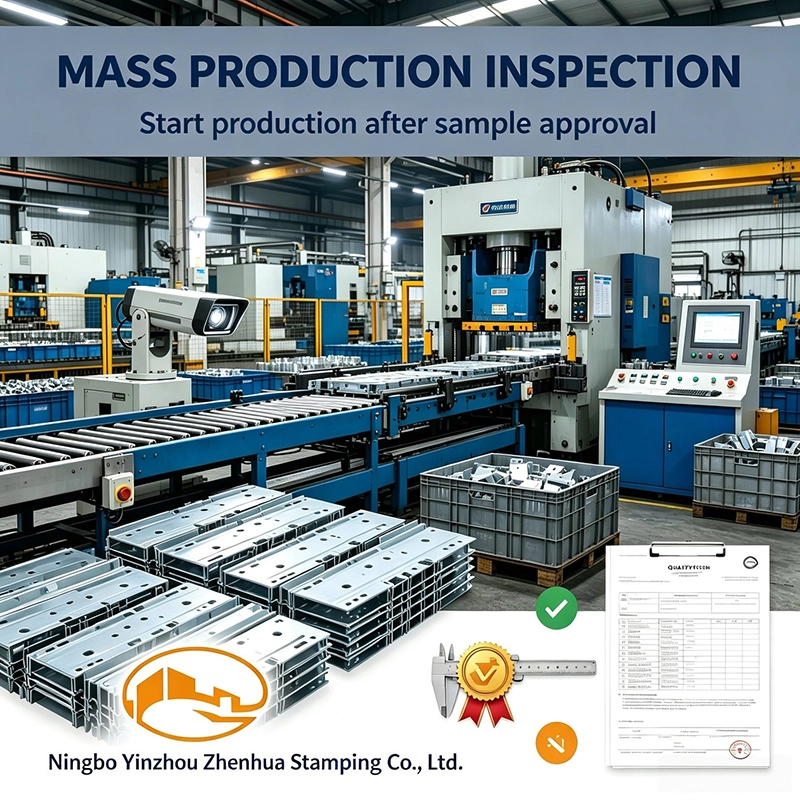
First-article inspection: key dimensions, tooth/clip geometry and appearance are checked after every setup before continuous production is released.
In-process patrol: bin-change checks plus a patrol round every 2-3 hours; any abnormality stops the press and quarantines the current and previous batches.
Post-treatment re-verification: heat treatment and surface treatment - including outsourced work returning to the plant - are re-checked batch by batch for hardness, film build and appearance.
Finished-part screening: vision inspection plus 100% manual quick-sorting as required, focused on cosmetic defects and mixed parts.
Batch traceability: customer batch/order numbers are linked to raw-material and production batches; quality records ship with the goods.
Three selection steps: (1) set the ID from the thread size; (2) set the serration type and hardness class from the mating surface hardness and load; (3) set the OD and whether a tab is needed from the assembly envelope.
Installation notes (please pass these to the line with the goods):
- The two washers must be stacked in opposite orientation - cam faces together, serrations facing outward. Remember it as: one washer faces the bolt head or nut, the other faces the work piece.
- Never use a single washer, and never stack a wedge washer with another washer type - it breaks cam face contact.
- Tightening torque may be slightly above standard, because the serrations need to bite. Stay within bolt strength and base material bearing limits; use a plain washer as a transition on thin or soft materials.
- Reusable - as long as the serrations are not flattened and the cam faces show no collapse, the pair can be re-used after disassembly. On heavy-duty joints, replacement at major overhaul is recommended.
- Mating surface - avoid surfaces that are too hard (a hardened layer prevents bite); keep roughness moderate and free of heavy oil or coating build-up.

These questions come from actual overseas enquiries, ordered by frequency. If your application is not covered, send us the drawing or application details directly.
Because the locking action comes from the wedge interlock of the two inner cam faces. A single washer has only the serrations, which resist rotation but cannot produce a one-way lock without the wedge rise angle - performance is then comparable to a plain tooth washer. Our standard practice is to ship paired, same-batch, matched-orientation so the line cannot mis-pair them.
Two criteria: vibration severity and whether the joint needs re-opening. DIN 6797 is sufficient for general machinery, electrical and appliance joints. For heavy-duty, high-vibration or safety-critical joints - wind, rail, chassis, construction equipment - specify a DIN 25201 paired wedge washer. Joints inspected on a schedule also favor wedge washers because they are reusable.
Standard sizes are accepted at normal production quantities, with many sizes available from 10,000 pieces. Custom cam angles or materials require a tooling and volume review. For trial fits we can supply samples with recommended torque values first.
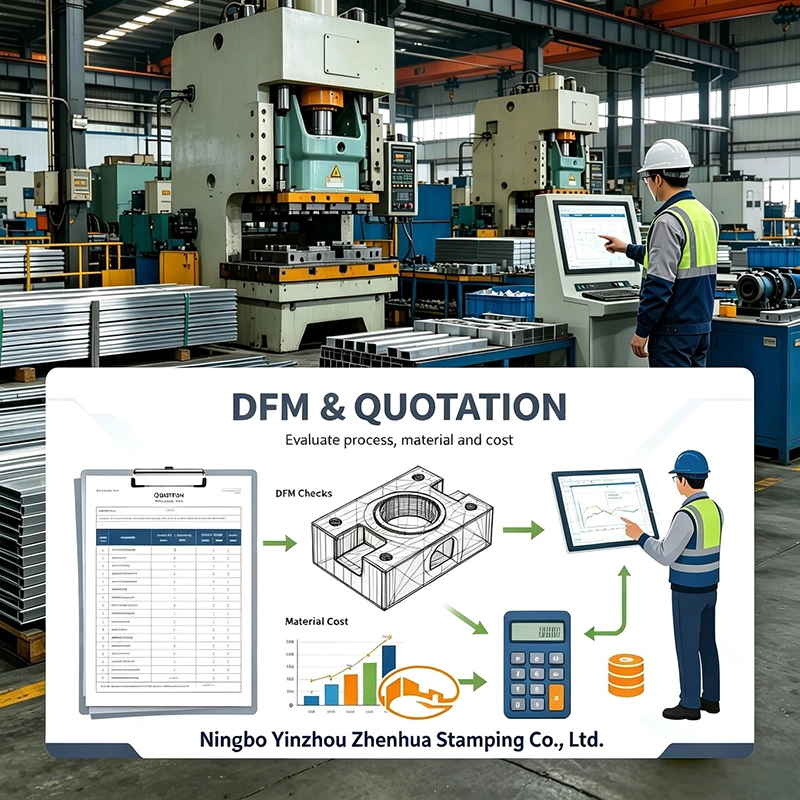
Yes. We have an in-house tooling team and can produce custom cam rise angles, OD, ID, thickness and serration geometry to drawing. Prototype lead time depends on complexity; we normally confirm the drawing (DFM) before cutting the die.
Mainly in achievable hardness. SUS304/316 can only be work-hardened, so they are softer than quenched spring steel and bite less effectively on high-hardness mating parts or under heavy load. They suit corrosion-first, moderate-load applications; for heavy duty, specify quenched spring steel with Dacromet.
Yes, noticeably. The thicker the film, the shallower the serration penetration and the weaker the lock. That is why we recommend Dacromet or black oxide/phosphate and do not recommend hot-dip galvanizing. Where a customer needs heavy corrosion protection, we compensate through a higher hardness class or taller serrations.
Wedge washers are designed to be re-opened and re-used. The criterion is whether the serrations are visibly flattened and whether the cam faces are collapsed or deformed. In general maintenance they can be re-used several times; safety-critical locations should follow the customer's maintenance spec and replace at major overhaul.
Lead time for standard sizes is confirmed against the production schedule at order. Packaging options include pair bags (which prevent wrong orientation), counted bags and private-label boxes, with barcode and batch marking on request. Price and lead time are finally confirmed with the sales contact.
Wedge lock washers are safety-critical parts. When requesting a quote, please include: bolt size and property class, required preload torque, mating part material and surface hardness, and the service conditions (vibration, temperature, corrosion). We will then recommend a suitable cam angle, serration type, material and coating.
Contact note: Standard and custom wedge washers can be quoted to drawing; drawings, samples and sample inspection reports are available on request. Price and lead time are subject to final sales confirmation.
Those three inputs are enough for us to confirm die coverage, material, finish and delivery. Custom wedge lock washers move from drawing to prototype using in-house dies.
✅ Get free sample!! Contact us today
✅ We will contact you within 24 hours