Washers

Leading Lock Washers Manufacturer for Secure Industrial Fastening

Lock Washers · Level 1 Category

One supplier behind every anti-loosening design your engineers specify

Buy lock washers from Ningbo Yinzhou Zhenhua Stamping Co., Ltd. when your specification calls for more than one type. A vibrating joint, a soft surface and a tight counterbore are three different problems, and they rarely resolve to the same washer. Zhenhua stamps the full family, so the recommendation comes from one plant rather than from three suppliers' catalogues.

Choosing a lock washer starts with the joint itself: how hard it shakes, what the mating surface is made of, and how much room the fastener has. Answer those three and the washer type follows.

LW-FAMILY · SECTION PROFILES TOOTH WEDGE SAFETY PUSH-ON
Four families, one plant Tooth, wedge, safety and push-on washers stamped in-house
Progressive-die tooling Geometry and spring rate repeat across million-piece runs
Traceable batches Material lot recorded from incoming coil to packed carton

Start with the joint, not the washer

Three properties of the joint decide which lock washer family applies. Get these right and the specification narrows to one or two part numbers.

01

How hard it shakes

A joint that sees continuous vibration — engines, compressors, rail bogies — behaves very differently from one that sees intermittent impact, such as a hand tool or a bracket struck during assembly. Continuous vibration walks a plain nut off regardless of torque; intermittent impact usually just needs added friction.

02

What the surface is

Serrated washers depend on biting into the mating surface. A hardened steel flange accepts tooth bite cleanly; a soft aluminium or painted panel may deform instead, and a coated surface may be damaged by the teeth. When the surface cannot be marked, a wedge lock washer replaces friction with geometry.

03

How much room the fastener has

Wedge lock washers come in matched pairs and need a specific orientation to work. Where the counterbore or the flange leaves no space for that, a push-on washer or a single tooth washer is the practical answer even if the theoretical performance is lower.

The four lock washer families

Each family solves a different failure mode. Zhenhua stamps all four, so the recommendation follows the joint rather than the catalogue page. Where a joint needs a nut rather than a washer, our self-locking counter nuts pair directly with these washers.

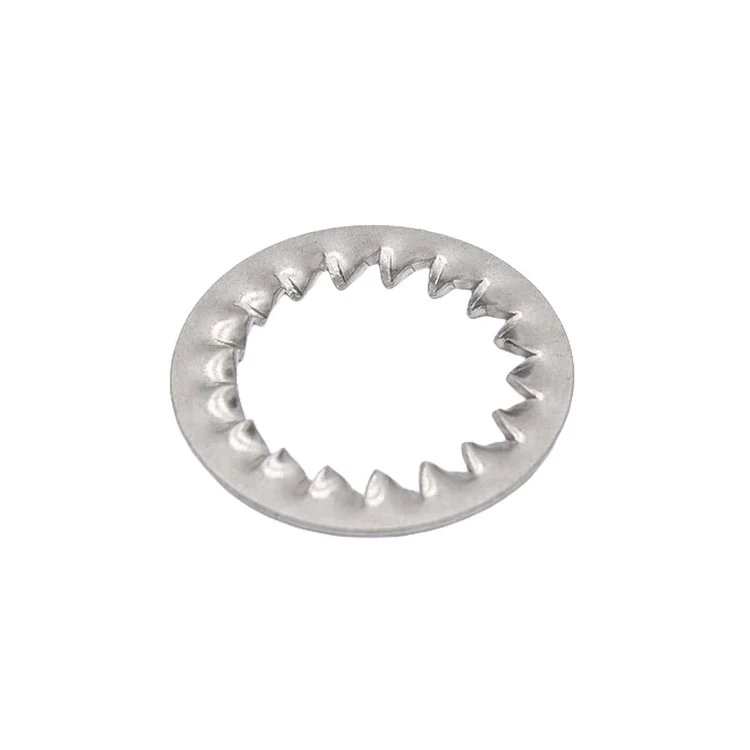
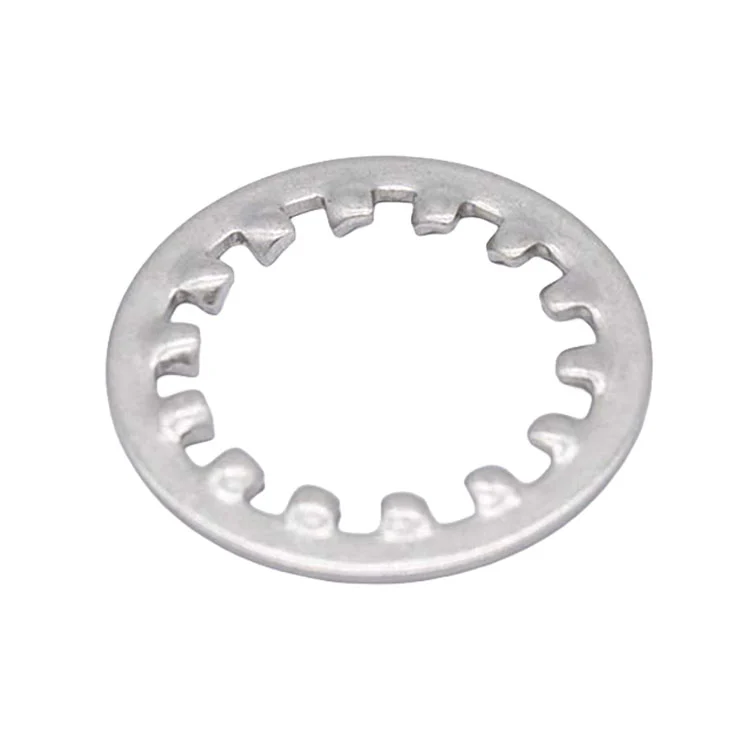
Friction locking DIN 6797J internal tooth lock washers with serrated inner teeth

Tooth Lock Washers

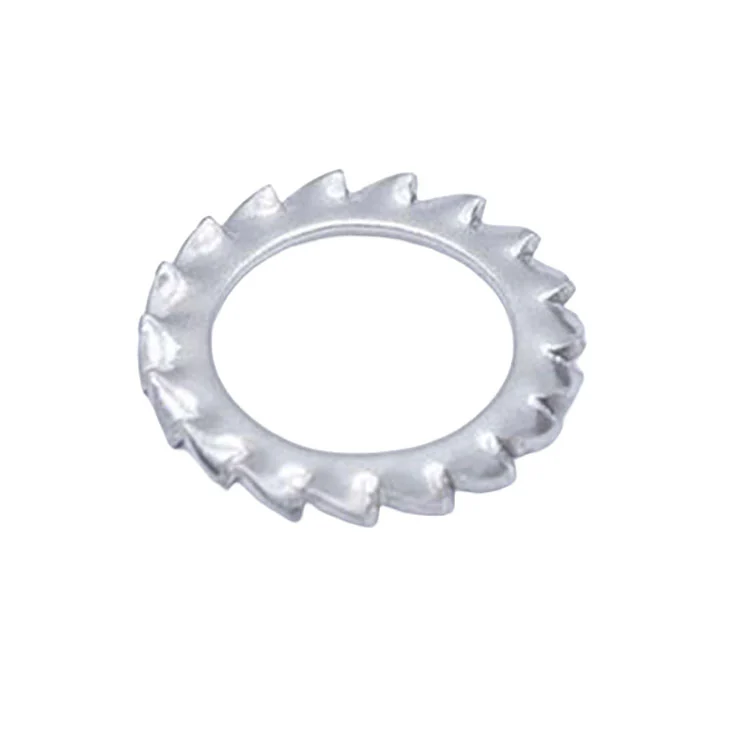
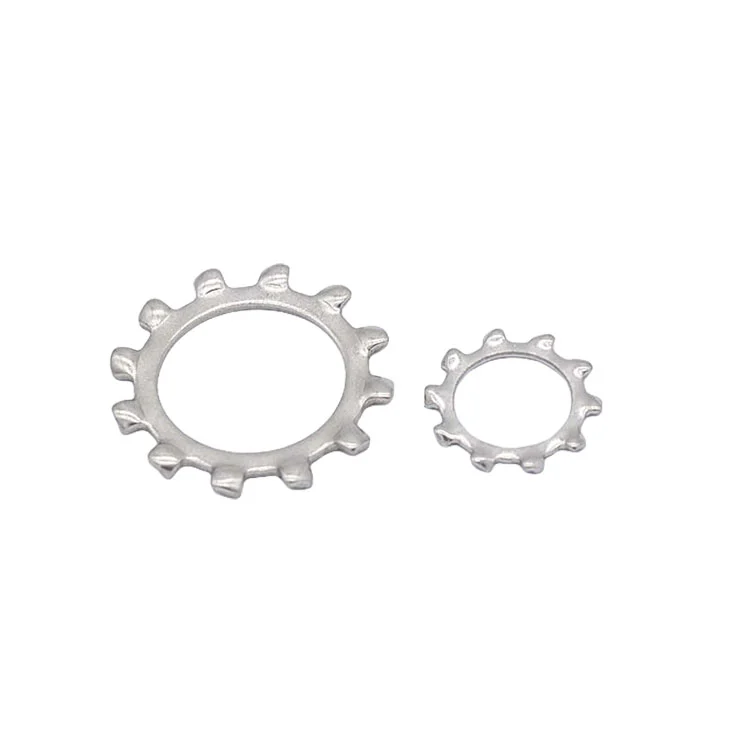
Sharp serrations formed on the inner or outer edge bite into the mating faces when the joint is tightened. The resistance to loosening comes from the friction and mechanical interference the teeth create, not from a change in the bolt's own preload path.

Specify when the surface can be marked and the load is light to medium — electrical connections, sheet metal enclosures, general machinery.
DIN 6797 J / A DIN 6798 J / A / V
View family
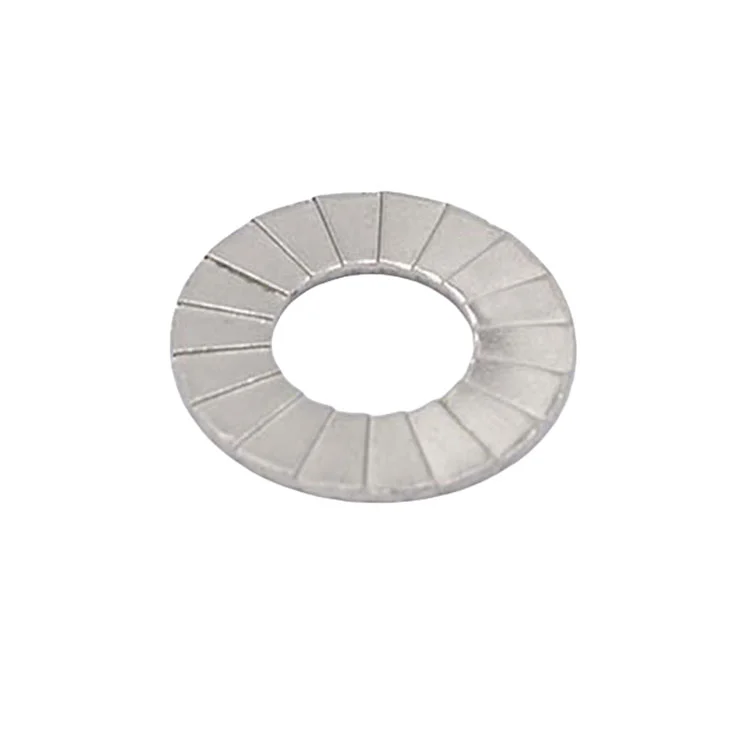
High preload Stainless steel DIN 25201 L wedge-locking washers in matched pair

Wedge Lock Washers

A matched pair with radial cams on the facing sides. The cam angle is steeper than the thread pitch, so any tendency to rotate out of the joint is converted into additional clamping force rather than into loosening. The mechanism does not rely on friction against the joint faces.

Specify for continuous vibration under high preload — rail, wind turbine towers, heavy machinery where retorque is not practical.
DIN 25201 Matched pairs
View family
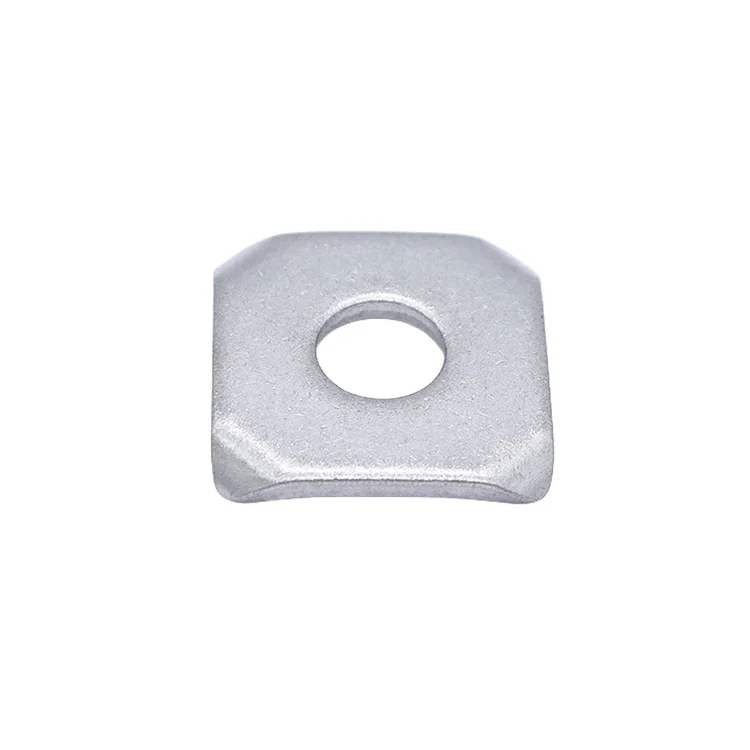
Load distribution DIN 434 square taper washers for structural and safety-critical joints

Safety Lock Washers

Tapered and square profiles that spread the bolt load across a wider bearing area and compensate for the angle of a channel or I-beam flange. Used where a plain washer would sit on a slope and load the bolt off-axis.

Specify for structural steel, channel and angle sections, and joints where the bearing surface is not parallel to the nut face.
DIN 434 Square taper
View family
Fast assembly External serrated push-on lock washers for fast assembly

Push-on Washers

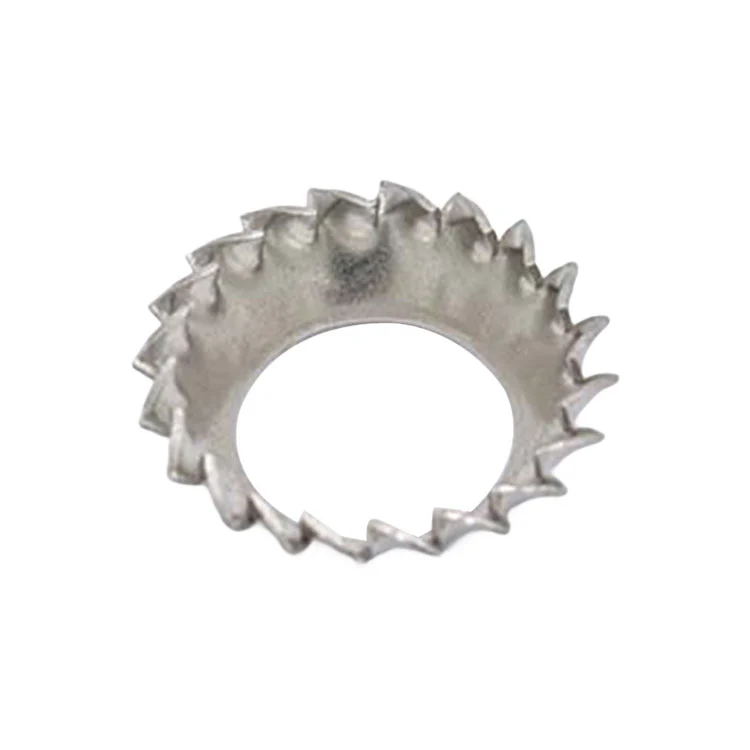
Dished profiles with radial slots that push onto a shaft or stud and grip without threading. The assembly step is a press rather than a rotation, which is why they appear in high-volume lines where cycle time is the constraint.

Specify for retained components, shaft-mounted parts and applications where the joint is assembled once and the fastening method must be fast and repeatable.
Push-on Dished profile
View family

How the four types compare

A side-by-side view of the locking mechanism, the surface requirement and the assembly step — the three things that decide whether a joint accepts the washer.

Washer family Locking mechanism Surface requirement Assembly step
Tooth Lock Washers Serration bite plus friction Marks the mating face Turned with the nut
Wedge Lock Washers Radial cams, angle steeper than thread pitch No marking, geometry-based Matched pair, orient per cam direction
Safety Lock Washers Load distribution plus taper correction Needs flat bearing area for taper to work Turned with the nut, sits under the nut face
Push-on Washers Dished spring grip on shaft or stud Shaft diameter and hardness Pressed on, no rotation
PROGRESSIVE DIE COIL → DIE → WASHER

What makes the geometry repeatable

A lock washer only works if the tooth angle or the cam rise is what the drawing said it was. Those are formed by the die, and the die is what we control in-house.

  • Progressive-die tooling built and maintained on site — tooth geometry, cam rise and dish height are set by the die, not by a subcontractor's tolerance.
  • Million-piece runs without geometry drift — the first washer off the die and the last one inspect to the same profile.
  • Material traceability by batch — coil lot recorded against the parts produced from it, from incoming stock to packed carton.
  • In-house finishing — zinc, black oxide and mechanical zinc applied to the specification of the joint, not to a stock finish list.
  • ISO 9001 quality management system across the stamping and finishing processes, with inspection records retained per batch.

Send the drawing, bolt grade and operating conditions

Those three inputs are enough for us to shortlist the right washer family and confirm the size, material and finish. Custom sizes and tooth profiles move from drawing to prototype in days using in-house dies — and where the joint also needs a locking nut, our self-locking counter nuts ship from the same plant.

Request a Quote
X
We use cookies to offer you a better browsing experience, analyze site traffic and personalize content. By using this site, you agree to our use of cookies. Privacy Policy
Reject Accept