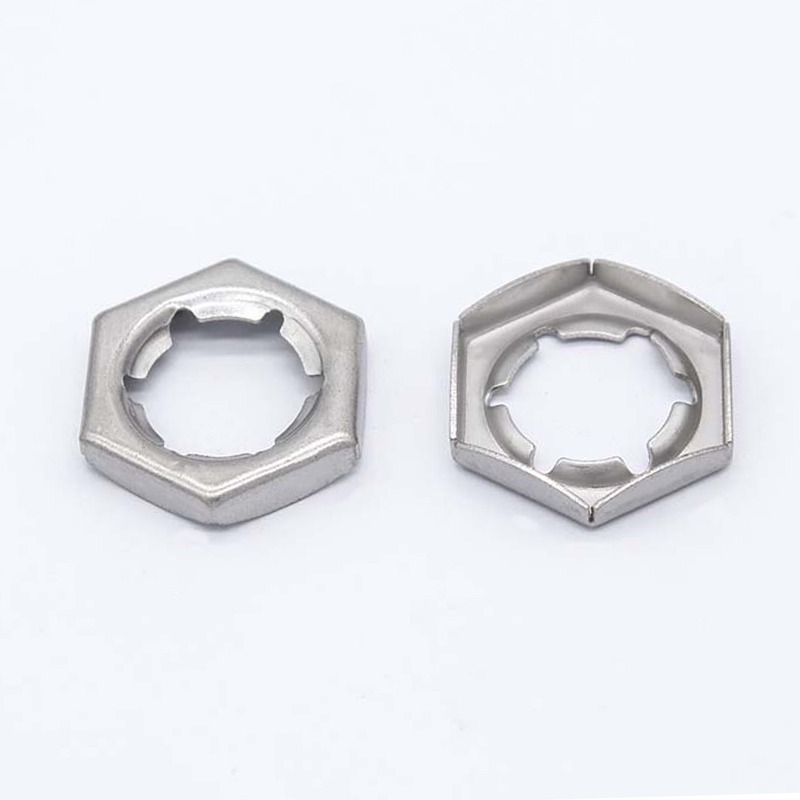
Leading Manufacturer of Self-Locking Counter Nuts for Reliable Locking Performance
Quick FactsAt a Glance
Founded1989
Quality SystemIATF 16949
Press Range30–400 t
Direct Exports~30%
The DIN 7967 pal nut is a one-piece stamped self-locking nut whose spring-clip teeth grip the bolt
thread — no lock washer, flat washer or nylon insert needed to hold preload under vibration. Zhenhua backs the range
with in-house tooling and 30–400 t high-speed pressing under IATF 16949, supplying
automotive Tier-2/Tier-3 chains and export programs worldwide.
1. Category Positioning & Buying Intent
Self-Locking Counter Nuts are a core Level-2 category under Zhenhua's Industrial Nuts range. When your fastening point needs a nut
that locks on its own, with no extra locking parts, the pal nut is the answer.
How do you choose self-locking pal nuts for a high-vibration line? Look at three things: the locking geometry, the number of reuses you expect, and the service temperature. Buy self-locking pal nuts from Ningbo Yinzhou Zhenhua Stamping Co., Ltd. and you
get more than a part — you get a repeatable locking solution: from incoming material verification to batch-level
traceability, thread fit, hardness and plating stay consistent from first sample to full container.
2. Product Overview: What Is a DIN 7967 Pal Nut
DIN 7967 (Self-Locking Countersunk Nuts, commonly called Pal Nuts) is a one-piece stamped self-locking
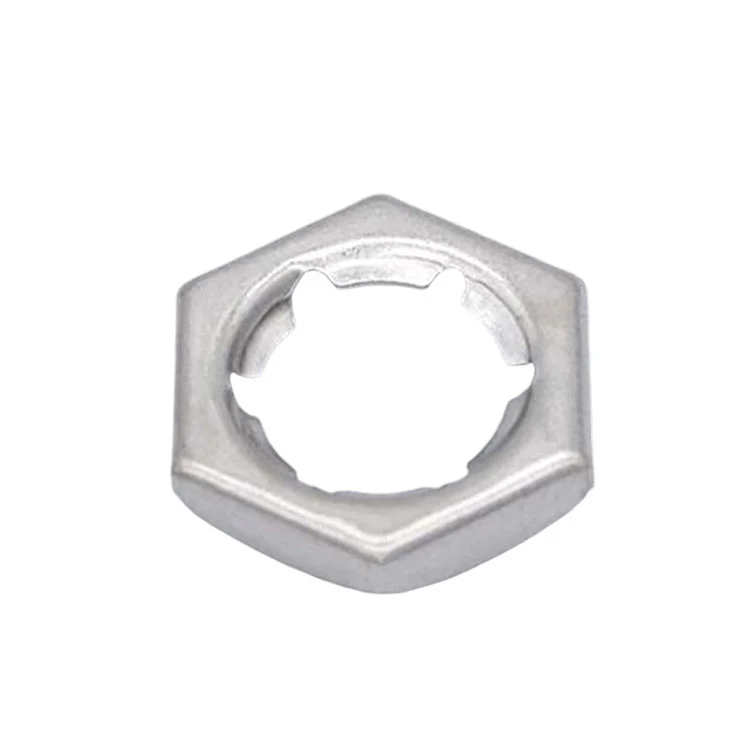
nut: a hex body with a thin, dome-shaped skirt, and spring-clip teeth blanked into the bore.
How it locks: as the nut runs down the bolt, the spring teeth are spread by the thread and keep gripping the shank,
creating a constant radial preload and drag torque — the nut stays put under vibration, with no lock
washer, flat washer or nylon insert required.
Feature
Advantage
Benefit to You
One-piece self-locking, teeth grip the thread
No washer stack needed
Fewer parts, shorter assembly, cleaner BOM
Thin-sheet stamping, one stroke
Lightweight, low profile
Fits lightweight and space-limited assemblies
Dome-shaped spring skirt
Smooth run-down, stable grip
Fast installation by hand, bit or automatic feeder
Progressive-die volume production
Consistent geometry, stable supply
No batch surprises on automated lines
Engineering note: pal nuts suit one-time or low-frequency installations. For repeated maintenance or
high torque, pair them with our hex nuts, or combine with our lock washers for a second line of defense.
3. Dimensions & Sizes (Series 1)
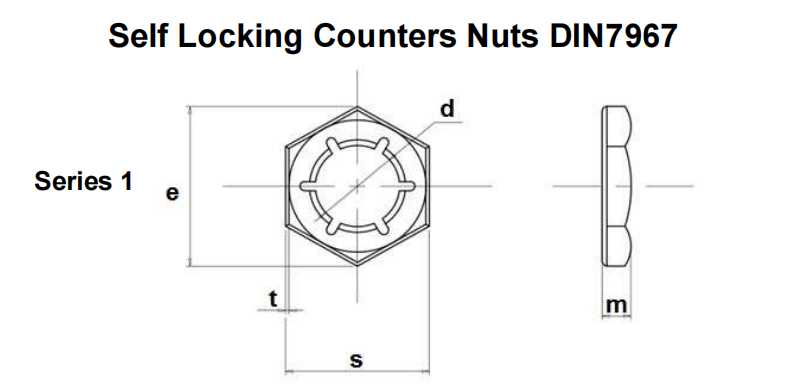
Five key dimensions define a DIN 7967 pal nut: d (nominal thread diameter), s (width across flats), e (width across corners), m (overall height)
and t (sheet thickness).
Figure 2 DIN 7967 Series 1 dimension drawing (d, e, s, t, m)
Symbol
Meaning
Why It Matters at Inquiry
d
Nominal thread diameter
Sets the mating bolt; defines how far the teeth are spread
s
Width across flats
Wrench/socket size and automatic feeding orientation
e
Width across corners
Clearance check and cosmetic coverage
m
Overall height
Axial space and protrusion after installation
t
Sheet thickness
Drives spring grip, tooling and material cost
Exact dimensions follow DIN 7967 standard values and Zhenhua's latest cost catalog / customer drawings; non-standard
sizes can be evaluated against samples or drawings.
4. Base Materials & Surface Finishes
Keep two concepts apart: the base material decides elasticity and locking force; the surface finish decides corrosion resistance and appearance.
Base Material
Carbon / spring steel (65Mn etc.)
Character & Use
Strong spring grip, usually heat-treated
Common Finishes
Zinc plating, black oxide, zinc-aluminum flake (Dacromet-type)
Ask at Inquiry
Heat-treatment hardness, hydrogen embrittlement risk, elasticity change after plating
Base Material
SUS304 stainless
Character & Use
Corrosion-resistant, general purpose; usable bare
Common Finishes
Bare, cleaned, passivated
Ask at Inquiry
Springback and work hardening need process review
Base Material
SUS316 stainless
Character & Use
Better chloride resistance than 304 (supplied as 316L)
Common Finishes
Bare, cleaned, passivated
Ask at Inquiry
Confirm whether 316 is mandatory and whether a mill certificate is required
Finish note: "zinc plated" alone is not a complete specification — confirm the color / passivation system, coating thickness and salt-spray hours together. Fine threads on small
pal nuts are sensitive to coating thickness; hot-dip galvanizing must be evaluated case by case; electroplating on
high-hardness steel requires a hydrogen-embrittlement review with possible baking.
5. Typical Applications
Automotive: interior trim, electrical housing covers, line and bracket fastening at low-to-medium torque (Zhenhua supplies as a Tier-2/Tier-3 automotive supplier under IATF 16949).
Electrical & machinery: terminal boards, fan and motor accessories, panel fastening.
General equipment: sheet-metal covers, nameplate riveting, guide accessories.
Outdoor & hardware: garden tools, outdoor appliances and furniture hardware where vibration plus weight reduction both matter.
Over 35 years of cold stamping — founded in 1989, Zhenhua is a fastener and precision stamping manufacturer exporting worldwide (about 30% direct exports, plus many end projects overseas).
In-house tooling: die design, improvement and maintenance stay internal; progressive dies and multi-out layouts support stable volume production of small parts.
Presses from 30 to 400 tons: including high-speed and high-precision presses; small pal nuts run on high-speed progressive lines, with stroke rate and die outlets matched to part and quality requirements.
IATF 16949 certified: a regular Tier-2/Tier-3 supplier in automotive chains; PPAP / first-article approval supported on request.
Traceable material: every incoming coil is verified with an element analyzer; thickness, specification and batch records are checked on arrival — traceable to your batch number.
Export-ready: feeder-friendly and private-label packaging negotiable; trade terms and ports confirmed per customer.
7. Quality Control: Six Gates from Coil to Shipment
1
Incoming material: element analyzer verifies composition; thickness and batch documents checked.
2
First-article inspection: thread go/no-go, tooth geometry, overall height and appearance verified before continuous running.
3
In-process patrol: bin-change checks plus rounds every 2–3 hours; any abnormality stops the press, and current and previous batches are quarantined.
4
Post-process re-inspection: heat treatment and plating (including outsourced finishing on return) are re-verified batch by batch.
5
Finished-part screening: vision inspection on request plus 100% rapid manual sorting against cosmetic defects and mixed parts.
6
Batch traceability: customer batch / order numbers linked to material and production batches.
8. FAQ
The eight questions below cover what overseas buyers and domestic assembly-line purchasers ask us most often —
selection, material, plating and batch traceability. If your question is not here, just send it to us directly.
Q1: Why does a pal nut resist vibration?
As it runs down, the spring teeth are spread by the thread and keep gripping the shank with constant radial force; vibration cannot overcome that grip, so the nut stays tight.
Q2: Can DIN 7967 pal nuts be reused?
Not recommended. The teeth lose elasticity after repeated installations and grip decays. For frequently serviced joints, use a hex nut with a lock washer instead.
Q3: Pal nut vs. nylon insert nut vs. washer stack — why choose the pal nut?
One piece locks by itself, the profile is thinner, the all-metal body handles temperature better than nylon inserts, volume cost is lower and installation is faster — a clear total-cost win in light and medium loads.
Q4: 304 or 316 stainless — which one?
304 covers most indoor and atmospheric service; choose 316 (supplied as 316L) for coastal, chemical or high-chloride environments. Note any certificate requirement at inquiry.
Q5: Does plating affect thread assembly?
Yes — coating thickness changes thread fit, so we control it against go/no-go gauges. Confirm the plating system, thickness and salt-spray requirement together when you inquire.
Q6: What sizes are available? Do you stock them?
Standard metric sizes are produced to the standard; sizes covered by existing dies have shorter lead times. Send the thread size and quantity and we will confirm die coverage, capacity and delivery.
Q7: Can you make custom pal nuts from drawings?
Yes. Send a 2D/3D drawing or sample with material grade, tolerances, annual volume and finish requirements; we complete a DFM review and die proposal before quoting, with die cost, ownership and life agreed per project.
Q8: How is batch quality guaranteed?
IATF 16949 in daily operation: incoming element analysis, first-article checks, scheduled patrols, dual finished-part screening and full batch traceability; PPAP documentation supported for automotive customers.
9. What to Send With Your Inquiry
Thread size (e.g. M6) and mating bolt grade;
Standard / drawing revision (DIN 7967 or customer drawing);
Base material grade and thickness (65Mn / SUS304 / SUS316);
Quantity unit and volume (pieces / MPC; per-order and annual);
Packaging, labeling and inspection requirements (certificate, vision sorting, etc.);
Target delivery date and destination (export buyers: incoterms and port).
Send the drawing, thread size and annual volume
Those three inputs are enough for us to confirm die coverage, material, finish and delivery. Custom pal nuts move from drawing to prototype using in-house dies — and where the joint also
needs a locking washer, our lock washers ship from the same plant.
We use cookies to offer you a better browsing experience, analyze site traffic and personalize content. By using this site, you agree to our use of cookies.
Privacy Policy