Washers

Trusted Push-on Washers Manufacturer for Secure Fastening Solutions

Push-on Washers · Level 2 Category

When assembly speed matters as much as holding power

Buy push-on washers from Ningbo Yinzhou Zhenhua Stamping Co., Ltd. when the assembly step is the constraint, not the load. Why choose a push-on washer when a nut takes three extra seconds? Because it snaps over a stud or screw in one motion, locks with internal teeth, and removes a part from the bill of materials.

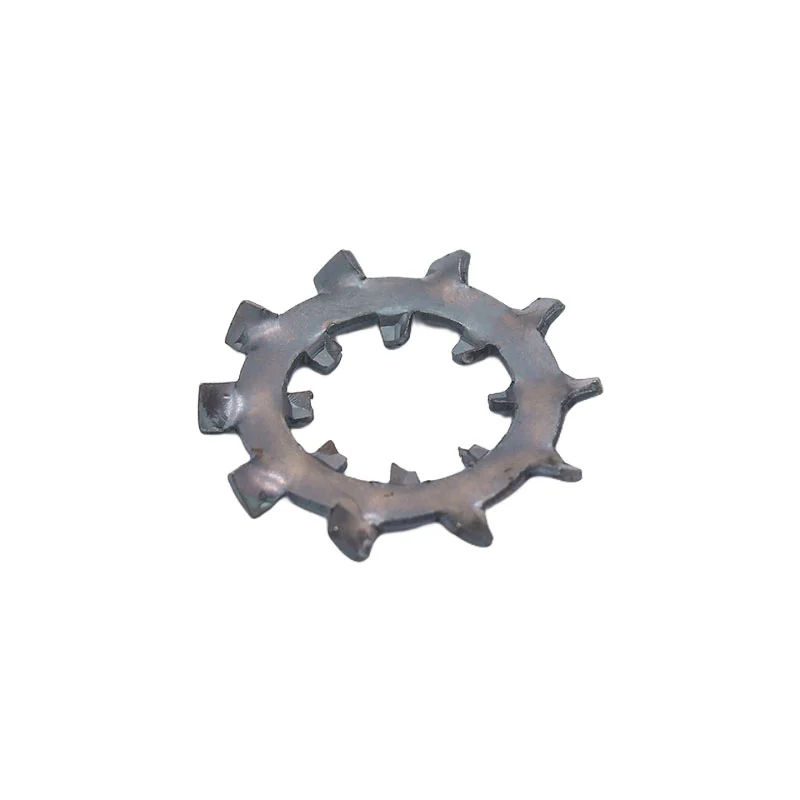
Zhenhua's push-on range includes countersunk lock washers, screw cup washers and star lock washers — stamped from spring steel or stainless and hardened for consistent tooth grip. The teeth angle inward so the washer seats firmly but resists pull-off, which is why these parts suit light to medium loads on automated lines.

One motion assembly Pressed on, no rotation, no torque step
One less part number The nut is removed from the BOM
Hardened teeth Consistent grip across the run
PUSH TO SEAT · NO ROTATION

Where the three seconds come from

The saving is not in the washer. It is in the assembly steps that a push-on washer removes.

Threaded nut assembly 4 steps
1 Pick and place washer on stud
2 Pick nut and start by hand
3 Run nut down with driver
4 Torque to specification
~4 steps plus tooling and torque verification
Push-on washer 1 step
1 Press washer onto stud until seated
1 step no rotation, no torque, no second part
The step reduction is real, but it has a boundary. Push-on washers are specified for light to medium loads on shafts and studs where the retention does not need full thread engagement. For heavier joints that need full thread engagement, the correct comparison is against our tooth lock washers or safety lock washers.

Three push-on forms, three jobs

The family covers the assembly-speed cases, but each form has a specific geometry and a specific reason to be chosen.

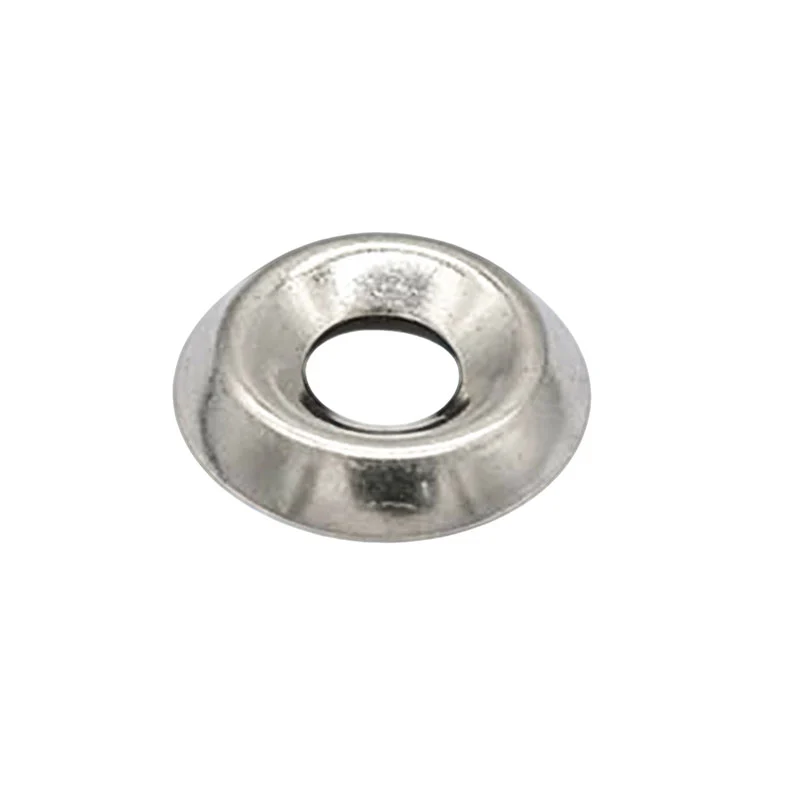
Countersunk lock washers

A shallow conical profile that seats into a countersunk hole or a screw head recess. The cone centres the washer on the stud as it is pressed on, which is why they appear in assemblies where the fastener is driven blind.

Used on screw heads, countersunk panels and blind assemblies.
Screw cup washers

A dished washer that cups the screw head, spreading the load over the panel rather than concentrating it under the head. Used where a screw drives into sheet metal or a soft panel and the head would otherwise pull through or deform the surface.

Used on sheet metal, plastic panels and decorative screw heads.

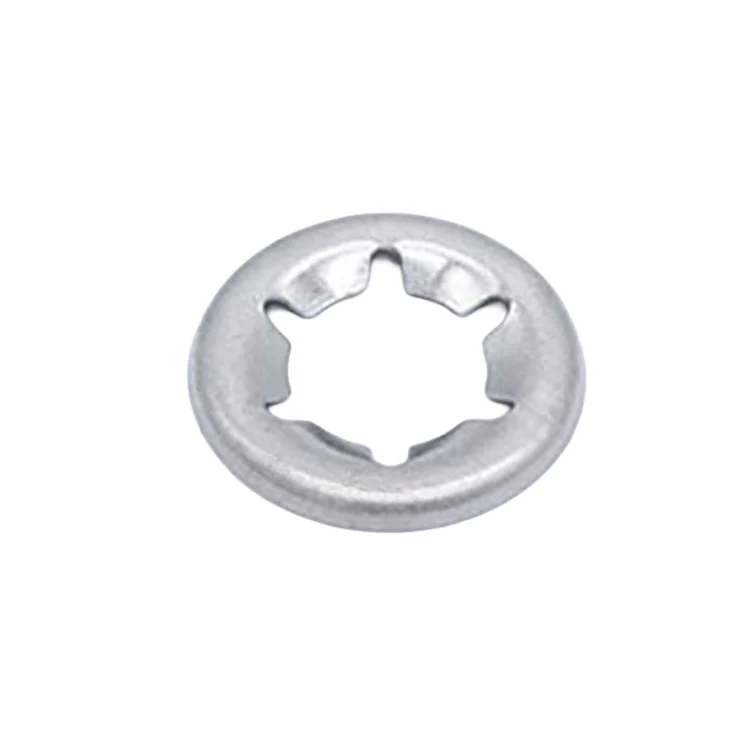
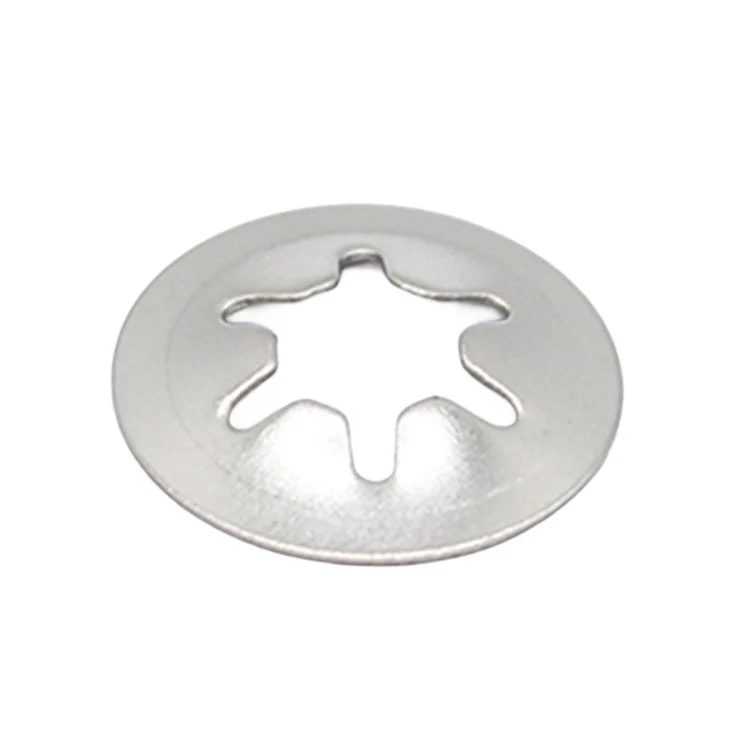
Star lock washers

Star-shaped inward teeth, spaced around the bore so the grip is distributed rather than concentrated. Specified where the stud is smooth rather than threaded and the retention relies entirely on the teeth biting into the shaft.

Used on smooth shafts, axles and unthreaded studs.

Why the teeth angle inward

The washer seats easily but resists pull-off. That asymmetry is not accidental — it comes from the angle at which the teeth are formed relative to the bore axis.

EASY IN HIGH PULL-OFF RESISTANCE θ SECTION DETAIL · INWARD TOOTH ANGLE STUD · WASHER BORE · TOOTH CONTACT

The geometry that makes it work

Three things drive how the washer behaves once seated. All three come from the die.

Inward tooth angle θ Teeth point inward and slightly toward the head of the stud. This lets the washer slide on without catching but resists any force that tries to pull it back.
Tooth hardness Spring steel or stainless, hardened after forming. The teeth must not flatten under repeated load — hardness is specified per part and confirmed per batch.
Bore tolerance The bore must sit between the tooth tips and the stud diameter. Too loose and the washer rattles; too tight and it will not seat by hand or press.

Typical BOM · threaded fastener

  • Stud or screw — full thread engagement required
  • Plain or lock washer — separate line item
  • Nut — separate line item
  • Torque step — in the work instruction
Replace

Push-on equivalent

  • Stud or screw — smooth or threaded
  • Push-on washer — one line item, replaces washer + nut

Push-on, tooth lock or safety — which fits

The comparison comes down to three factors: how much load the joint carries, whether the joint will be opened again, and how the fastener is driven.

Decision point Push-on Washers Tooth Lock Washers Safety Lock Washers
Assembly method Pressed on, no rotation Turned with the nut Turned with the nut
Load range Light to medium Light to medium Medium to heavy, shock
Full thread engagement Not required Required Required
Reusability Limited — teeth relax after removal Reusable, teeth may degrade Reusable, inspect teeth between cycles
Surface marking Marks the stud or shaft Marks the mating face Marks both faces
Typical use Automated lines, retained components, smooth shafts Electrical, sheet metal, light machinery Rail, braking, wind, commercial vehicle
BOM effect Removes the nut Adds one part Adds one part
The table is a decision aid, not a specification. Send us the stud diameter, the load the joint carries and the assembly cycle, and we will confirm which of the three is the right choice for the application.

Send the stud diameter, material and assembly cycle

Those three inputs name the right push-on profile. Stock sizes ship with short lead times in feeder-friendly packaging; volume pricing and private-label boxes are available on request. Where the joint needs full thread engagement, we will point you to the tooth lock washers or safety lock washers that fit better.

Request a Quote
X
We use cookies to offer you a better browsing experience, analyze site traffic and personalize content. By using this site, you agree to our use of cookies. Privacy Policy
Reject Accept