

Washers

Industrial Nuts Factory Direct Supply

Industrial Nuts

The half of a bolted joint that keeps torque where it belongs

A bolt carries the tension; the nut holds it there. In a vibrating assembly, whatever the nut loses, the joint loses too — usually long before the next maintenance window. Zhenhua produces industrial nuts in stamped and machined formats, engineered to pair directly with our lock washers and tooth lock washers as one complete anti-loosening package.

1993Company founded
30+ yearsFastener manufacturing
IATF 16949Process control

How to Choose Industrial Nuts for a Vibrating Assembly

Four decisions settle most nut selection questions before you open a catalogue. Get these right and the rest is sizing.

01

Load type

Continuous vibration and intermittent impact are different problems. Continuous vibration usually needs a nut that locks on its own, or a wedge-locking solution. Intermittent impact is often handled with a standard nut plus a tooth lock washer.
02

Thread size and pitch

Match the bolt specification and tolerance class. A loose thread fit undermines any locking element you add — the lock can only work if the thread is right first.

03

Plating and material

Salt-spray exposure, operating temperature and galvanic contact drive the choice between zinc plating, zinc-nickel and stainless. The wrong pairing fails at the coating before it fails at the thread.

04

Locking method

Does the nut lock by itself, or does it rely on a companion part? That single answer changes your assembly sequence, your part count and your inspection routine.

The Zhenhua Industrial Nut Range

Two nut families, plus the washers they are engineered to work with.

Standard torque transfer

Hex Nuts

Used where the joint already includes a locking washer. Choose this when assembly space is open, the load is mostly static, and you want a familiar, low-cost fastening element.

Metric & imperial Standard & custom
Built-in locking

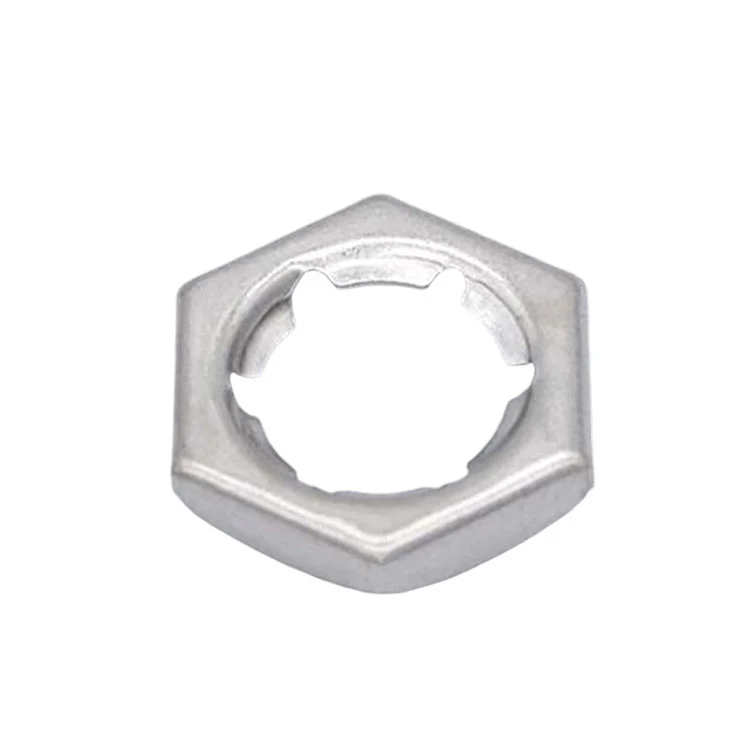
Self-Locking Counter Nuts

The nut carries its own locking element, so it holds preload without an extra part. Specified when continuous vibration is present, or when the installation simply has no room for a washer.

DIN 7967 forms No extra parts

Pair the nut with the right washer

Most vibrating joints are solved with a combination, not a single part. These three pairings cover the majority of Zhenhua customer applications.

Hex nut + tooth lock washer Friction locking through serrated teeth. Used for electrical connections and light-to-medium load joints.
Counter nut + wedge lock washer Two locking mechanisms in one joint. Specified for railway, wind energy and other continuous-vibration environments.
Self-locking counter nut alone For joints where installation space does not allow a washer, or where the assembly must stay minimal.

Hex Nuts or Self-Locking Counter Nuts?

A side-by-side view of the two nut families, so specification decisions are made on function rather than habit.

Decision point Hex Nuts Self-Locking Counter Nuts
Typical application Static joints and light intermittent vibration Continuous vibration or repeated impact
Locking method Relies on a companion washer Built-in locking element in the nut
Extra parts required Tooth lock washer or wedge lock washer None
Assembly space Needs room for washer beneath the nut Fits confined installations
Recommended pairing Tooth lock washers Wedge lock washers, safety lock washers
Inspection routine Torque check on the assembly Torque check plus locking-element condition

Send the specification, get the nut type back

Thread size, strength grade, surface finish and the working environment are enough for us to shortlist the right nut — and confirm lead time before you commit to an order.

Request a Quote
X
We use cookies to offer you a better browsing experience, analyze site traffic and personalize content. By using this site, you agree to our use of cookies. Privacy Policy
Reject Accept