Base Material
65Mn / spring steel
- Character & fit
- Good elasticity, low cost — the general-purpose first choice
- Common finishes
- Black oxide, zinc, yellow zinc
- Inquiry focus
- Heat-treat hardness; permanent set after flattening

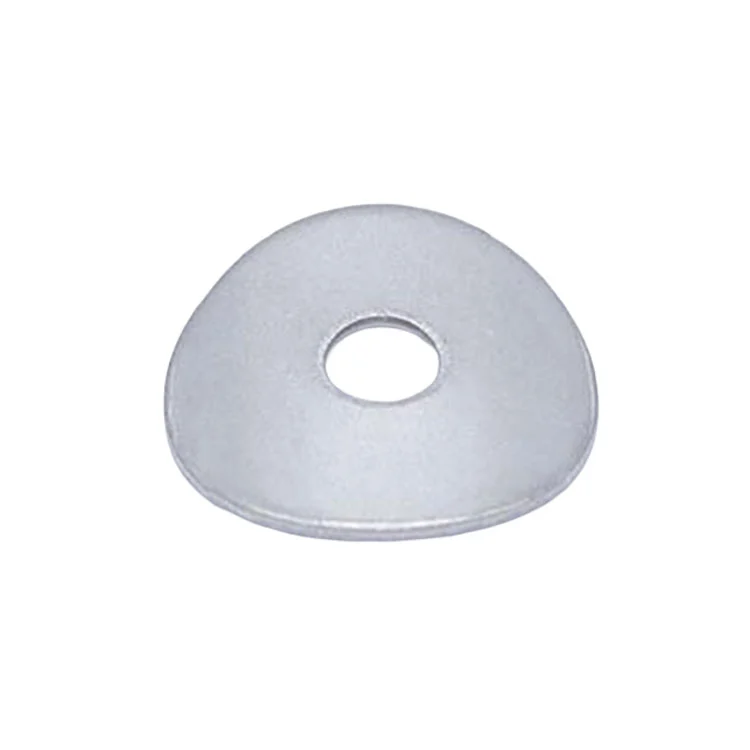
Curved spring washers (also called arched or bowed washers) are the third Level-2 category under Zhenhua's Spring Washers range. Zhenhua backs the range with in-house tooling and 30–400 t pressing under IATF 16949 , supplying automotive Tier-2/Tier-3 chains and export programs worldwide.
Curved spring washers (also called arched or bowed washers) are the third Level-2 category under Zhenhua's Spring Washers range. The division of labour between the three is worth memorising:
| Category | Core structure | Value proposition | Typical role |
|---|---|---|---|
| Belleville washer DIN 6796 | Conical disc (curve set by h0) | Short travel, high load | Holding high clamping force |
| Wave washer DIN 137 | Sinusoidal corrugation (set by wave count) | Modest load, continuous travel | Taking up axial clearance |
| Curved washer | One continuous arc (set by arc height) | Elasticity with the smallest stack height | Elastic support where space is tight |
The distinctive advantage of a curved washer is its small stack height: it is stamped from a thin plate bowed into an arc, so it occupies less axial space than a Belleville washer of the same outside diameter. When an assembly has almost no room for an elastic element but still needs elastic preload, a curved washer is often the only workable answer.
Its second characteristic is directional elasticity: the bow runs in one direction only, so it offers some resistance to off-centre loading and rotation — useful as an elastic support that also provides light location.
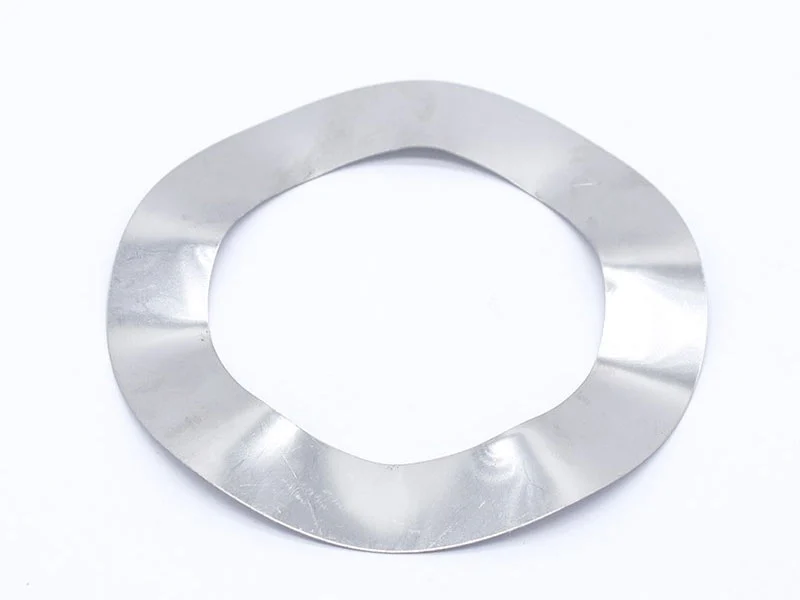
A curved washer gets its elasticity from a thin plate bowed into an arc. Unlike a wave washer, where several crests share the load, here the load is carried along the whole arc length, supported at the ends and bowed in the middle:
| Geometry | What it does | Direction of change | Effect on performance |
|---|---|---|---|
| Arc height h | Bow height in the free state | h increases | Travel grows; reaction force at a given deflection falls slightly |
| Arc length L | Effective developed plate length | L increases | Compliance rises, load falls, deflection is gentler |
| Thickness t | Strip thickness | t increases | Load rises roughly with a high power of t; stiffness climbs sharply |
| Plate width b | Bearing width | b increases | Section inertia rises, load increases, contact area grows |
An intuitive way to see it: a curved washer is essentially a short-span leaf spring. It therefore inherits two leaf-spring traits — load rising approximately linearly with deflection, and high positional accuracy at small deflection.
Selection note: the recommended working compression for a curved washer is normally 50–70% of the arc height. Note the important difference from a wave washer: once a curved washer is flattened (compressed to 100% of arc height) it loses its elastic capability and becomes an ordinary flat shim. Always leave enough working clearance.
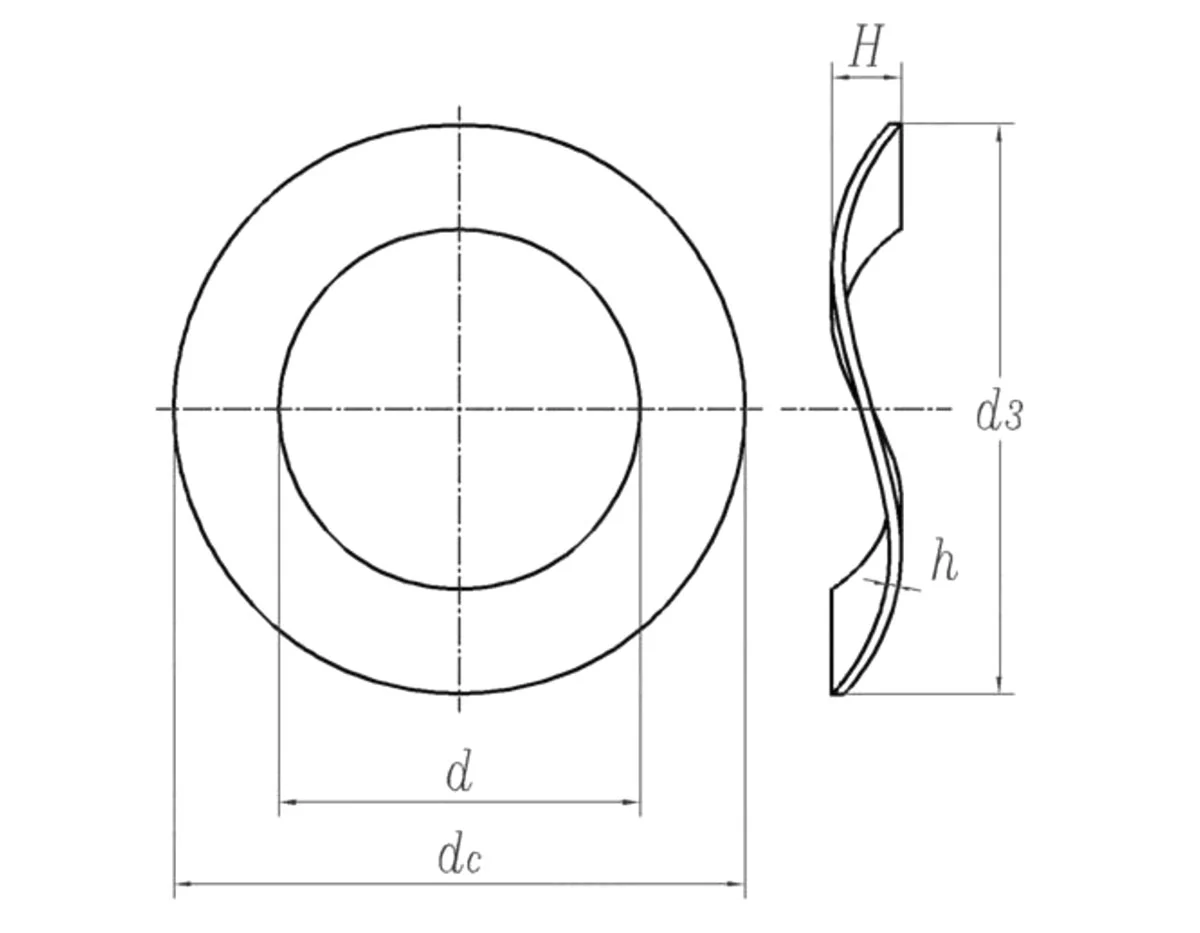
Zhenhua's curved washers divide into two sub-series, matching different drawing systems and naming conventions:
| Sub-series | Size system | Structural feature | Where it fits |
|---|---|---|---|
| Industrial Curved | Imperial / general industrial sizes | Wider plate, larger arc height | Heavy machinery, bearing housings, general equipment |
| Metric Curved | Metric size system | Matched to metric bolts and shaft diameters | Metric drawings, European projects, precision shaft trains |
| Custom curved | Made to drawing | Arc height, arc length, bore and OD all custom | A specific stiffness and space constraint |
The difference between the two sub-series is mainly dimensional naming and what they mate with, not the structural principle. If your drawing comes from a European or American project it is usually metric or imperial curved; for a maintenance replacement part, the fastest route is to send the original bore, outside diameter, thickness and free-state arc height — those four dimensions are enough for us to reproduce it.
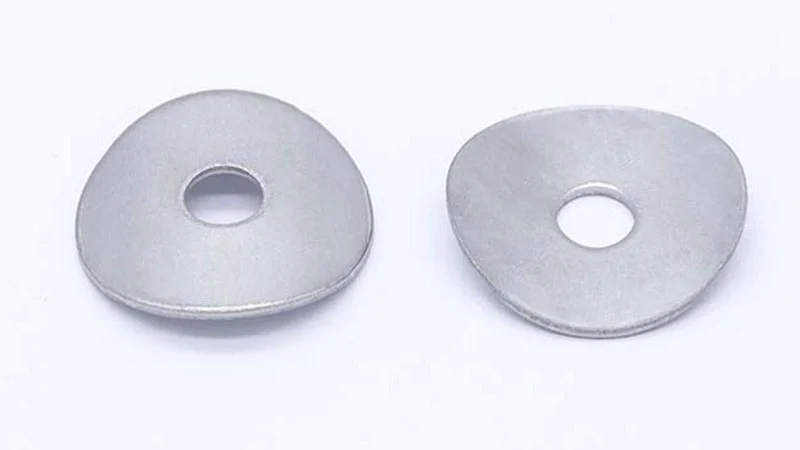
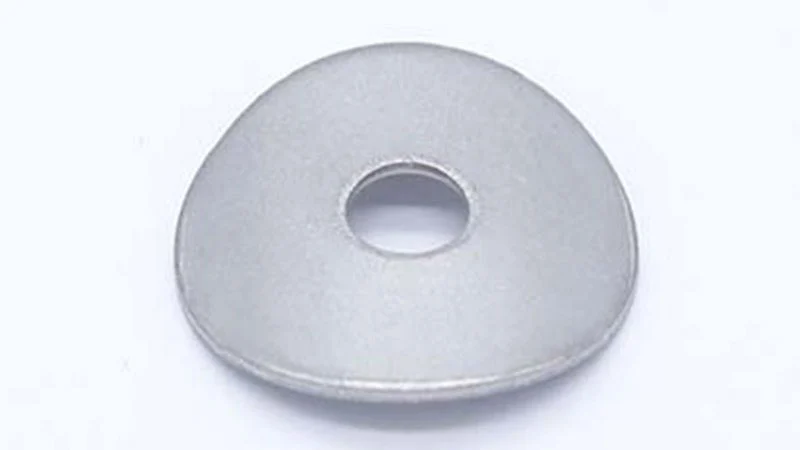
A curved washer is a thin-plate formed part, so formability and elastic retention are the two selection threads: too much springback makes the arc height hard to control, too little makes it hard to obtain enough elastic travel.
Forming note: the arc height of a curved washer is the result of springback after forming, not a fixed die dimension. That means material batch, thickness tolerance and heat treatment all affect the final arc height. Our first-article inspection and patrols therefore always measure the free-state arc height. If you need a tight arc-height tolerance (say within ±0.1 mm), tell us up front and we will adjust the forming and sorting plan accordingly.
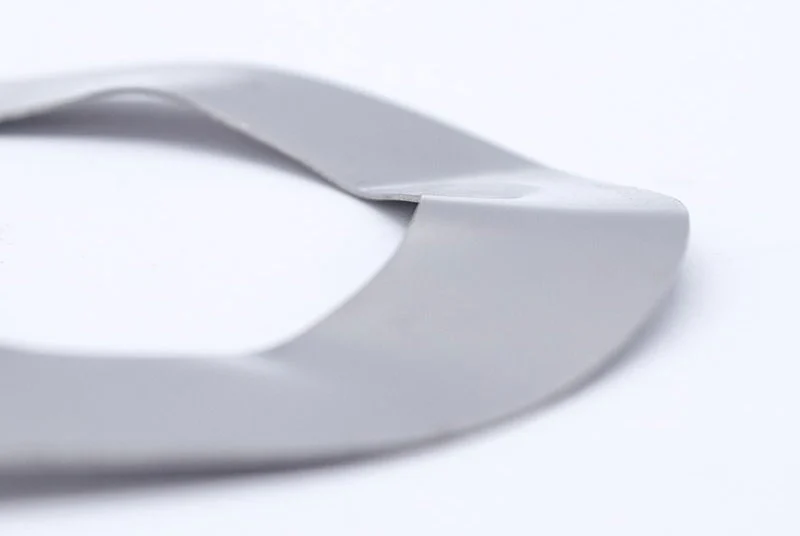
This section puts all three Level-2 categories side by side so you can locate yours quickly — it is also the most practical cross-reference between this page and the other two.
| Comparison | Curved washer | Wave washer DIN 137 | Belleville washer DIN 6796 |
|---|---|---|---|
| Elastic structure | One continuous arc | Sinusoidal corrugation (multi-wave) | Conical disc |
| Load level | Low to medium | Low to medium | High |
| Usable travel | Medium (50–70% of arc height) | Medium (≤75% of wave height) | Small (75–80% of cone height) |
| Stack height | Smallest | Small | Larger |
| Leaves bite marks | No | No | No (conical face) |
| Directionality | Yes (single-direction bow) | No (circumferentially even) | No (axisymmetric) |
| Best for | Elastic support in very tight space | General clearance take-up | Holding high clamping force |
One-line rule: want force, choose Belleville; want evenness, choose wave; want to save space, choose curved.
Bearing and shaft-train preload: gentle preload in axially restricted bearing arrangements to eliminate clearance and raise stiffness — the minimum stack height of a curved washer is the decisive advantage here.
Precision instruments and optical equipment: where elasticity is needed but magnetic interference or surface marking is not acceptable.
General machinery and equipment maintenance: replacement parts for original curved washers, reproducible from four key dimensions; also used to compensate axial slack from tolerance-stack accumulation.

Ningbo Yinzhou Zhenhua Stamping Co., Ltd.
The eight questions below come from assembly engineers and buyers, focused on telling a curved washer from a wave washer, arc-height tolerance control and assembly orientation. If your question is not here, just send it to us directly.
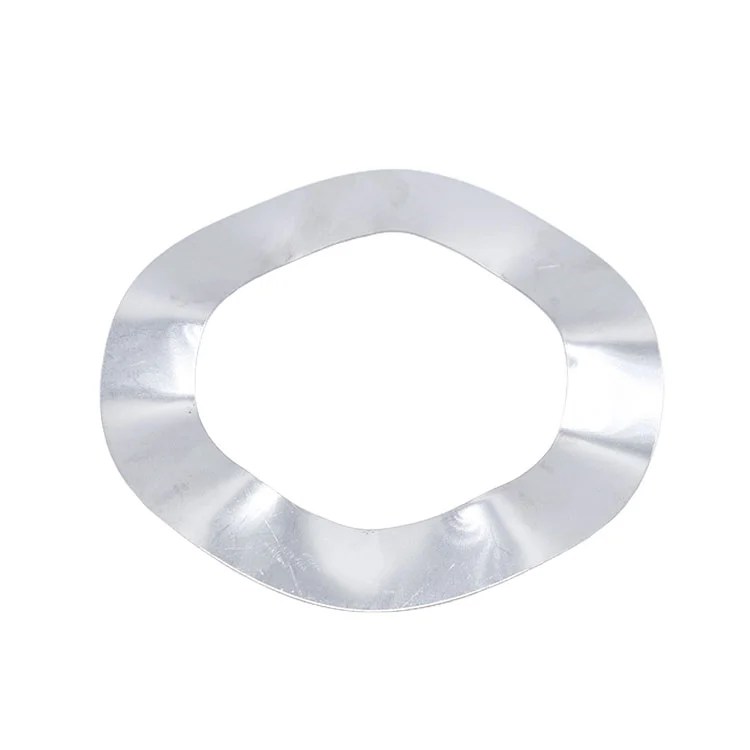
Count the elastic features. A wave washer has several crests around the circumference (DIN 137B usually three to six); a curved washer has one continuous arc bowing in a single direction. Functionally, the wave gives circumferentially even elasticity, while the curved is directional and has a smaller stack height.
No. Flattened (compressed to 100% of arc height) it becomes an ordinary flat shim and loses its elastic capability. This is an important difference from a wave washer, which tolerates brief flattening. Keep working compression within 50–70% of the arc height.
Choose by the size system on your drawing. European and American project drawings usually map to metric or imperial curved. For a maintenance replacement part, send the original bore, outside diameter, thickness and free arc height and we reproduce from those four dimensions.
Arc height results from forming springback and is affected by material batch, thickness tolerance and heat treatment. We control to normal industry practice by default; if you need within ±0.1 mm, tell us in advance and we will adjust forming and sorting.
65Mn for general duty (good elasticity, low cost); 304/316L for corrosion resistance or where no plating is wanted. Stainless has more springback, so arc-height retention needs process confirmation and dimensions or load may need re-calculating.
Yes. The bow direction is fixed. At assembly the bow must face the side that needs the elasticity. Show it on the drawing or state the orientation requirement at inquiry and we can distinguish it in packaging or marking.
Yes. Arc height, arc length, plate width, bore, outside diameter and thickness can all be made to drawing. We design and maintain the dies in-house — send the target load, working height and permitted installation space.
IATF 16949 in operation: element analysis of incoming material, first-article inspection with mandatory free arc-height measurement, patrols every 2-3 hours, post-treatment re-verification, load-deflection sampling and batch traceability — PPAP documentation available for automotive customers.
The minimum for a complete inquiry: what the part is + material + finish + quantity + when + how it is accepted. For spring washers, always state the spring figures (free height and load at working height) - this is the dividing line between a quote and a process review.
Those three inputs are enough for us to confirm die coverage, material, finish and delivery. Custom curved washers move from drawing to prototype using in-house dies.
✅ Get free sample!! Contact us today
✅ We will contact you within 24 hours