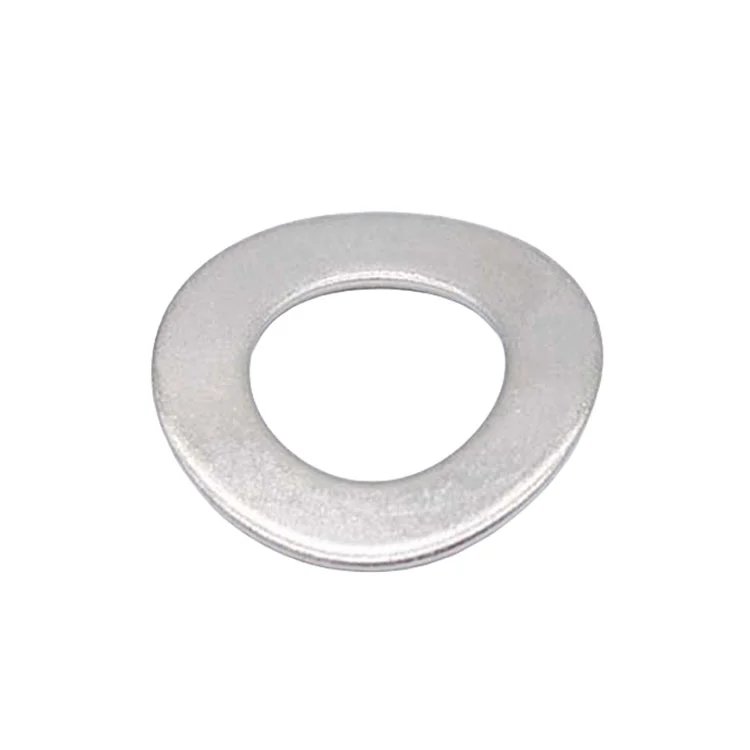
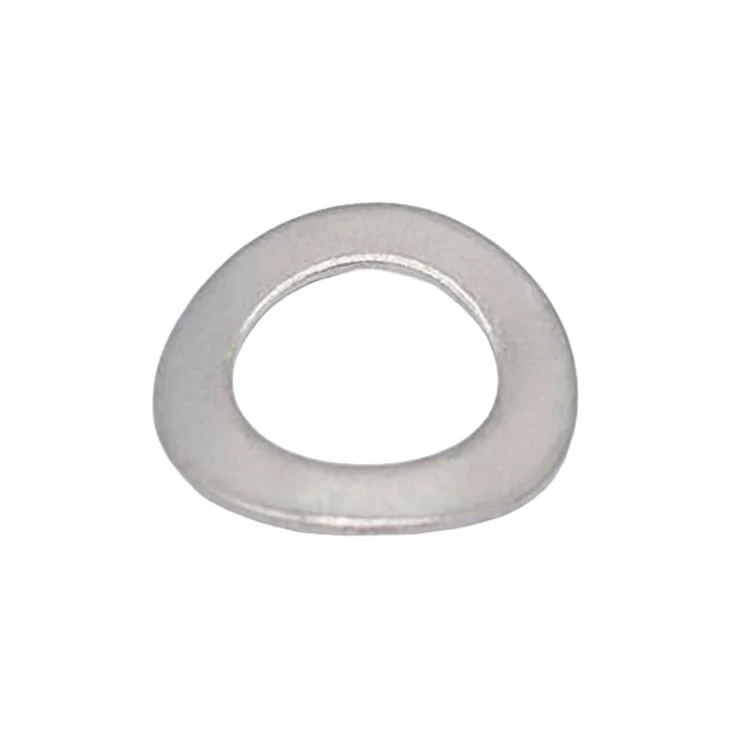
Base Material
65Mn / spring steel
- Character & fit
- Good elasticity, low cost — the general-purpose first choice
- Common finishes
- Black oxide, zinc, yellow zinc
- Inquiry focus
- Heat-treat hardness; springback consistency after flattening

Wave spring washers are the second Level-2 category under Zhenhua's Spring Washers range. Zhenhua backs the range with in-house tooling and 30–400 t pressing under IATF 16949 , supplying automotive Tier-2/Tier-3 chains and export programs worldwide.
Wave spring washers are the second Level-2 category under Zhenhua's Spring Washers range. Their value proposition is the opposite of the previous category: a Belleville washer trades a tiny travel for a very large load; a wave washer trades a modest load for continuous axial elastic travel.
Its job is not to clamp hard but to stay in contact: absorbing assembly tolerances, taking up axial clearance, damping vibration and holding bearing preload.
Choose a wave washer when your joint needs elasticity but not much force, and when bite marks are not acceptable - for example on bearing steel, precision machined faces or cosmetic surfaces. Classic cases: bearing preload, axial location of a motor rotor, and clearance elimination in precision shaft trains.
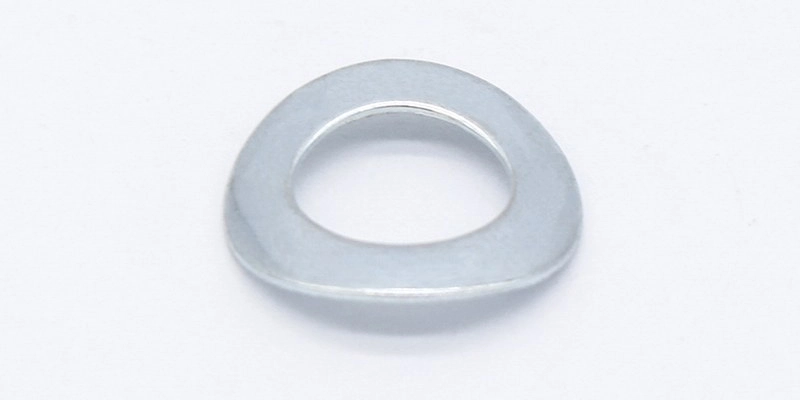
A wave washer is an annular thin plate stamped into a sinusoidal corrugation. Under load the crests are pressed toward the flat, and the waves around the circumference deform together - so it delivers continuous, approximately linear axial elasticity rather than the steeply rising non-linear curve of a Belleville washer.
| Parameter | What it does | Direction of change | Effect on performance |
|---|---|---|---|
| Wave count n | Number of crests around the circumference | n increases | Load is shared more evenly, per-wave load falls, stability improves |
| Wave height h | Axial height from crest to valley | h increases | Usable elastic travel grows; force to flatten rises slightly |
| Thickness t | Strip thickness | t increases | Load rises roughly with the square (or higher) of t; stiffness climbs sharply |
| Outside / bore | Effective bearing circumference | Circumference increases | Total load rises approximately linearly |
Rule of thumb: load scales roughly with wave count (shared across waves), with a high power of thickness, and inversely with wave-height compliance. So "softer" usually means thinner strip or taller waves, and "stiffer" means thicker strip or fewer waves.
Selection note: keep maximum compression within about 75% of the wave height. Beyond that the wave form flattens, elastic margin runs out, and repeated over-compression causes permanent set — a loss of free height.
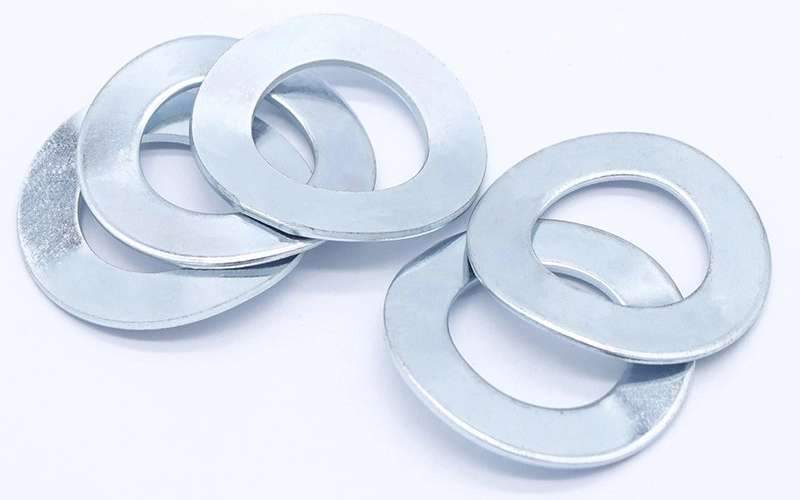
This is the first fork in wave washer selection, and the point most often confused with a Belleville washer — always confirm the type from this section first:
| Type | Standard | Structural feature | Where it fits |
|---|---|---|---|
| Single-wave | DIN 137A | One crest around the circumference (with one or more support points) | Tight axial space; directional elasticity; point-contact location |
| Multi-wave | DIN 137B | Three to six crests evenly distributed | Circumferentially even load; resistance to off-centre load; general clearance take-up |
| Custom multi-wave | Made to drawing | Wave count, wave height, bore and OD all custom | A specific load-versus-travel curve |
137A for local, directional elasticity or when space allows only one direction to act. The two look obviously different — an A-type has a single hump, a B-type has a ring of waves.
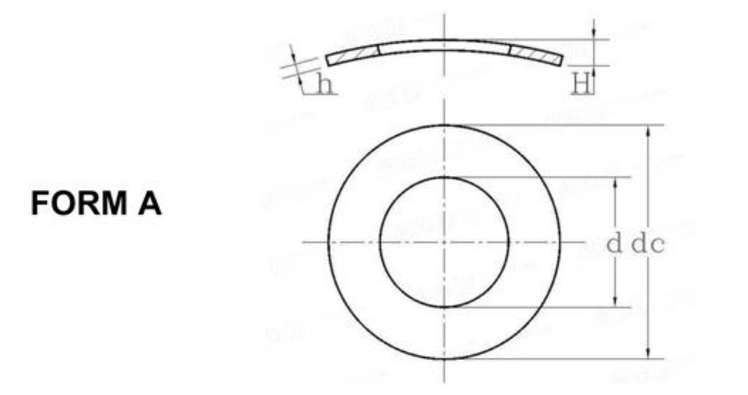
DIN137A Curved Spring Washers
*All measurements in millimeters (mm)*
| Size | d | dc | h | h Tolerance | H min | H max | Kg/1000pcs |
|---|---|---|---|---|---|---|---|
| 2.5 | 2.8 | 5.5 | 0.3 | ±0.03 | 0.55 | 1.1 | 0.041 |
| 3 | 3.2 | 6 | 0.4 | ±0.05 | 0.65 | 1.3 | 0.053 |
| 3.5 | 3.7 | 7 | 0.4 | ±0.05 | 0.7 | 1.4 | 0.088 |
| 4 | 4.3 | 8 | 0.5 | ±0.05 | 0.8 | 1.6 | 0.11 |
| 5 | 5.3 | 10 | 0.5 | ±0.05 | 0.9 | 1.8 | 0.222 |
| 6 | 6.4 | 11 | 0.5 | ±0.05 | 1.1 | 2.2 | 0.247 |
| 7 | 7.4 | 12 | 0.5 | ±0.05 | 1.2 | 2.4 | 0.265 |
| 8 | 8.4 | 15 | 0.5 | ±0.05 | 1.7 | 3.4 | 0.476 |
| 10 | 10.5 | 18 | 0.8 | ±0.06 | 2 | 4 | 1.05 |
The DIN 137B multi-wave type is the workhorse of general clearance take-up. The table gives typical nominal size bands; exact values follow the standard and the specification drawing on this page:
| Nominal size | Bore d1 (approx.) | OD d2 (approx.) | Thickness s (approx.) | Wave height h (approx.) | Typical use |
|---|---|---|---|---|---|
| M3-M5 | 3.2-5.3 mm | 6-9 mm | 0.4-0.5 mm | 0.6-0.9 mm | Small motors, precision shafts |
| M6-M8 | 6.4-8.4 mm | 11-15 mm | 0.5-0.8 mm | 0.9-1.4 mm | Bearing preload, gearboxes |
| M10-M12 | 10.5-13 mm | 17-21 mm | 0.7-1.0 mm | 1.2-1.8 mm | General machinery, pumps and valves |
| M14-M20 | 15-21 mm | 24-31 mm | 0.9-1.4 mm | 1.6-2.4 mm | Heavy machinery, flanges |
The bands above are order-of-magnitude guidance for an initial selection conversation. Confirm the final selection against DIN 137B standard values and Zhenhua's latest cost catalog; nonstandard wave counts and heights can be made to drawing.
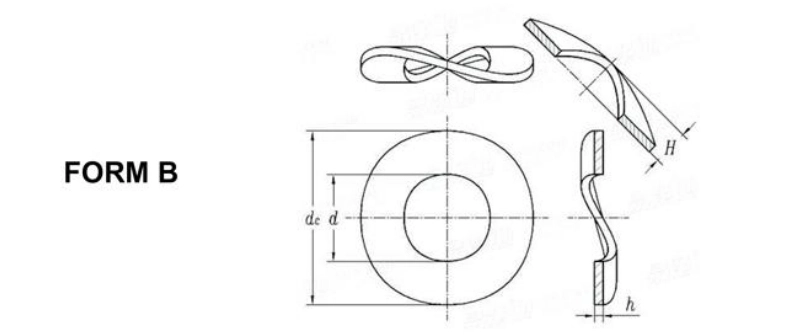
DIN137B Waved Spring Washers
*All measurements in millimeters (mm)*
| Size | d | dc | h | h Tolerance | H min | H max | Kg/1000pcs |
|---|---|---|---|---|---|---|---|
| 2.5 | — | — | — | — | — | — | — |
| 3 | 3.2 | 8 | 0.5 | ±0.05 | 0.8 | 1.6 | 0.166 |
| 3.5 | 3.7 | 8 | 0.5 | ±0.05 | 0.9 | 1.8 | 0.154 |
| 4 | 4.3 | 9 | 0.5 | ±0.05 | 1.0 | 2.0 | 0.193 |
| 5 | 5.3 | 11 | 0.5 | ±0.05 | 1.1 | 2.2 | 0.266 |
| 6 | 6.4 | 12 | 0.5 | ±0.05 | 1.3 | 2.6 | 0.316 |
| 7 | 7.4 | 14 | 0.8 | ±0.06 | 1.5 | 3.0 | 0.7 |
| 8 | 8.4 | 15 | 0.8 | ±0.06 | 1.5 | 3.0 | 0.76 |
| 10 | 10.5 | 21 | 1 | ±0.07 | 2.1 | 4.2 | 2.04 |
| 12 | 13 | 24 | 1.2 | ±0.07 | 2.5 | 5.0 | 3.1 |
| 14 | 15 | 28 | 1.6 | ±0.08 | 3.0 | 6.0 | 5.5 |
| 16 | 17 | 30 | 1.6 | ±0.08 | 3.2 | 6.4 | 6 |
| 18 | 19 | 34 | 1.6 | ±0.08 | 3.3 | 6.6 | 7.8 |
| 20 | 21 | 36 | 1.6 | ±0.08 | 3.7 | 7.4 | 8.43 |
| 22 | 23 | 40 | 1.8 | ±0.1 | 3.9 | 7.8 | 11.9 |
| 24 | 25 | 44 | 1.8 | ±0.1 | 4.1 | 8.2 | 14.5 |
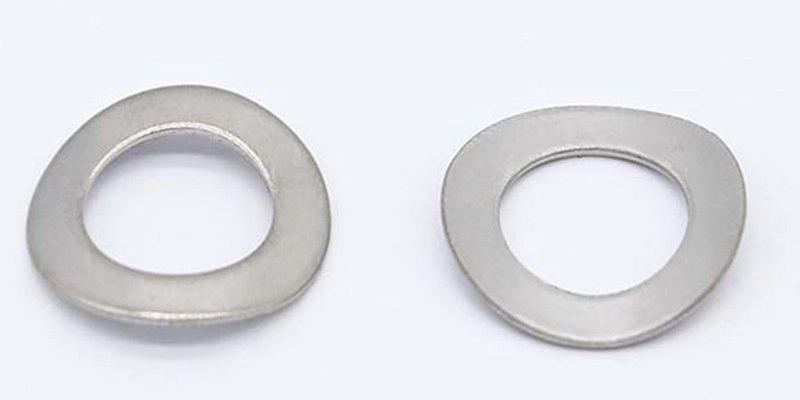
Wave washers are usually thin (0.4-1.4 mm), so elasticity and formability of the base material matter more than raw strength: too hard a strip cracks, too soft a strip loses wave height and the free height decays in service.
Thin-strip note: typical strip thickness for wave washers is 0.4-1.4 mm - precision thin-gauge stamping. Burr control and wave-height consistency are the quality keys: burrs score bearing races or precision faces, and inconsistent wave height causes uneven circumferential load. State the permitted burr height and burr direction at inquiry.
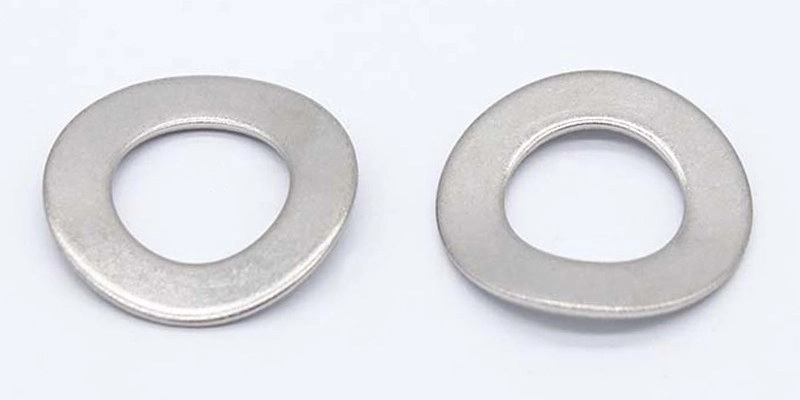
Bearing preload: eliminating axial clearance in rolling bearings to raise stiffness and rotational accuracy while cutting noise and vibration. This is the classic wave washer duty - it applies a gentle, continuous preload and, unlike a Belleville stack, is hard to overload.
Motors and gearboxes: rotor axial location and end-bell clearance, absorbing thermal expansion and accumulated assembly tolerances.
Precision shaft trains and instruments: optical tables, measuring instruments and precision lead screws, where marks and magnetic interference are unacceptable.
General machinery: any bolted joint or shaft train loosened by tolerance-stack accumulation - a wave washer is more controllable than adding shims.

Ningbo Yinzhou Zhenhua Stamping Co., Ltd.
The eight questions below come from assembly engineers and buyers, focused on telling DIN 137A from DIN 137B, how wave count and height drive load, and burr control on thin strip. If your question is not here, just send it to us directly.
Ask whether you need travel or load. For continuous low-force elastic travel and clearance take-up, choose a wave washer; for high load in a short travel holding clamping force, choose a Belleville washer. A wave washer also does not bite the bearing face, so it leaves no marks — good for bearings and precision surfaces.
137A is the single-wave type with one crest — directional elasticity or restricted space. 137B is the multi-wave type with several crests evenly distributed — general clearance take-up needing even circumferential load and resistance to off-centre loading. The visual difference is obvious.
Keep maximum compression within about 75% of the wave height. Beyond that the form flattens and the elastic margin is gone; sustained over-compression causes permanent set, free-height decay and lost preload. Give us the working position and maximum compression together.
Load rises roughly with wave count (shared across waves) and with a high power of thickness. Thinner strip or taller waves soften it; thicker strip or fewer waves stiffen it. We adjust this in the die to reach the load-versus-travel behaviour you need.
Very much. Wave washer strip is commonly 0.4-1.4 mm and burrs score bearing races or precision machined faces. We control burr height and direction — tell us your permitted value and the required burr orientation.
65Mn for general duty (good elasticity, low cost); 304 for corrosion resistance or where no plating is wanted; 301 when higher elasticity is required. Thin stainless has pronounced forming springback, so dimensions and load need a fresh process review — raise it early.
Yes. Wave count, wave height, bore, outside diameter and thickness can all be made to drawing. We design and maintain the dies in-house, so non-standard samples turn around quickly. Send the target load, working height and installation space.
IATF 16949 in operation: element analysis of incoming material, first-article inspection including wave height and free height, patrols every 2-3 hours, post-treatment re-verification, load-deflection sampling and batch traceability — PPAP documentation available for automotive customers.
The minimum for a complete inquiry: what the part is + material + finish + quantity + when + how it is accepted. For spring washers, always state the spring figures (free height and load at working height) this is the dividing line between a quote and a process review.
Those three inputs are enough for us to confirm die coverage, material, finish and delivery. Custom wave washers move from drawing to prototype using in-house dies.
✅ Get free sample!! Contact us today
✅ We will contact you within 24 hours