
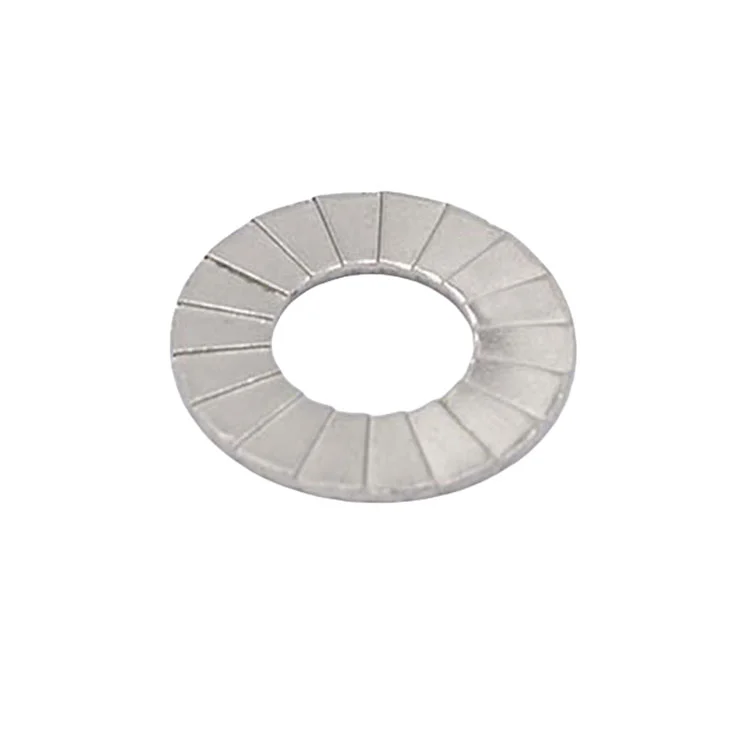
Stainless Steel DIN 25201 L Wedge-Locking Washers use a matched pair of cam washers to maintain clamp load under vibration, shock and dynamic loading. Available in AISI 304, AISI 316 and 27MnCrB5, with custom sizes, hardness and coatings for industrial bolted joints.
Stamping parts manufacturer
Owned factory
Stamping capacity · 120 presses up to 450 T
Quotation response
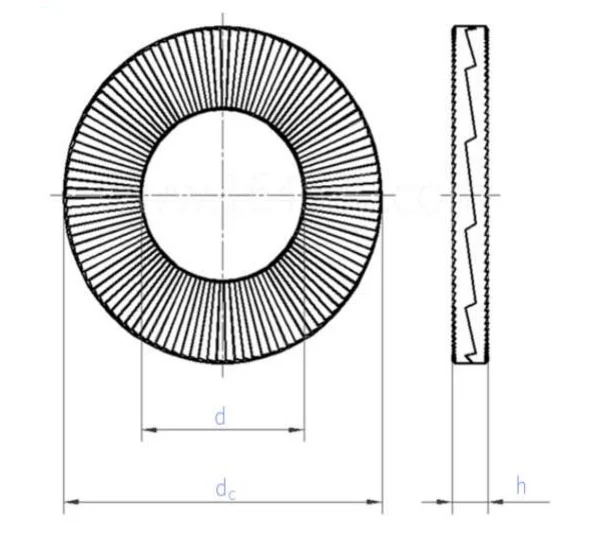
|
|
||||||||||||||||||||||||||||||||||||||||||||||||||||||||||||||||||||||||||||||||
|
|||||||||||||||||||||||||||||||||||||||||||||||||||||||||||||||||||||||||||||||||
Non-standard sizes can be manufactured from customer drawings or samples. For quotation, please provide the required washer dimensions, screw size and material where available.
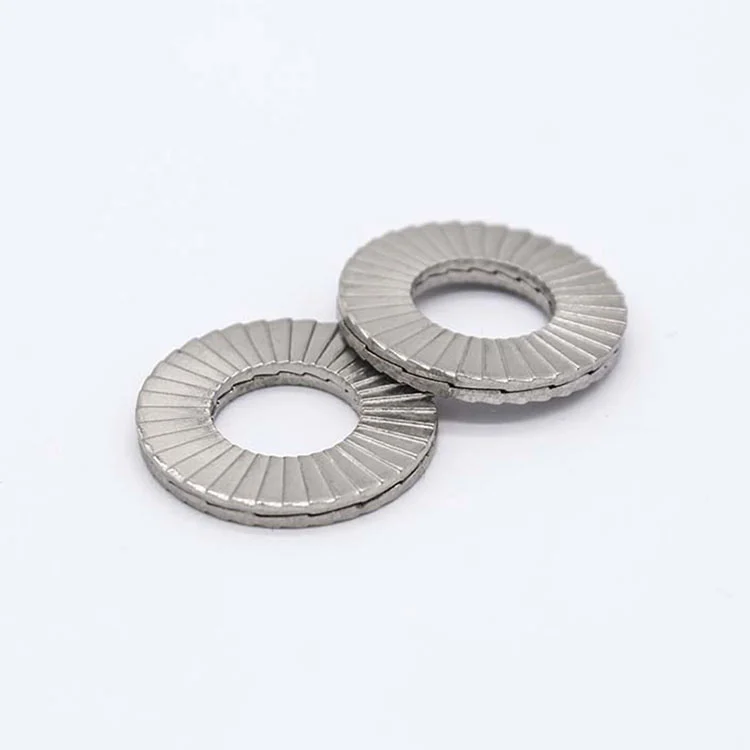
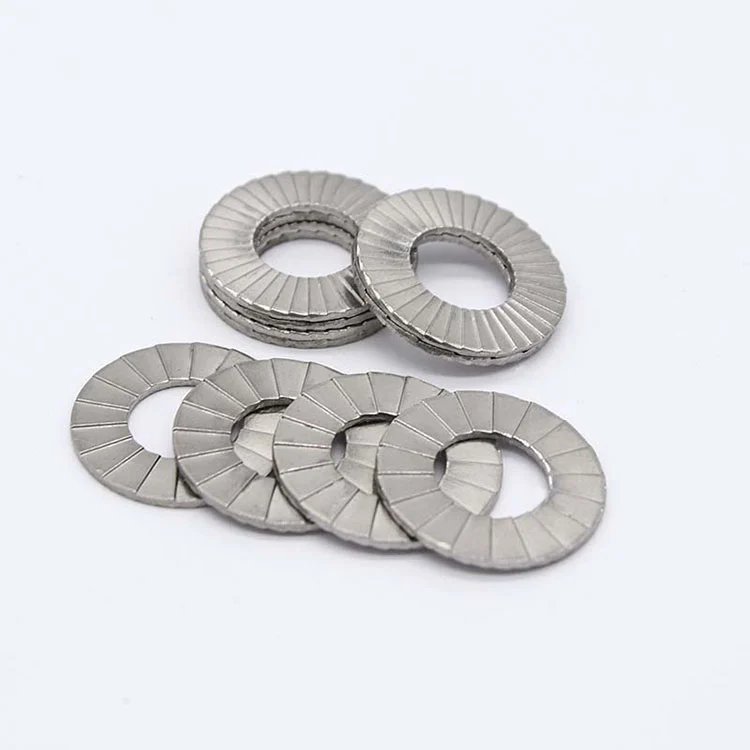
Stainless Steel DIN 25201 L Wedge-Locking Washers are supplied as a matched pair, featuring interlocking cam surfaces and radial teeth designed to secure bolted joints against vibration and dynamic loads. Installed with the cam surfaces facing each other, the washers create a wedge-locking effect that increases clamp force when bolt loosening begins, preventing loss of preload.
As a China DIN 25201 wedge lock washer manufacturer, Ningbo Yinzhou Zhenhua supplies SS304 (A2) as standard and SS316 (A4) upon request for industrial equipment, machinery, outdoor structures, and other high-reliability fastening applications.
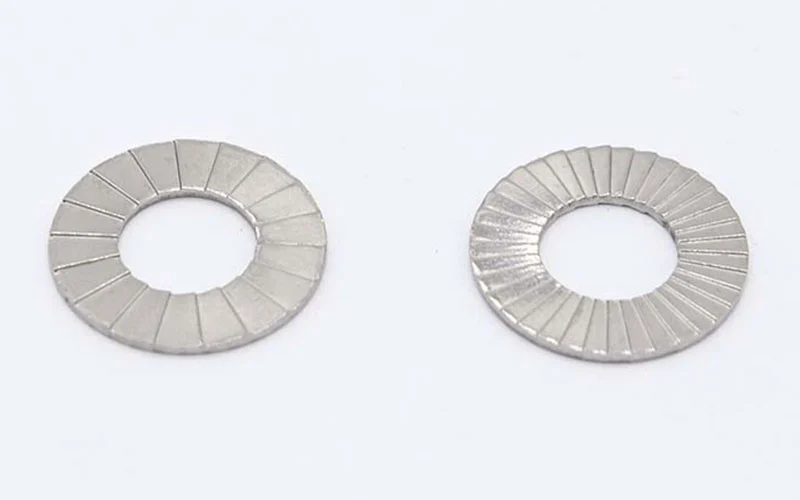
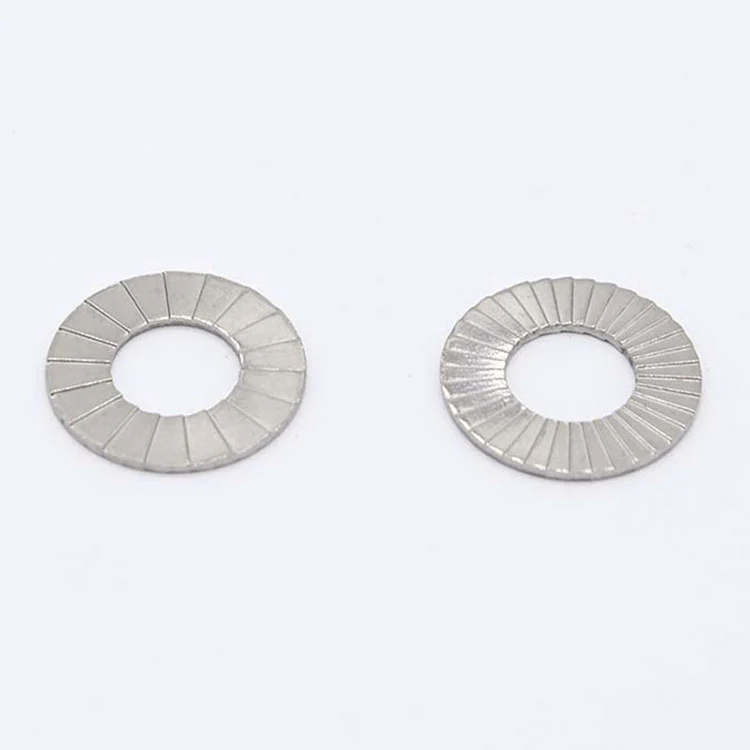
A DIN 25201 L washer set is not a conventional single-piece serrated lock washer. It consists of two washers used as a matched pair, with cams on the inner faces and radial serrations on the outer faces.
When the bolt begins to rotate in the loosening direction, the relative movement takes place across the cam surfaces. Because the cam angle is greater than the thread pitch angle, this movement forces the bolt and joint to maintain or increase their clamping force rather than simply allowing the fastener to back off.
The serrations have a separate job: they grip the underside of the bolt head or nut and the joint surface, keeping the washer pair seated against the assembly.
This makes DIN 25201 particularly relevant where ordinary friction-based locking methods can lose effectiveness because of continuous vibration, impact, alternating loads or repeated changes in joint conditions.
As a China DIN 25201 wedge-lock washer manufacturer, Ningbo Yinzhou Zhenhua supplies AISI 304 and AISI 316 stainless steel versions together with carbon-steel options for industrial machinery, transportation equipment, construction machinery, outdoor structures and other demanding bolted joints.
The two faces of the washer pair should not be treated as having the same function.
The cams form the wedge-locking interface. Their geometry is responsible for resisting loosening rotation and preserving clamp load when the joint is subjected to vibration.
The radial teeth engage with the underside of the bolt head or nut and the mating surface. This prevents the washer pair from rotating with the fastener.
The washers are supplied as a pair and should remain together during handling and installation. Separating the pair or reversing one washer changes the intended locking arrangement.
This distinction is important when specifying DIN 25201 for a new application. The locking effect comes from the interaction of the two washer surfaces and the bolted joint, not simply from the presence of serrations.
Stainless Steel DIN 25201 L Wedge-Locking Washers are generally considered when the joint is exposed to conditions that can repeatedly disturb preload.
For a normal static joint, a conventional flat or serrated washer may be sufficient. For a joint where loss of preload caused by vibration or dynamic movement is the main concern, the wedge-locking principle provides a different engineering approach.
The correct washer size should still be selected together with the bolt grade, joint material, tightening torque and available bearing area.
DIN 25201 requires closer control than a conventional flat washer because the cam geometry, tooth profile, washer thickness and pair relationship all affect the locking behaviour.
Ningbo Yinzhou Zhenhua manufactures the washer components through stamping, progressive die and machining processes, with tooling design and maintenance handled in-house. Production is controlled under an IATF 16949 quality management system, with traceability through the manufacturing process.
Samples can be developed before batch production when the application involves a non-standard size or customized geometry.
For quotation, provide the washer size, bolt size and grade, material, quantity, surface treatment and drawing or sample where available.
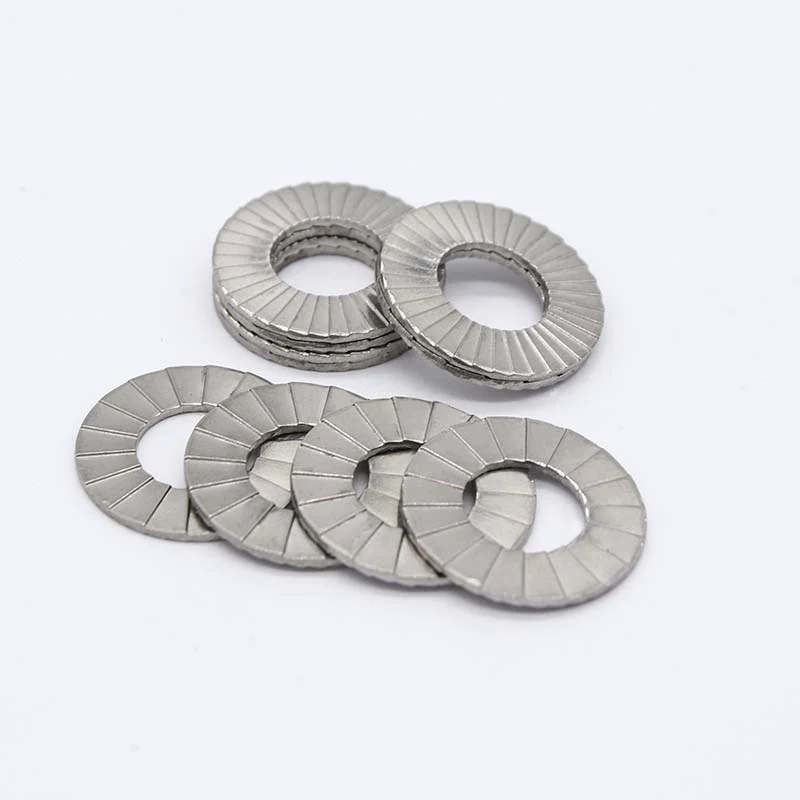
One of the most important selection points is that DIN 25201 should not simply be treated as a stronger version of a DIN 6797 or DIN 6798 washer.
|
|
|||||||||||
|
The key difference is what happens when the fastener starts to rotate. A DIN 25201 pair uses the relative movement between the cams to maintain the clamping condition, whereas conventional serrated washers depend primarily on the teeth resisting movement at the contact surfaces.
For a high-vibration joint, this difference can be more important than simply comparing washer thickness or tooth count.
Not automatically. The two products use different locking mechanisms. DIN 25201 is normally selected when vibration, shock or dynamic loading makes preload retention a primary concern. The joint should be reviewed before replacing an existing washer type.
The wedge-locking action depends on the two cam surfaces sliding against each other during attempted loosening. A single washer cannot provide this mechanism, so the two components are supplied and installed together.
The serrated outer face faces the bolt head or nut and the mating surface. The two smooth cam faces remain together inside the pair.
They can be used with high-strength bolted joints when the washer material, hardness, dimensions and joint configuration are properly matched. For grade 10.9 or 12.9 fasteners, the washer specification should be confirmed together with the bolt and mating material rather than selected by bolt size alone.
For critical or heavily vibrated joints, replacement with a new matched pair is recommended. If a pair has been removed, inspect the cam surfaces and serrations before considering reuse; any visible deformation, wear or damage is a reason for replacement.
The most useful information is bolt size, bolt grade, required material, quantity, surface treatment, application environment and drawing or sample. This allows the washer size and material to be checked before confirming price and lead time.
Send us your bolt size, quantity, material requirement and drawing or sample. Ningbo Yinzhou Zhenhua can confirm the suitable DIN 25201 L washer pair, surface treatment, production lead time and packaging requirements.
send your size, quantity and drawing for countersunk lock washers, and we will reply after confirming specifications and lead time.
✅ Get free sample!! Contact us today
✅ We will contact you within 24 hours
