
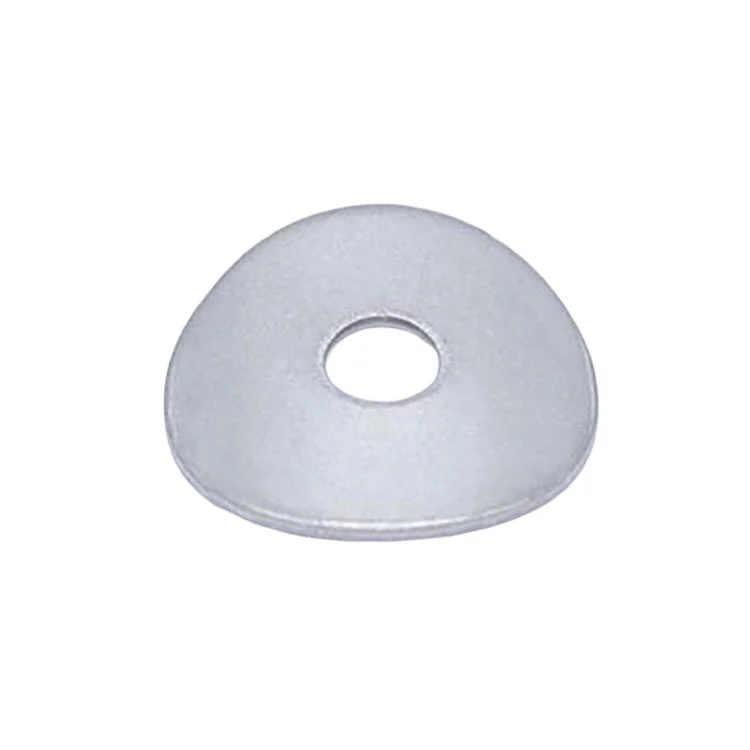
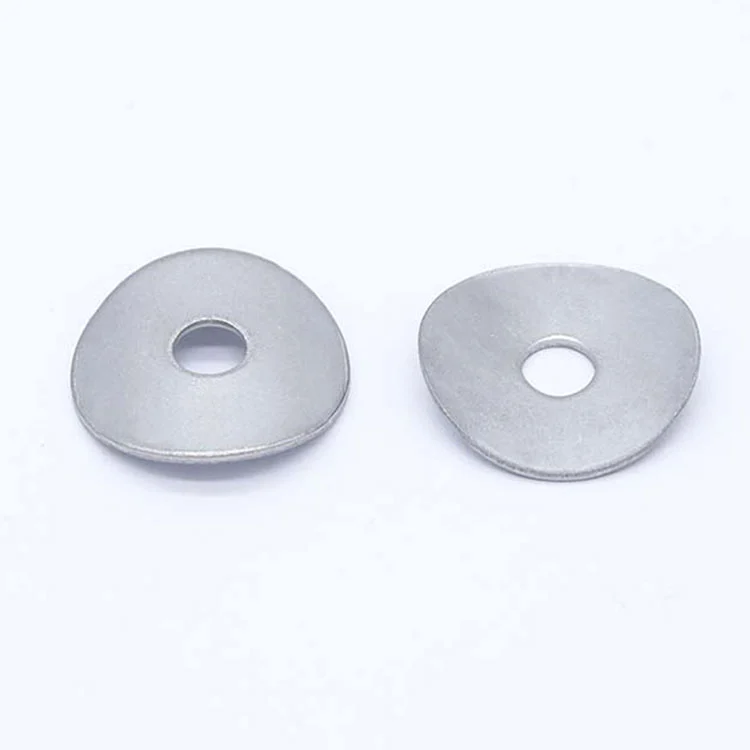
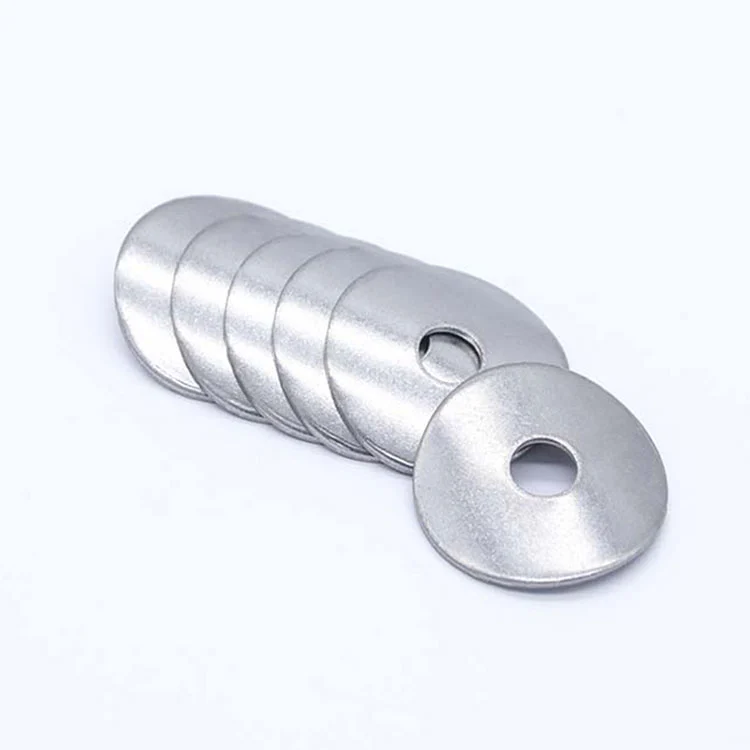
Arc height & spring force made to drawing | Gap compensation & preload retention | OEM/ODM
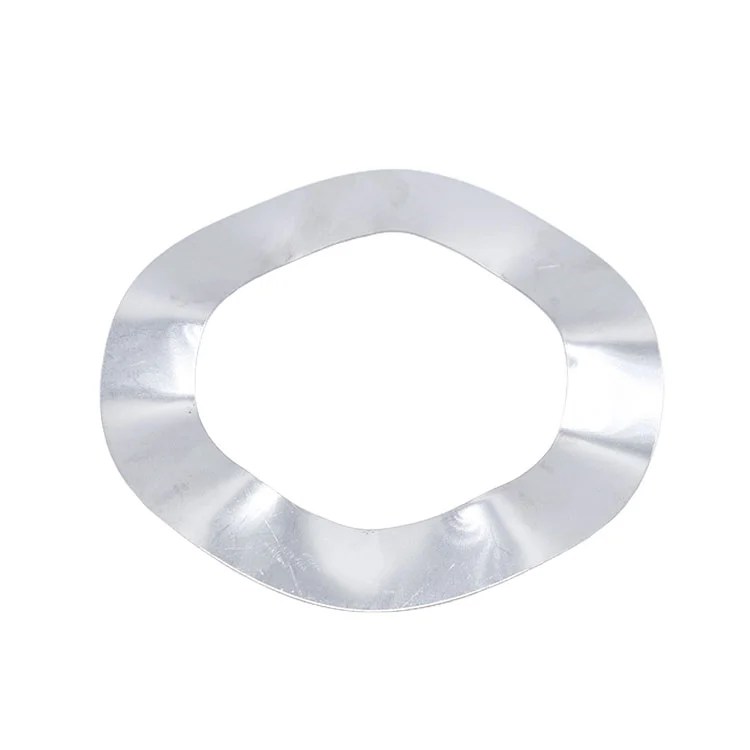
Custom Curved Spring Washer is made to drawing or sample, with size, arc height and spring force matched to your assembly. They maintain axial preload, compensate gaps and absorb vibration in motors, pumps, gearboxes and other compact mechanisms.Stamping parts manufacturer
Owned factory
Stamping capacity · 120 presses up to 450 T
Quotation response
|
|
|||||||||||||||||||||||||||||||||||||||||||||||||||||||||||||||
|
||||||||||||||||||||||||||||||||||||||||||||||||||||||||||||||||
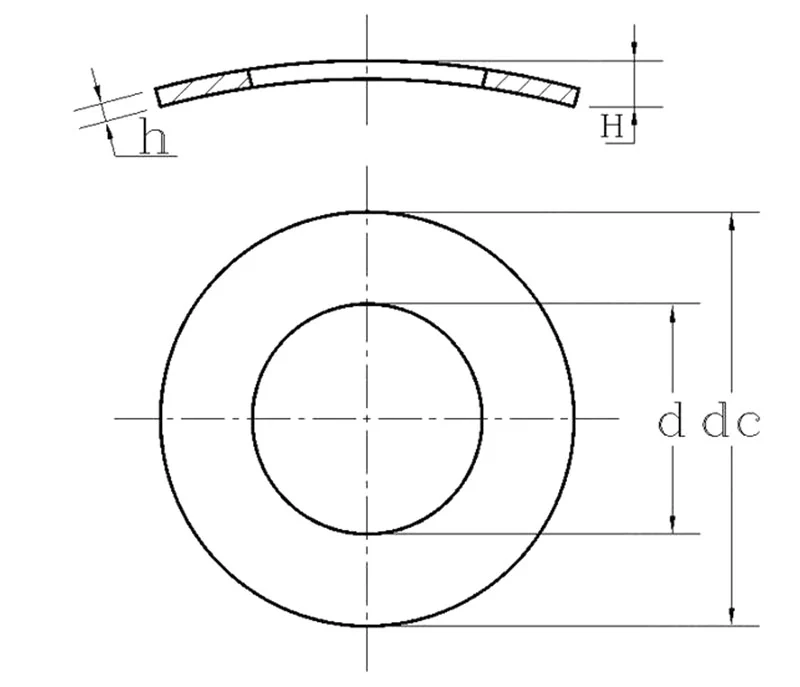
Custom curved spring washer is stamped spring washers manufactured to customer drawings, with inner diameter, outer diameter, thickness, wave height and spring-force characteristics customized for the assembly. The curved profile stores elastic energy under compression and applies continuous axial spring force, compensating thermal expansion, tolerance gaps and axial play while keeping clamp load and absorbing vibration and shock.
A custom curved washer normally goes through several engineering decisions before production.
Requirement → Drawing review → Material selection → Tooling → Trial stamping → Dimensional inspection → Spring-performance verification → Production
The important point is that the forming tool does more than produce the outside shape. It determines the repeatability of the curved profile from one production batch to another.
ID, OD, available height and surrounding components are checked before the forming geometry is finalized.
The expected assembled height is compared with the free height so that the washer is not designed around an unrealistic working condition.
Where a defined load is required, the target force should be associated with a specified deflection or working height rather than simply describing the washer as “high spring force.”
Thickness, hardness, elastic properties and forming characteristics are considered together because the same geometry does not produce identical results in different materials.
The approved sample becomes the reference for subsequent dimensional and functional inspection.
This approach is particularly useful when the washer is installed inside a motor, gearbox, bearing assembly or compact electrical mechanism where changing the surrounding components is more expensive than developing the correct spring washer.
|
||||||||||||
|
Custom curved spring washers are useful when the joint or mechanism has a defined amount of axial movement or dimensional variation that a flat washer cannot accommodate.
| Application | Function of the curved washer |
| Motor assemblies | Maintains axial contact while accommodating dimensional variation |
| Pump and gearbox assemblies | Provides elastic compensation where components experience vibration or thermal changes |
| Bearing-related assemblies | Applies controlled axial spring force where a rigid spacer would not provide compensation |
| Electrical equipment | Maintains contact or clamping condition in compact assemblies |
| Industrial automation | Compensates assembly tolerances without adding a separate spring component |
| Custom mechanical assemblies | Provides a spring function within the footprint of a washer |
The washer should not be treated as a universal anti-loosening device. Its main engineering function is elastic compensation and axial force generation. If the primary requirement is mechanical locking against bolt rotation, a dedicated locking washer or another locking method may be more appropriate.
The same curved geometry can behave differently depending on the material, thickness and heat-treatment condition. Material selection should therefore start with the working environment and required spring behavior, rather than simply choosing stainless steel by default.
A practical choice for general industrial equipment where corrosion resistance and stainless construction are required. It is suitable for many indoor machines, electrical assemblies and general mechanical applications.
More appropriate where the washer is exposed to chlorides, moisture, marine environments or frequent washdown. The molybdenum-containing stainless grade provides better resistance to chloride-related corrosion than 304.
A spring-steel option for applications where elastic performance and repeated compression are important. It is often considered when the design requires a spring-oriented material rather than stainless corrosion resistance.
For a custom part, the material grade should be confirmed together with thickness, hardness/condition and required spring performance. Changing only the material while keeping every geometric parameter unchanged does not guarantee the same force-deflection behavior.
For custom spring washers, surface treatment should not be selected only by appearance. Coating thickness, dimensional build-up, corrosion environment and the effect of processing on the formed component all need to be considered.
| Finish | Typical consideration |
| Passivation | Preferred for stainless-steel parts when the natural corrosion resistance of the stainless substrate needs to be maintained |
| Polishing | Used where surface appearance or a smoother surface is required |
| Zinc plating | Suitable for selected carbon/spring-steel applications requiring additional corrosion protection |
| Black oxide / phosphating | Commonly considered for 65Mn and machinery applications where a dark protective finish is acceptable |
| Zinc-aluminium coating | Considered for demanding corrosion environments where the specified coating system is compatible with the assembly |
| Special finish | Available according to drawing, environmental requirement and dimensional tolerance |
For precision spring components, the coating system and its thickness should be confirmed before mass production, particularly where the washer is fitted into a tight assembly or the spring response is validated at a defined working height.
Ningbo Yinzhou Zhenhua manufactures stamped and formed washer components with in-house tooling design and maintenance, allowing the forming geometry to be controlled during development rather than relying entirely on an external tooling supplier.
For custom curved spring washers, production control can focus on three different levels
ID, OD, thickness, free height and other drawing dimensions are checked against the approved specification.
The curved profile is monitored because changes in free height or forming condition can affect the final spring response.
Where required by the customer's specification, spring force can be checked at a defined deflection or working height rather than relying only on dimensional inspection.
This distinction matters. A washer can be dimensionally acceptable while still producing a different spring response if the forming condition is not adequately controlled.
The company's IATF 16949 quality management system provides a process-control framework suited to repeat production and traceability requirements.
The reason to choose a manufacturer for this product should be based on what the factory can actually control, not generic claims about quality.
Ningbo Yinzhou Zhenhua was established in 1993, giving the company long-term experience in stamped metal components and tooling-based production.
Custom curved washers depend heavily on forming-tool geometry. In-house tooling design and maintenance allow tooling adjustments to be handled within the manufacturing process.
For a custom spring washer, ID and OD are only part of the specification. The team can review arc height, thickness, material and application requirements before sample production.
The same manufacturing background supports development from a customer sample or drawing through to repeat production, rather than limiting supply to catalog dimensions.
The system provides a documented framework for process control and consistency, particularly relevant when the washer is supplied as part of a repeat industrial or automotive-related assembly.
customers do not have to redesign the surrounding assembly simply to accommodate a standard washer. The spring component can instead be developed around the actual installation conditions.
Yes. A customer drawing, physical sample or defined engineering requirement can be used as the starting point. For a new design, ID, OD, thickness, free height and required spring behavior should be established before tooling is finalized.
Neither should be considered independently. Thickness and formed height work together with material and geometry to determine spring behavior. A washer with the correct arc height can still produce the wrong load if its thickness or material condition is different from the design.
The most useful specification gives the force at a defined deflection or assembled height. For example, specifying a target force at a particular working height provides a more meaningful production reference than simply stating “high spring force.”
Not necessarily. If the material changes, the force-deflection behavior and forming response may change as well. The drawing should identify the required material and, where necessary, the spring-performance requirement.
This should be avoided unless the design has specifically been validated for that condition. A spring washer requires usable elastic travel; prolonged operation near full flattening can reduce available spring recovery and affect preload retention.
For safety-critical or vibration-sensitive assemblies, replacement is recommended. If reuse is being considered, the washer should be checked for permanent flattening, deformation and loss of its specified free height or spring response.
A drawing or sample is preferred. If unavailable, provide ID, OD, thickness, free height, material, finish, required force, working height/deflection, application, operating environment and estimated quantity.
No. Both generate axial spring force, but their formed profiles and force-deflection characteristics can differ. The correct choice should be based on available axial space, required spring travel and target load rather than the name alone.
send your size, quantity and drawing for countersunk lock washers, and we will reply after confirming specifications and lead time.
✅ Get free sample!! Contact us today
✅ We will contact you within 24 hours
