
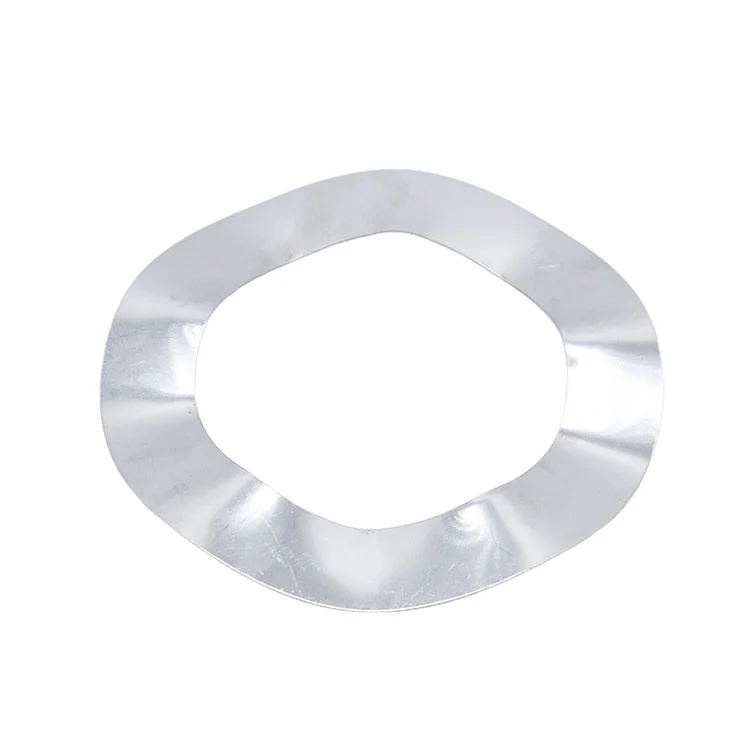
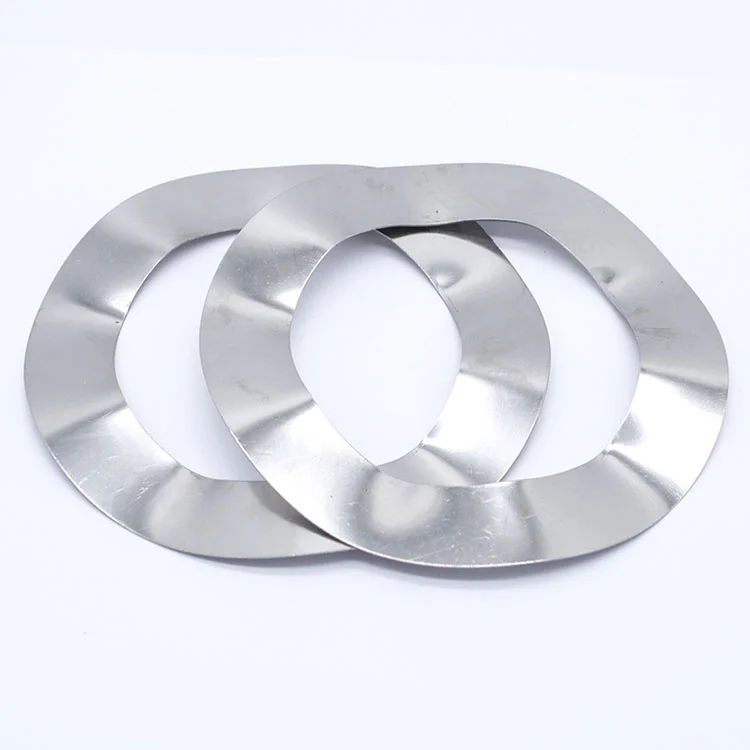
Single-turn continuous curve spring force | Gap compensation & preload retention | OEM/ODM
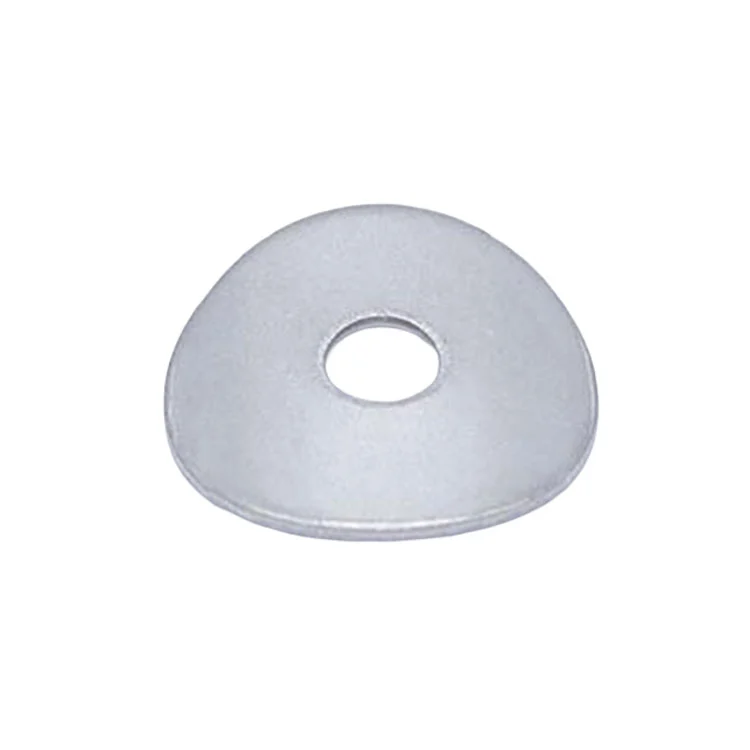
Industrial curved washers use a continuous curved profile to generate axial spring force when compressed. They help compensate assembly tolerances, axial gaps and thermal movement while maintaining contact pressure. Available in AISI 304, AISI 316 and 65Mn, with custom arc height, thickness, diameter and spring characteristics for motors, pumps, gearboxes, bearings and electrical equipment.
Stamping parts manufacturer
Owned factory
Stamping capacity · 120 presses up to 450 T
Quotation response
|
|
|||||||||||||||||||||||||||||||||||||||||||||||||||||||||||||||||||||||||||||||||||
|
||||||||||||||||||||||||||||||||||||||||||||||||||||||||||||||||||||||||||||||||||||
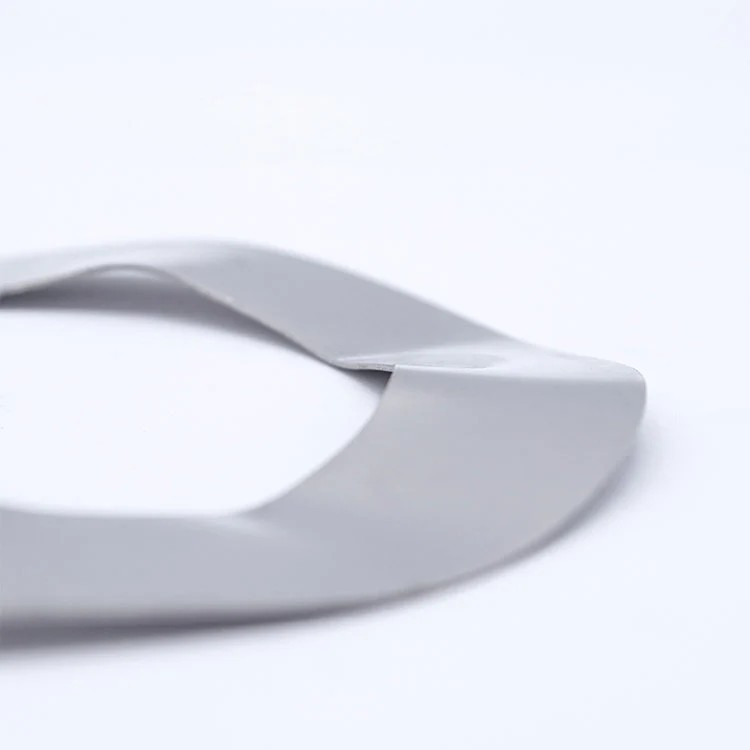
Industrial curved washers are single-turn continuous-curve spring washers: during tightening the curved body compresses and stores elastic energy, applying continuous axial spring force that compensates thermal expansion, assembly tolerance gaps and axial play while keeping clamp load under vibration and shock. Compared with multi-wave spring washers, the single-loop continuous curve offers a larger deflection range for gap compensation.
As a China industrial curved washer manufacturer, Ningbo Yinzhou Zhenhua supplies AISI 304 (A2), AISI 316 (A4) and 65Mn for motors, pumps, gearboxes, bearing preloading and electrical equipment. Purchase these washers directly from the factory to confirm sizes, lead time and custom requirements.
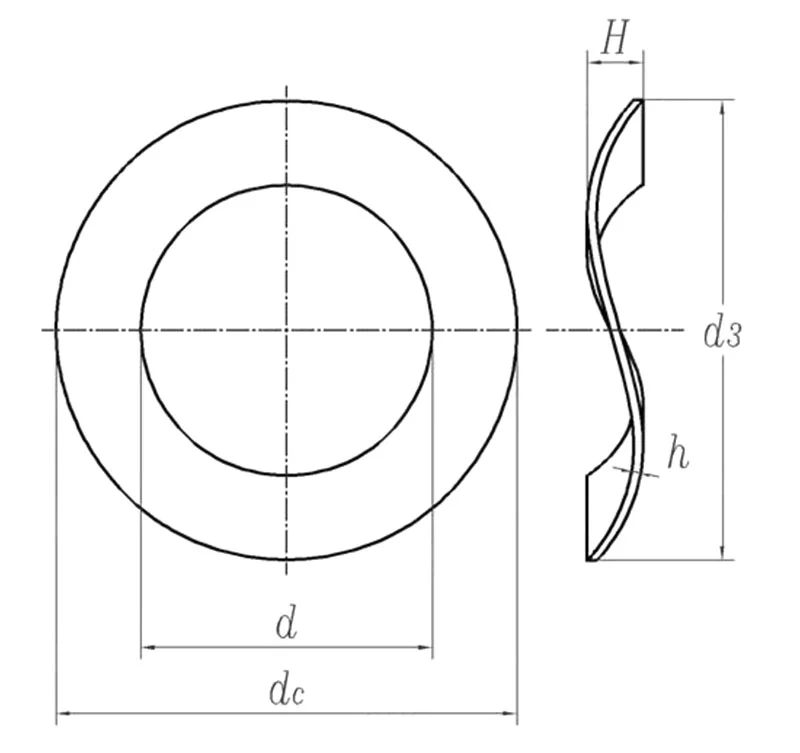
Two curved washers can have the same nominal diameter but provide different spring behavior if their thickness or free height differs.
A simplified way to understand the working sequence is:
Free curved height → initial compression → elastic spring force → reduced gap → continued contact pressure
The important design question is therefore not simply "Will the washer fit the bolt?" but:
How much axial movement must the washer accommodate before the joint reaches its required preload condition?
A washer with insufficient available deflection may become nearly flat before the expected joint movement occurs. Once the available elastic travel is exhausted, it can no longer compensate effectively for additional dimensional change.
Conversely, excessive deflection or prolonged over-compression can alter the washer's permanent geometry and reduce its useful spring characteristics.
For OEM applications, the arc height and material thickness should therefore be treated as functional dimensions rather than cosmetic features.
|
||||||||||||||||||
|
This distinction is important when replacing another washer type. A curved washer should not automatically be substituted for a DIN 6796 conical spring washer, wave washer or serrated lock washer, because these components generate their working effect through different geometries.
|
|
|||||||||||
|
The curved profile is particularly useful when the designer needs a simple stamped spring element without introducing the more complex geometry of a conical disc or multi-wave profile.
The most important manufacturing characteristic of this product is not simply the outside diameter. It is the consistency of the formed curvature.
The most important manufacturing characteristic of this product is not simply the outside diameter. It is the consistency of the formed curvature.
For a custom project, the production sequence can be based on:
Drawing review → material confirmation → tooling/forming assessment → samples → dimensional verification → approval → batch production
For applications where spring force is critical, the customer should provide the required working deflection, load condition or reference sample where available. This gives the manufacturer more useful information than specifying only the bolt size.
Industrial Curved Washers are frequently used as application-specific stamped components rather than universal commodity washers.
The curve itself can be developed around the available installation space and required compression condition.
For new designs, it is useful to provide the available axial space and expected movement of the joint, because these values help determine whether a curved washer has enough spring travel for the application.
Ningbo Yinzhou Zhenhua has been engaged in stamped metal components and anti-loosening fastening products since 1993. More than three decades of stamping experience is directly relevant to curved washers because the performance of the finished part depends heavily on repeatable forming rather than machining alone.
The company combines tooling development, stamping and production control, allowing the formed profile to be managed within the manufacturing process. This is particularly useful for OEM customers whose washer drawings specify not only diameter and thickness but also the free height, curved profile and forming requirements.
For drawing-based orders, the practical advantage is that engineering and production requirements can be reviewed together before tooling and batch production. This helps reduce a common risk with spring-type stamped parts: a dimensionally correct washer that nevertheless does not provide the expected spring behavior after forming.
Yes, within its available elastic travel. When the connected components expand or contract axially, the curved washer can change its deflection and continue applying contact force. The actual compensation range depends on its geometry, material and working compression.
Arc height should be related to the required spring travel and available installation space. It should not be selected independently from thickness and diameter. For a new application, providing the expected axial movement or compression condition is preferable.
If the Industrial Curved Washers are compressed beyond its intended working range, the available spring travel is reduced and permanent deformation may occur. It should not be treated as a component that can remain indefinitely at maximum compression without considering fatigue and material behavior.
No. 65Mn is attractive when mechanical spring performance is the priority, but 304 or 316 stainless steel may be more appropriate where corrosion resistance is the dominant requirement. The final choice depends on both environment and required spring characteristics.
Not as a universal substitute. DIN 6796 uses a conical disc-spring geometry, while a curved washer uses a different deformation profile. If the original joint was designed around a specific spring-load/deflection relationship, the replacement should be validated rather than selected only by diameter.
Yes. A physical sample can be used as a reference for dimensional review, material confirmation and tooling assessment. For production-critical spring characteristics, a drawing specifying the required geometry is preferable where available.
send your size, quantity and drawing for countersunk lock washers, and we will reply after confirming specifications and lead time.
✅ Get free sample!! Contact us today
✅ We will contact you within 24 hours
