Few small parts work as hard as a serrated lock washer. Its sharp radial teeth dig into both mating surfaces during tightening, creating a positive mechanical lock against rotation. Over the past century, engineers have refined this idea into three major families: the DIN 6798 serrated types, the DIN 9250 double-sided safety washers, and the French NFE 25-511 conical series. Each answers a slightly different question about the joint.
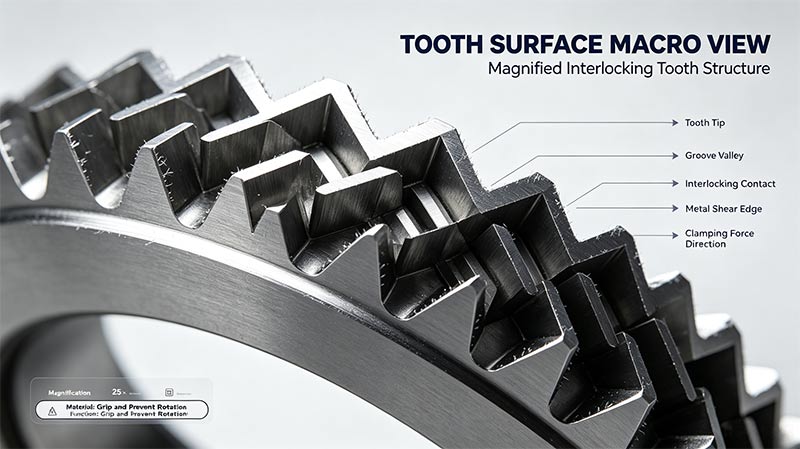
Unlike a friction-based split washer, a serrated washer locks mechanically. As the fastener is torqued, the tooth tips embed into the bolt head or nut on one side and the workpiece on the other, resisting loosening rotation in both directions. The closely related DIN 6797 family uses the same principle with a distinct tooth form, which is why the two series are often compared side by side.
The DIN 6798 family comes in three profiles:
In all three, the curved or conical body also compresses during tightening, adding axial spring force to the tooth bite - a dual anti-loosening action.
When a single toothed face is not enough, DIN 9250 takes the concept further. These serrated disc lock washers combine a conical disc with radial teeth on both faces and are supplied as matched pairs. The teeth bite into both the fastener and the workpiece while the disc spring keeps elastic preload working after the joint settles. Standard (S), reinforced (VS) and heavy-duty (L) profiles let engineers match the cross-section to the load. The heavy-duty L type is used where a thicker section and higher load capacity are required.
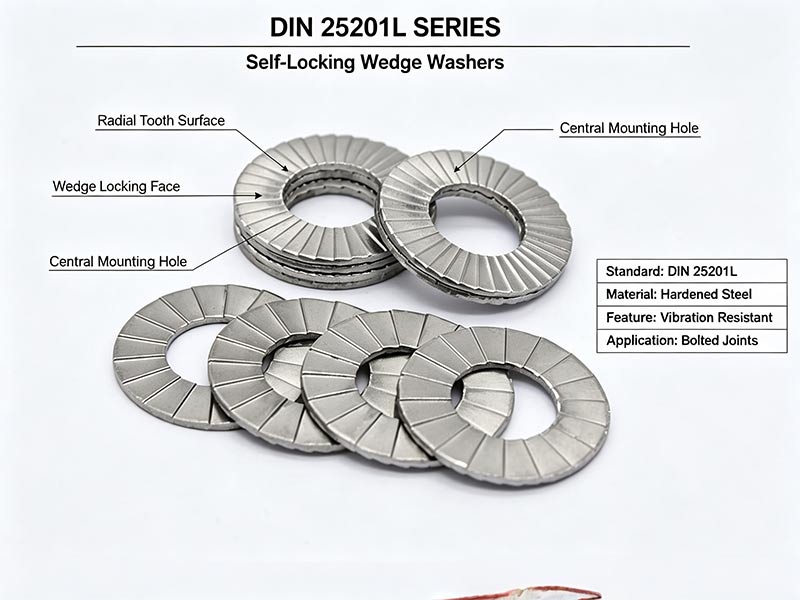
The French standard NF E 25-511 (NFE 25-511) developed its own serrated conical design: one face carries radial sun-ray serrations while the other is a smooth conical surface. During tightening, the conical face generates elastic preload while the teeth bite in - combining spring force with tooth engagement. The standard defines three width series: narrow (N), medium (M) and large (L). The L type offers the widest bearing area and highest load capacity, making it useful for distributing clamp load over softer or thinner substrates.
| Family | Structure | Key characteristic | Typical applications |
|---|---|---|---|
| DIN 6798A/J | Flat, single-sided teeth | Tooth bite plus axial spring force; select by clearance | Flat surfaces, sheet metal, compact assemblies |
| DIN 6798V | Conical, external teeth | Higher spring force, uneven-surface friendly | High-vibration joints, dynamic loads |
| DIN 9250 S/VS/L | Conical disc, double-sided teeth, paired | Disc preload plus bi-directional tooth lock | Heavy-duty, safety-critical joints |
| NFE 25-511 N/M/L | Conical, single-sided teeth | Spring preload plus tooth bite, wide bearing area | Automotive, rail, power, construction |
Serrated washers are one-time-use parts for critical joints: the teeth embed at first tightening, so reuse is not recommended after disassembly. Installation is straightforward - the toothed face goes against the bolt head or nut and the workpiece, and the joint is torqued so the teeth engage. Over-torquing should be avoided, as it can flatten the tooth profile and reduce locking performance.
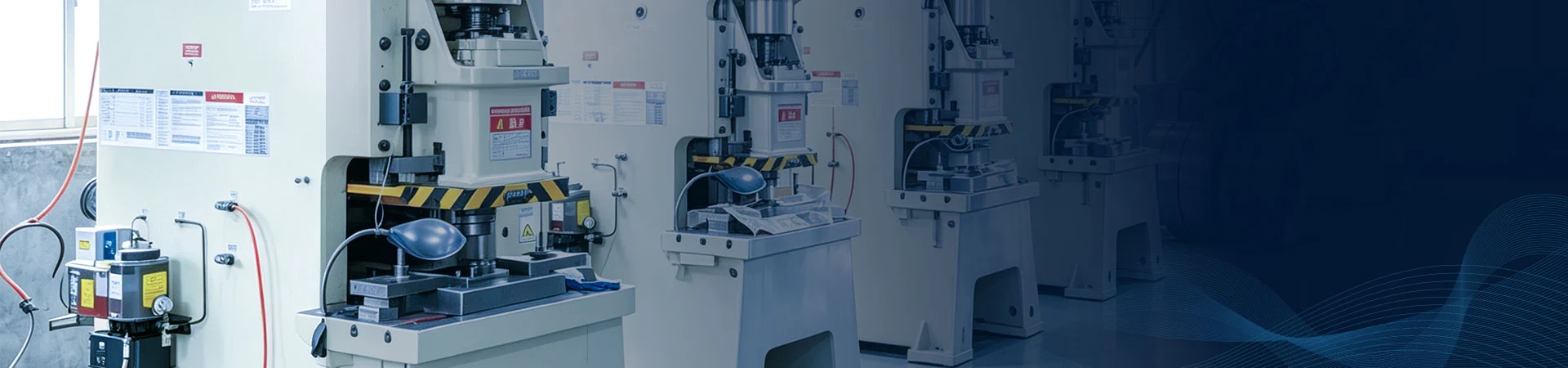
At Ningbo Yinzhou Zhenhua Stamping Co., Ltd., the full serrated range - DIN 6797, DIN 6798, DIN 9250 and NFE 25-511 - is stamped with in-house dies, heat treated, and delivered with material traceability and PPAP documentation on request.
Send Zhenhua your bolt size, substrate material and vibration profile, and we will confirm whether an external, internal, conical or double-sided serrated design fits - and which standard family matches your drawings.
✅ Get free sample!! Contact us today
✅ We will contact you within 24 hours
