Washers
DIN 9250S Serrated Disc Lock Washers

DIN 9250S Serrated Disc Lock Washers

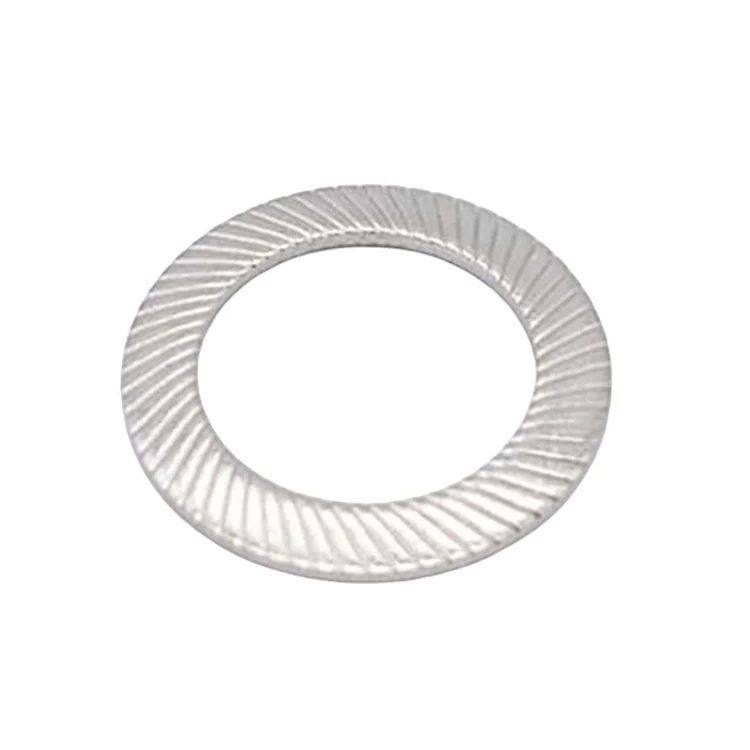
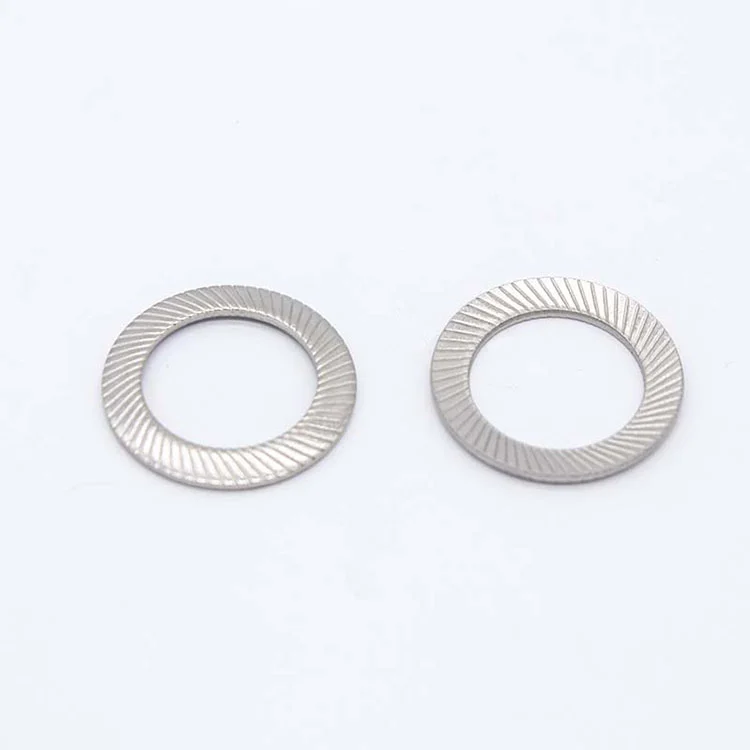
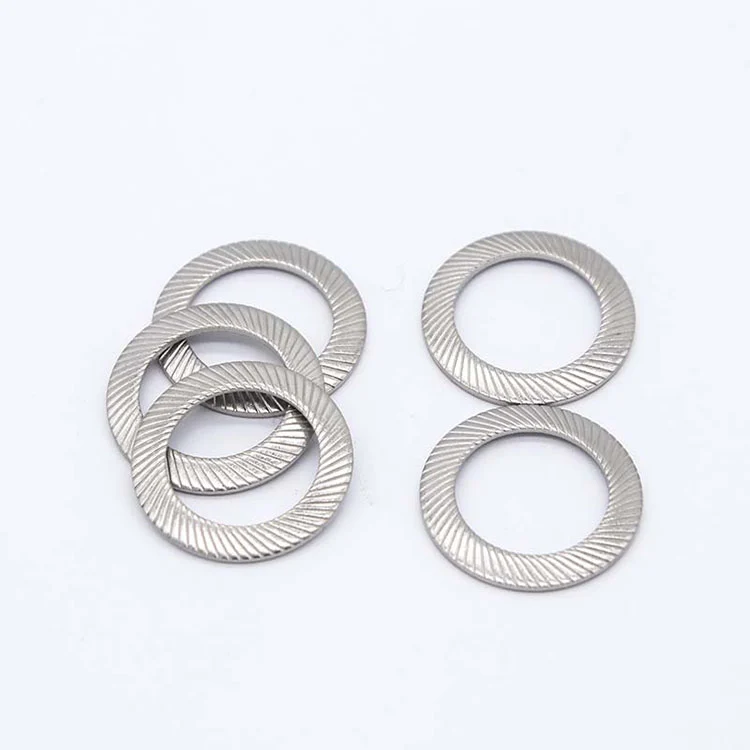
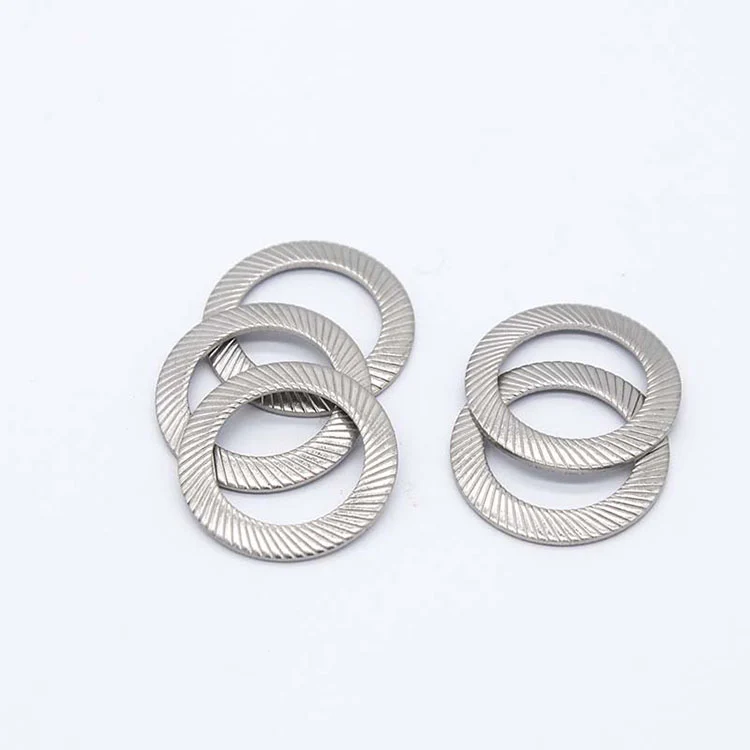
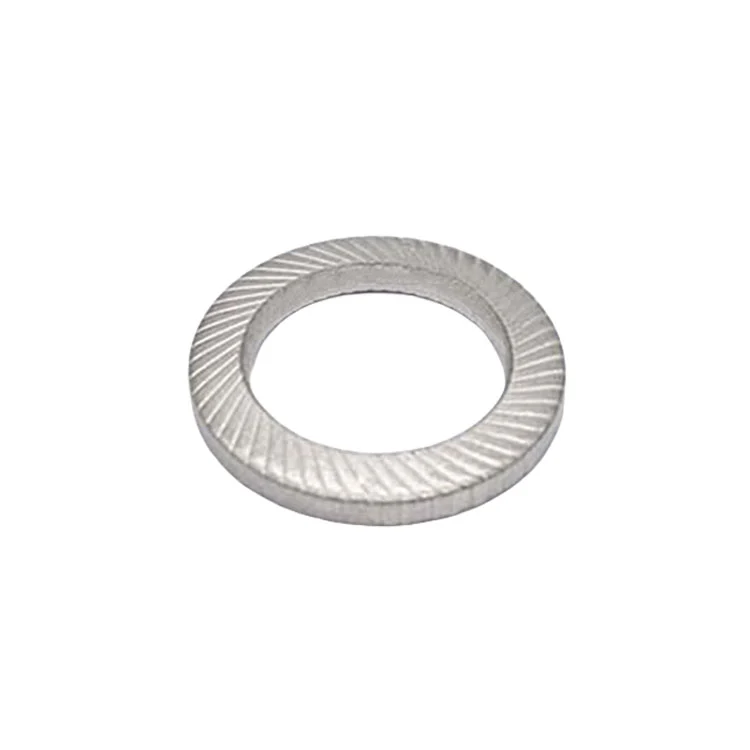
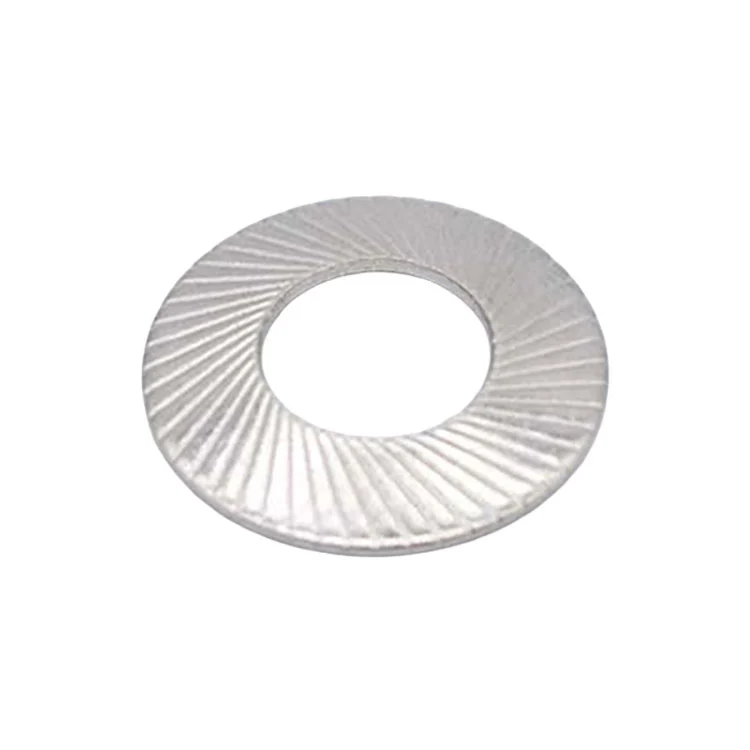
DIN 9250S Serrated Disc Lock Washers are the standard-type version of the DIN 9250 serrated disc washer series. Each set uses a conical disc-spring body with radial serrations on both faces. During tightening, the toothed surfaces engage with the bolt head or nut and the mating surface, while the disc shape provides elastic spring force within the joint.

AISI 304 (A2) AISI 316 (A4) 65Mn

Disc-spring preload + double-sided tooth bite | Standard loads & compact assemblies | OEM/ODM

Since 1993

Stamping parts manufacturer

12,000 m²

Owned factory

12,000 t/yr

Stamping capacity · 120 presses up to 450 T

24 h

Quotation response

Product Overview

The S type is designed around compactness and conventional joint requirements. Its thinner cross-section makes it suitable where installation space is limited, the joint uses relatively thin plates, or the assembly requires a smaller washer profile.

Unlike a conventional flat serrated washer, the DIN 9250S combines disc-spring action with double-sided tooth engagement, providing both preload retention and mechanical resistance to rotational loosening.

Ningbo Yinzhou Zhenhua Stamping Parts Co., Ltd. manufactures DIN 9250S Serrated Disc Lock Washers lock washers in AISI 304, AISI 316 and 65Mn, with standard and non-standard sizes available according to the company's dimensional specifications, customer drawings or samples.

Size Chart (Reserved Area)

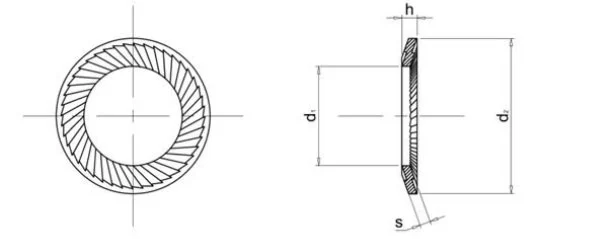
Safety Lock Washers DIN9250 Type "S"

DIN 9250S Serrated Disc Lock Washers

*All measurements in millimeters (mm)*

Model
S1.6
S2
S2.5
S3
S3.5
S4
S5
S6
S6.35
S7
S8
S10
S11.1
S12
S12.7
S14
S16
S18
S19
S20
S22
S24
S25.4
S27
S30
S33
S36
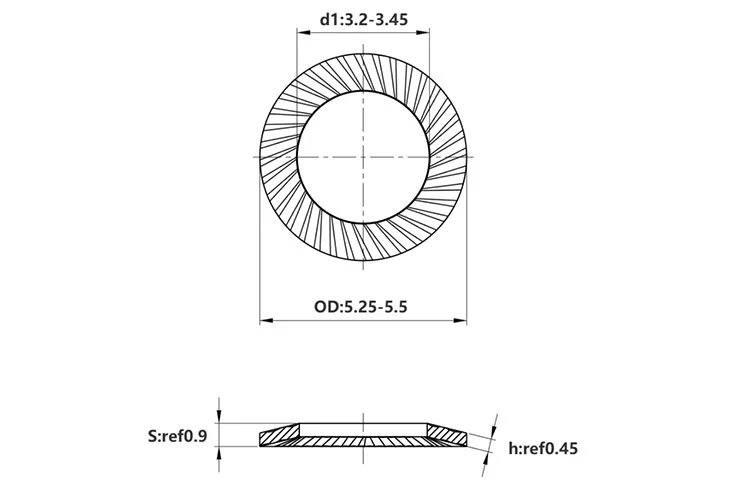
d1 d2 s h min h max kg/1000 Thread(mm) Thread(inch)
1.7 3.2 0.35 0.38 0.6 0.013 1.6 —
2.2 4. 0.35 0.39 0.6 0.021 2. —
2.7 4.8 0.45 0.49 0.9 0.039 2.5 —
3.2 5.5 0.45 0.51 0.9 0.049 3. 3/8"
3.7 6. 0.45 0.52 0.9 0.055 3.5 —
4.3 7. 0.5 0.59 1. 0.085 4. 5/32"
5.3 9. 0.6 0.73 1.1 0.167 5. 3/16"
6.4 10. 0.7 0.82 1.2 0.2 6. —
6.7 9.5 0.7 0.79 1.2 0.15 6.35 1/4"
7.4 12. 0.7 0.89 1.3 0.355 7. —
8.4 13. 0.8 0.98 1.4 0.392 8. 5/16"
10.5 16. 1. 1.21 1.6 0.75 10. 3/8"
11.6 15.9 1. 1.18 1.6 0.595 11.1 7/16"
13. 18. 1.1 1.31 1.7 0.879 12. —
13.7 19. 1.1 1.33 1.8 0.976 12.7 1/2"
15. 22. 1.2 1.52 2. 1.641 14. 9/16"
17. 24. 1.3 1.63 2.1 1.984 16. 5/8"
19. 27. 1.5 1.85 2.3 2.97 18. —
20. 30. 1.5 1.98 2.5 4.1 19. 3/4"
21. 30. 1.5 1.94 2.5 3.742 20. —
23. 33. 1.5 2.08 2.7 4.507 22. 7/8"
25.6 36. 1.8 2.32 2.9 5.91 24. —
27. 38. 2. 2.52 3.1 7.449 25.4 1"
28.6 39. 2. 2.52 3.1 7.369 27. —
31.6 45. 2. 2.78 3.6 10.78 30. 1 1/8"
34.6 50. 2.5 3.26 4. 18. 33. 1 1/4"
38. 54. 2.5 3.38 4.2 21.28 36. 1 3/8"

Why Choose the DIN 9250S Standard Type?

The main advantage of the S type is not simply higher locking force. It is the balance between locking function, spring action and installation space.

For conventional bolted joints, a heavier washer is not always necessary. The DIN 9250S provides the same basic double-sided serrated disc locking principle as other DIN 9250 types while using a more compact section.
This makes it worth considering when:

  • The joint has limited washer clearance.
  • The assembled components are relatively thin.
  • A compact fastening stack is preferred.
  • The joint operates under conventional vibration or dynamic loading.
  • The application does not require the reinforced section of the VS or L type.

Why Work With Ningbo Yinzhou Zhenhua

  • Ningbo Yinzhou Zhenhua handles stamping, progressive die production and machining in-house. Tooling design and maintenance are also managed internally, allowing production conditions and process records to be controlled from one stage to the next.
  • For custom parts, production can start from a customer drawing, sample or specified requirement. Material, dimensions, surface finish and packaging can be adjusted to suit the application, with the same process carried through from sample approval to repeat production.
  • Our IATF 16949 quality management system supports process control and batch consistency throughout production. Inspection and production records provide traceability for key manufacturing steps.
  • Engineering and production teams work directly with customers on part selection, sampling and production requirements. This keeps technical details clear and avoids unnecessary communication through multiple intermediaries.
DIN 9250S Serrated Disc Lock Washers

How the Double-Sided Tooth Design Works

The DIN 9250S uses two functional elements:

Radial serrations provide mechanical engagement with the fastener and mating surface.

The conical disc provides elastic spring action when the pair is compressed during tightening.

When correctly installed, the two toothed faces are positioned between the bolt head or nut and the workpiece. The teeth engage the contacting surfaces while the disc geometry contributes elastic recovery to the joint.

The result is different from a conventional flat serrated washer because the locking mechanism is based on the combination of tooth engagement and disc-spring behavior.

DIN 9250S vs DIN 9250VS and DIN 9250L

The DIN 9250 series should be selected according to the joint rather than simply choosing the thickest available type.

Type
DIN 9250S
DIN 9250VS
DIN 9250L
Main characteristic Typical selection consideration
Standard, compact section Conventional loads, limited space, thin assemblies
Reinforced section and greater elastic recovery Higher preload retention and demanding vibration
Heavy-duty section Higher-load and heavy-duty bolted joints

S is the compact standard option. If the joint requires greater elastic recovery or a reinforced section, consider VS. For higher-load heavy-duty joints, L may be more appropriate.
Material Options

  • AISI 304 (A2): general-purpose stainless steel with balanced corrosion resistance for industrial equipment, outdoor structures and conventional machinery.
  • AISI 316 (A4): molybdenum-bearing stainless steel with improved resistance to chlorides and acids for marine, chemical and frequent-washdown environments.
  • 65Mn: spring-steel grade with good elasticity and fatigue resistance for joints under higher loads and repeated vibration.

Surface Treatments

  • Plain: retains the natural silver stainless steel surface and metallic appearance.
  • Polished: a higher surface finish for appearance-sensitive applications.
  • Passivated: removes surface free iron and reinforces the passive film for improved corrosion resistance.
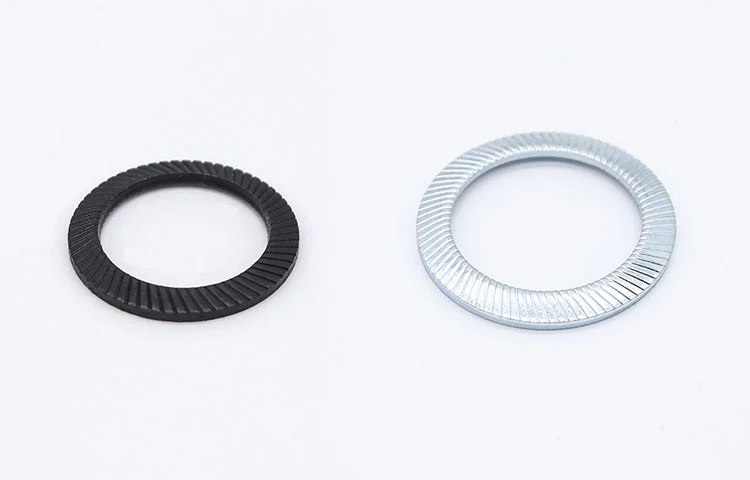
  • Trivalent blue-white zinc: eco-friendly zinc plating with a bright blue-white appearance for general corrosion protection.
  • Black oxide / phosphating: matte dark surface commonly used inside machinery or where a non-reflective appearance is required.
  • Eco Dacromet: chromium-free zinc-aluminium coating with good corrosion resistance for outdoor or demanding environments.
  • Special surface treatments: custom finishes can be realized on request; process and lead time are confirmed at inquiry.
DIN 9250S Serrated Disc Lock Washers

Installation Considerations

DIN 9250S Serrated Disc Lock Washers are supplied as matched pairs. The toothed faces should be positioned toward the bolt head or nut and the mating surface.

During installation

  • Confirm that the washer size matches the bolt and joint.
  • Position the two toothed faces against the fastening surfaces.
  • Tighten the fastener according to the specified installation torque.
  • Ensure that the joint surfaces are suitable for tooth engagement.
  • Do not substitute an installation torque without considering bolt grade, friction and joint design.

The actual tightening torque should be determined according to the complete fastening system rather than the washer alone.

OEM/ODM DIN 9250S Manufacturing

Ningbo Yinzhou Zhenhua Stamping Parts Co., Ltd. manufactures fastening components through stamping, tooling and related machining processes, with in-house tooling development and production support.

For DIN 9250S projects, customers can specify

  • Washer dimensions
  • Material grade
  • Surface treatment
  • Packaging requirements
  • Special tolerances
  • Non-standard dimensions
  • Drawings or reference samples

Engineering personnel can support the transition from sample approval to batch production, while production and inspection processes are controlled under the company's quality management system.

FAQ

Q1 What is the difference between the DIN 9250S and the DIN 9250L (heavy-duty) type?

A This DIN 9250S lock washer is the standard double-sided serrated disc type with a thinner cross-section and compact profile for conventional loads, thin plates and soft substrates; the DIN 9250L is the heavy-duty version with a thicker cross-section and higher load capacity. Both share the same double-sided serrated disc locking principle, so the choice mainly depends on joint load, space and substrate.

Q2 How does the DIN 9250S differ from DIN 6797 and DIN 6798?

A DIN 6797 (internal serrations) and DIN 6798 (external serrations) are flat single-face serrated washers that rely mainly on serration-edge friction against the mating surface. The DIN 9250S uses a conical disc plus radial teeth on both faces: during tightening the teeth bite into the fastener and the workpiece while the disc spring maintains preload, giving stronger vibration resistance and higher load capacity.

Q3 What are the installation requirements?

A The toothed faces must face the bolt head/nut and the workpiece respectively; tighten to the recommended torque so the teeth bite into both surfaces and form a mechanical lock. No additional locking parts are needed. Torque depends on the bolt grade and the joined components.

Q4 What materials and surface treatments are available?

A Standard options are AISI 304 (A2), AISI 316 (A4) and 65Mn. Surface treatments include plain, polished, passivated, trivalent blue-white zinc, black oxide/phosphating, eco Dacromet and special finishes on request; confirm details at inquiry.

Q5 What is the lead time?

A AISI 304 standard sizes are generally kept in stock and can be prioritized; other materials or non-standard sizes are produced within about 15–30 days, confirmed at inquiry.

Product Selection at a Glance

  • Choose DIN 9250S when compactness and conventional joint requirements are the priority.
  • For reinforced preload retention, compare the DIN 9250VS.
  • For heavier-load fastening applications, compare the DIN 9250L.

Request a Quote

send your size, quantity and drawing for countersunk lock washers, and we will reply after confirming specifications and lead time.
X
We use cookies to offer you a better browsing experience, analyze site traffic and personalize content. By using this site, you agree to our use of cookies. Privacy Policy
Reject Accept