
Abstract: This guide from Zhenhua explains how Screw Cup Washers cover screw heads, spread clamping load, and improve finished appearance—covering cup angles, materials, surface treatments, size ranges, and specification tips for OEM buyers.
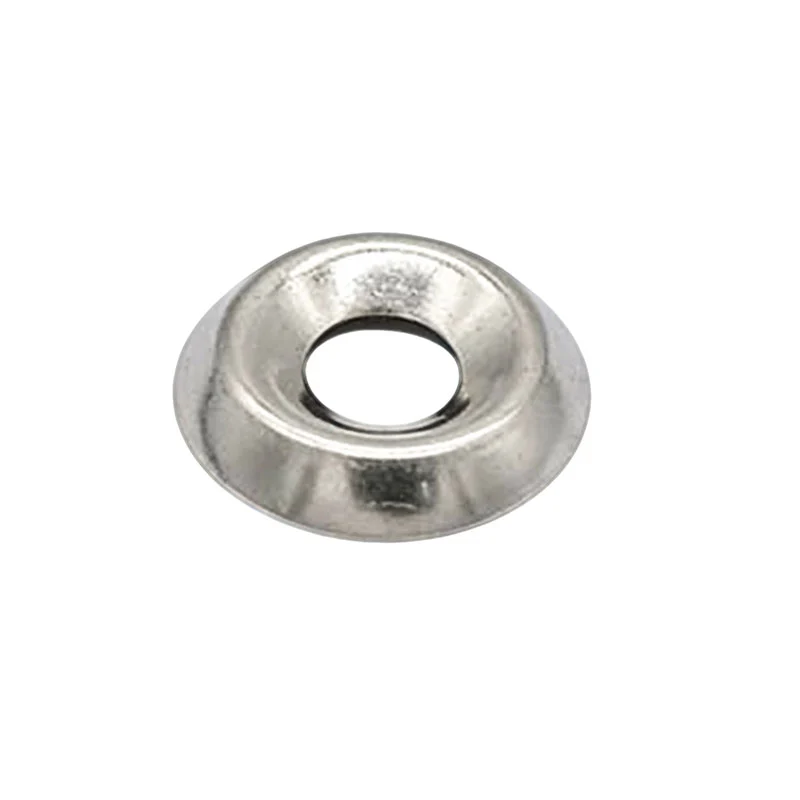
Zhenhua manufactures Screw Cup Washers that solve two problems at once: they cover the screw head with a domed cup for a clean finished surface, and their flat bearing base spreads clamping force across a wider contact area. That combination matters in visible fastening points—automotive trim, furniture, sheet-metal enclosures, and electrical panels—where an exposed screw head looks unfinished and a concentrated load can dent soft substrates.
Unlike a standard flat washer, a cup washer encloses the screw head rather than sitting beneath it in full view. The result is a smoother surface with less snagging risk and better protection for the fastener itself. For buyers specifying parts, understanding cup geometry, material grade, and finish is the difference between a part that works and one that causes assembly or corrosion issues later.
The cup angle must match the screw head geometry. A mismatch creates poor contact, uneven seating, and visible gaps around the head.
Cup angle is not the only geometric variable. Cup depth, outside diameter, wall thickness, flange width, and dome profile all affect fit and appearance. Zhenhua produces these dimensions according to confirmed drawings or samples, which is essential when matching an existing screw and panel thickness.
Material choice follows the service environment and mechanical demand.
A practical rule: if the assembly will be inspected visually after years outdoors, specify 316. If the part is internal and load-bearing, 65Mn with proper plating may be the efficient choice. For most indoor industrial work, 304 balances cost and durability.
Finishing serves both appearance and protection, and the right choice depends on the base material.
For visible decorative assemblies, polished stainless offers a bright, consistent look that resists discoloration. For hidden structural fastening, zinc-plated 65Mn is usually the most economical option that still meets corrosion targets.
The table below summarizes typical specification ranges and selection guidance for screw cup washers produced by Zhenhua.
| Parameter | Standard Range | Selection Guidance |
|---|---|---|
| Thread size (d) | M2 to M12 | Match the screw size used in the assembly; verify clearance with the cup inner diameter |
| Cup angle | 82°, 90°, 100° | Confirm against the actual countersunk screw head geometry |
| Outside diameter (dc) | 10 mm to 18 mm in common sizes | Larger OD spreads load more; check clearance to adjacent features |
| Cup height (H) | 2 mm to 3.5 mm in common sizes | Must clear the screw head height while keeping a low profile |
| Wall thickness (s) | 0.4 mm to 0.5 mm in common sizes | Thicker walls improve resistance to deformation under high clamp load |
| Material | AISI 304, AISI 316, 65Mn | Match corrosion exposure and mechanical requirements |
| Finish | Passivated, polished, zinc, black oxide, phosphating, Dacromet | Specify based on material and environment |
| Customization | Cup depth, OD, wall thickness, dome profile, angle | Submit a drawing or sample for confirmation before tooling |
For high-volume programs, confirming these parameters in a single drawing review prevents the most common cause of rework: a cup angle or depth that does not match the screw actually used on the line.
Cup washers are specified where appearance, load distribution, or surface protection matters:
In sheet-metal enclosures, the flat base is particularly valuable: it prevents the screw head from dimpling thin panels, which improves both appearance and gasket sealing in weather-resistant designs.
Q1: What is the difference between a screw cup washer and a standard flat washer?
A: A screw cup washer uses a formed cup to cover the screw head, while a standard flat washer leaves the head exposed. Choose the cup type when head coverage, finished appearance, or a specific assembly structure is required.
Q2: Can the cup be matched to specific screw head angles?
A: Yes. 82°, 90°, and 100° cup angles are available. Confirm the correct angle against the actual screw head geometry before ordering.
Q3: What materials are available?
A: Zhenhua supplies AISI 304, AISI 316, and 65Mn. Selection depends on corrosion exposure, required hardness and strength, and the application.
Q4: Can cup depth and outside diameter be customized?
A: Yes. Cup depth, outside diameter, wall thickness, flange width, dome profile, and cup angle can all be customized per confirmed drawing or sample.
Q5: Can you provide samples before mass production?
A: Yes. Sample development, small-batch trial production, and mass production are supported. Tooling and sample arrangements are confirmed according to product structure and order requirements.
Q6: What surface treatments are available?
A: Plain, polished, passivated, trivalent blue-white zinc, black oxide, phosphating, and eco-friendly Dacromet. Special finishes can be discussed based on material and application.
Q7: What are the MOQ and lead time?
A: AISI 304 standard sizes are generally stocked and can be prioritized. Other materials or non-standard sizes are typically produced within about 15–30 days, with final lead time confirmed by specification, quantity, and schedule.
Q8: Can the washers be reused?
A: Reuse should be evaluated against your assembly specification and product design. Where the specification requires it, install a new washer on reassembly.
A screw cup washer is a small part with an outsized effect on how an assembly looks, seals, and holds up over time—and the details that determine that outcome are cup angle, material grade, wall thickness, and finish. Zhenhua has been producing stamped fastening components since 1993, with an IATF 16949 quality system, in-house progressive die and deep drawing capability, and traceability from raw material to finished part. Standard M2–M12 sizes in 304, 316, and 65Mn are available, and custom cup geometry is produced to your confirmed drawing. Send us your screw type, size, material, quantity, drawing or sample, and destination country, and we will respond with a clear quote and lead time. contact us today to discuss your specification, and let our engineering team confirm the right cup angle and finish for your assembly—contact us now for samples or a fast quotation.
✅ Get free sample!! Contact us today
✅ We will contact you within 24 hours