Choosing the right fastening component is essential for maintaining reliable mechanical connections in demanding industrial applications. Zhenhua provides fastening solutions for manufacturers and engineering professionals seeking practical, consistent, and application-oriented hardware. A DIN 7967 Self-Locking Pal Nut is a compact counter nut designed to help resist loosening when correctly matched with a primary nut, making it a useful option for selected assemblies where space, installation efficiency, and fastening stability matter.
A DIN 7967 Self-Locking Pal Nut is a thin, hexagonal metal locking nut commonly used as a secondary fastening element. Its spring-like geometry creates resistance against the primary nut when installed in a suitable configuration. This article explains its working principle, materials, dimensions, applications, selection criteria, installation considerations, and purchasing requirements. It also highlights an important specification detail: DIN 7967 has been withdrawn without replacement, so buyers should verify dimensional compatibility and current engineering requirements before placing an order.
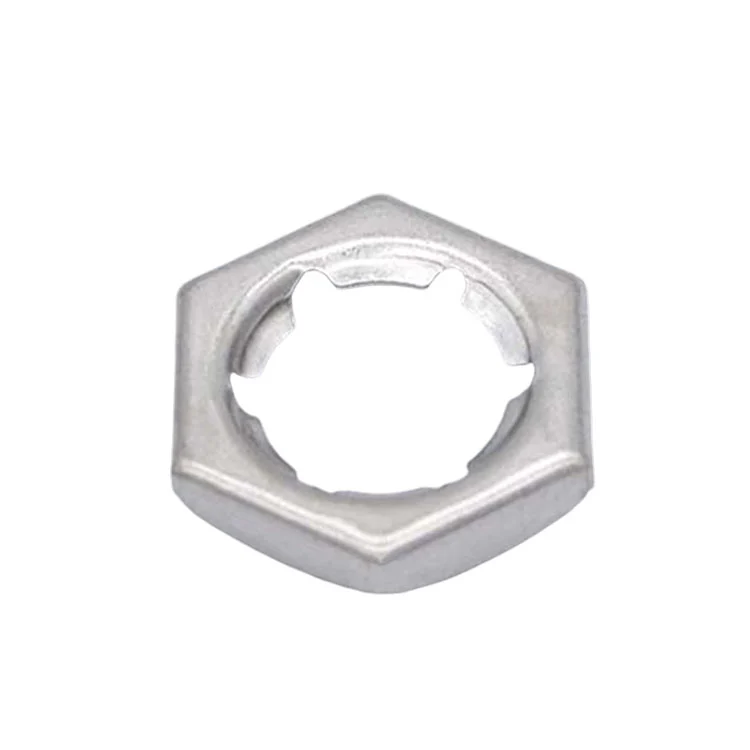
A DIN 7967 Self-Locking Pal Nut, also called a PAL nut or self-locking counter nut, is a thin metal nut with a hexagonal outer profile and a specially formed locking structure. It is generally used with a conventional nut as part of a secondary locking arrangement rather than as a direct substitute for every standard hex nut.
Its relatively low profile can make it suitable for assemblies where installation space is limited. The component is designed to create resistance within the fastening arrangement, helping reduce the likelihood of unintended loosening under suitable service conditions.
Typical characteristics include:
For product details and available configurations, refer to Zhenhua's DIN 7967 Self-Locking Pal Nut product page.
The locking function depends on the component's formed geometry and how it interacts with the primary nut and threaded fastener. When correctly fitted, the Pal Nut creates additional resistance within the assembly, helping counter the tendency of the primary nut to rotate unintentionally.
In a typical arrangement, the main nut establishes the required clamping force. The secondary Pal Nut is then installed according to the specified assembly procedure. The exact installation sequence, orientation, and tightening method should follow the supplier's instructions and the equipment designer's requirements.
Several factors affect the effectiveness of this arrangement:
A Pal Nut should not be treated as a universal vibration-proof solution. Where failure could cause injury, equipment damage, or substantial downtime, engineers should evaluate the complete joint and select a locking method supported by suitable testing and application requirements.
Material and finish selection influence corrosion resistance, mechanical behavior, service life, and compatibility with the surrounding components. Spring steel is a common material for traditional Pal Nut designs because the locking geometry relies on the material's mechanical response.
| Material or Finish | Key Characteristics | Selection Considerations |
|---|---|---|
| Spring steel | Supports formed locking features and elastic behavior | Confirm the specified mechanical properties and heat treatment. |
| Carbon steel | Common engineering material for general fastening products | Verify whether its properties are suitable for the intended locking design. |
| Zinc-plated finish | Provides a protective coating for suitable environments | Check coating specifications, corrosion requirements, and applicable restrictions. |
| Hot-dip galvanized finish | Can provide a thicker zinc coating for selected applications | Confirm dimensional fit, thread compatibility, and coating suitability. |
| Stainless steel | Offers corrosion resistance depending on the grade and environment | Verify grade, mechanical properties, and whether the required locking geometry is available. |
Not every material or coating is available in every size or configuration. Buyers should request the actual product specification rather than assume that all finishes listed for general fastening products are available for a particular Pal Nut.
For assemblies exposed to moisture, chemicals, salt, or temperature fluctuations, evaluate the complete fastener combination. Coating compatibility, galvanic corrosion, thread fit, and any applicable environmental requirements should all be considered.
Dimensional accuracy is critical when specifying a DIN 7967 Self-Locking Pal Nut. A component that appears visually similar may not provide the correct thread engagement, tool access, or locking behavior if its dimensions differ from the approved design.
Important specification fields include:
The following table gives illustrative nominal dimensions for selected traditional DIN 7967 Pal Nut sizes. Values are in millimeters and should be treated as reference information, not as a substitute for an approved product drawing.
| Nominal Thread | Thread Pitch (mm) | Inner Diameter d1 (mm) | Width Across Flats s (mm) | Across Corners e (mm) |
|---|---|---|---|---|
| M6 | 1.00 | 5.3 | 10.0 | 11.5 |
| M8 | 1.25 | 6.9 | 13.0 | 15.0 |
| M10 | 1.50 | 8.6 | 17.0 | 19.6 |
| M12 | 1.75 | 10.4 | 19.0 | 21.9 |
| M16 | 2.00 | 14.1 | 24.0 | 27.7 |
| M20 | 2.50 | 17.6 | 30.0 | 34.6 |
These values represent commonly published reference dimensions for the listed sizes. Always confirm the relevant dimension definitions, tolerances, and product drawing before manufacturing or assembly.
Important standards note: DIN 7967 has been withdrawn without replacement. The designation may still be used commercially to identify an established Pal Nut design, but it should not be interpreted as proof that a product meets a currently active DIN standard. For new designs and replacement purchases, confirm the required dimensions, functional requirements, and acceptance criteria with the supplier.
Pal Nuts may be considered for secondary locking in mechanical assemblies where their geometry, material, and operating characteristics are suitable. Their compact form can be helpful when a conventional locking arrangement would require more space.
Potential application areas include:
These are potential use cases rather than universal approvals. Applications involving safety-critical joints, heavy dynamic loads, high temperatures, or severe vibration require a documented engineering assessment. The selected fastener must meet the applicable equipment specification and regulatory requirements.
Choosing a suitable Pal Nut requires more than matching the nominal thread size. Purchasing teams should consider the assembly design, service conditions, material requirements, and inspection criteria before confirming an order.
Because DIN 7967 is withdrawn, buyers should clearly identify whether they require a legacy replacement part, a dimensionally compatible product, or a newly engineered locking solution. These requirements are related but not necessarily interchangeable.
Even a correctly manufactured fastener may perform poorly if it is installed incorrectly or used outside its intended operating conditions. Consistent installation and inspection practices help reduce avoidable assembly problems.
A practical incoming inspection plan can include visual checks, thread gauging, dimensional verification, finish inspection, and confirmation of product identification. For applications with specific mechanical requirements, request supporting test documentation and agree on acceptance criteria before production.
Supplier evaluation should also cover batch consistency, traceability where required, packaging protection, delivery documentation, and the ability to meet agreed specifications. These controls are particularly valuable for buyers sourcing fasteners in volume or managing recurring replacement requirements.
Its main purpose is to provide a secondary locking action in a compatible fastening arrangement. It is generally used with a primary nut to help resist unintended loosening, subject to correct installation and suitable operating conditions.
No. A standard hex nut primarily provides threaded fastening, while a Pal Nut has a thinner profile and specially formed geometry intended to provide a locking function. The two components should not be considered interchangeable without checking the assembly design.
Traditional product ranges include various metric sizes, commonly beginning at M4 or M6 depending on the supplier and extending to larger diameters in some catalogs. Availability, pitch, dimensions, and materials must be confirmed for the specific product.
They may be suitable for selected outdoor applications when the material and surface finish provide adequate protection. The appropriate choice depends on humidity, salt exposure, chemicals, temperature, and the required service life. Verify the complete fastening system before use.
DIN 7967 has been withdrawn without replacement. The designation remains in commercial product descriptions, but buyers should confirm the actual drawing, dimensions, tolerances, and performance requirements instead of relying solely on the historical standard number.
Reuse depends on the specific design, condition, and manufacturer instructions. A locking component may lose functional effectiveness through deformation, wear, or damage. If reuse has not been explicitly approved, replacement is the safer procurement and maintenance approach.
Provide the nominal thread size and pitch, required dimensions, material, surface finish, order quantity, application environment, packaging requirements, and any applicable drawing or inspection criteria. Mention whether the order is for a legacy DIN 7967 part or a dimensionally compatible alternative.
A DIN 7967 Self-Locking Pal Nut can be a practical choice for selected mechanical assemblies that require a compact secondary locking component. Reliable selection depends on accurate dimensions, suitable material and coating, correct installation, and verification against the intended operating conditions. Since DIN 7967 has been withdrawn, engineering and procurement teams should confirm the applicable technical requirements before approving a replacement or new component.
Zhenhua can be a starting point for buyers researching Pal Nut specifications and fastening options. If you need help identifying the appropriate size, checking dimensional compatibility, or discussing your project requirements, visit the DIN 7967 Self-Locking Pal Nut product page and contact us to discuss a suitable fastening solution for your application.
✅ Get free sample!! Contact us today
✅ We will contact you within 24 hours