
When reliable fastening is essential, Zhenhua DIN 6798A External Serrated Lock Washers provide a practical mechanical locking solution for applications exposed to vibration and dynamic loads. Their outward-facing teeth engage with the underside of the fastener and mating surface, helping reduce relative rotation while maintaining a compact washer profile for suitable assemblies.
DIN 6798A External Serrated Lock Washers are designed with external teeth around the washer circumference to improve resistance to fastener loosening. Unlike conventional flat washers, their serrated edge creates mechanical engagement during tightening. This makes them particularly useful for sheet-metal assemblies, equipment panels, machinery, brackets, electrical enclosures, and other applications where sufficient radial clearance is available.
The correct washer selection involves more than simply matching the nominal bolt size. Engineers and purchasing teams should consider the washer's inner diameter, outer diameter, thickness, tooth geometry, material, surface finish, mating surface, available clearance, and operating environment. Zhenhua supplies DIN 6798A washers in AISI 304, AISI 316, and 65Mn, with standard and customized production options.
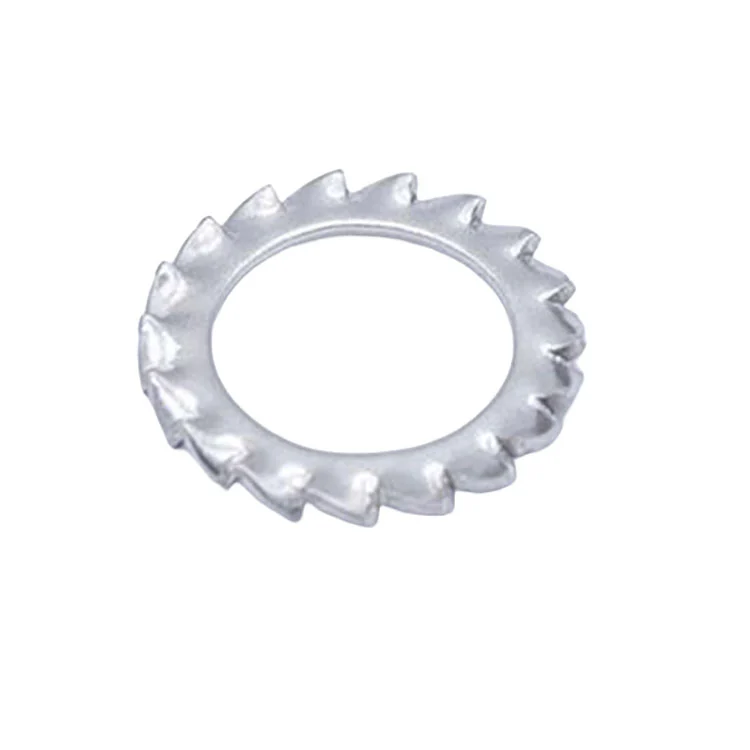
Table of Contents
- What Are DIN 6798A External Serrated Lock Washers?
- How Does the External Serrated Design Work?
- What Are the Key Benefits?
- How Should You Select the Correct Size?
- Which Materials Are Available?
- How Does DIN 6798A Compare With Other Serrated Washers?
- Where Are DIN 6798A Washers Used?
- What Should You Consider During Installation?
- Frequently Asked Questions
- How Can You Choose the Right Supplier?
What Are DIN 6798A External Serrated Lock Washers?
DIN 6798A External Serrated Lock Washers are metric serrated locking washers characterized by teeth positioned around their outside circumference. When installed beneath an appropriate bolt head or nut, the external teeth extend beyond the washer's inner bore and make contact with the surrounding bearing surfaces.
The basic purpose is to increase resistance to relative rotation between the fastener and the joint. As the fastener is tightened, the serrated teeth are pressed against the mating surfaces. This creates mechanical engagement that can help maintain fastening stability where vibration or dynamic movement could otherwise contribute to loosening.
Because the teeth are located externally, DIN 6798A requires adequate space around the fastener. This characteristic makes it especially suitable for flat mounting surfaces, panels, brackets, sheet-metal structures, and machinery assemblies where the washer's outside diameter can be accommodated.
For applications with limited external space, an internal-tooth washer such as DIN 6798J Internal Serrated Lock Washers may offer a more appropriate configuration.
How Does the External Serrated Design Work?
The locking effect of DIN 6798A comes primarily from the interaction between its external teeth and the two contacting surfaces. During tightening, the washer is compressed between the fastener and the joint. The teeth are forced into the contact areas, increasing resistance to rotational movement.
This design is particularly useful when the washer can be installed on a relatively flat bearing surface. The external tooth arrangement places the serrations at a larger radial distance from the bolt axis, making the washer effective where the surrounding structure provides enough space.
- External teeth create mechanical engagement.
- The serrated edge helps resist relative rotational movement.
- The washer provides a defined bearing interface beneath the fastener.
- The design is well suited to assemblies with adequate radial clearance.
- Correct installation depends on matching the washer to the fastener and mating surface.
However, a serrated washer should not be treated as a universal solution for every bolted joint. The surface material, tightening conditions, vibration level, joint design, and required service life should all be evaluated before selecting the washer.
What Are the Key Benefits?
Improved Resistance to Loosening
The external teeth increase resistance to relative rotation between the fastener and mating surface. This is valuable in machinery and equipment exposed to vibration or repeated dynamic loading.
Simple Mechanical Locking
DIN 6798A does not depend on adhesives or additional locking compounds. Its locking action is produced through the physical engagement of the serrated edge.
Multiple Material Choices
Depending on application requirements, the washer can be produced in stainless steel or spring-steel materials. This allows engineers to balance corrosion resistance, mechanical performance, and service conditions.
Suitable for Industrial Assemblies
The washer format is practical for sheet-metal structures, machinery, electrical assemblies, brackets, equipment panels, and other applications where external serrations can be accommodated.
OEM Customization
For specialized assemblies, manufacturers can review drawings or physical samples to determine the required dimensions, tooth geometry, material, and finish. This is useful when a standard washer does not provide the required fit.
How Should You Select the Correct Size?
Choosing a DIN 6798A washer should involve checking the complete joint rather than relying only on the nominal thread diameter. The washer's inner diameter needs to accommodate the fastener, while its outer diameter must fit within the available surrounding area.
| Nominal Size | Inner Diameter Approx. | Outer Diameter Approx. | Thickness Approx. | Typical Thread |
|---|---|---|---|---|
| M3 | 3.2 mm | 6 mm | 0.4 mm | M3 |
| M4 | 4.3 mm | 8 mm | 0.5 mm | M4 |
| M5 | 5.3 mm | 10 mm | 0.6 mm | M5 |
| M6 | 6.4 mm | 11 mm | 0.7 mm | M6 |
| M8 | 8.4 mm | 15 mm | 0.8 mm | M8 |
| M10 | 10.5 mm | 18 mm | 0.9 mm | M10 |
| M12 | 13 mm | 20.5 mm | 1.0 mm | M12 |
| M16 | 17 mm | 26 mm | 1.2 mm | M16 |
| M20 | 21 mm | 33 mm | 1.5 mm | M20 |
| M24 | 25 mm | 38 mm | 1.5 mm | M24 |
| M30 | 31 mm | 48 mm | 1.6 mm | M30 |
The dimensions above represent common DIN 6798A sizes and should be verified against the applicable technical specification before production or installation. Zhenhua also supports non-standard dimensions based on customer drawings or samples.
Before ordering, verify:
- Nominal bolt or nut size
- Required inner diameter
- Available radial clearance
- Required outer diameter
- Washer thickness
- Fastener head or nut geometry
- Mating surface material and condition
- Required material and surface treatment
Which Materials Are Available?
Material selection should reflect the mechanical and environmental requirements of the joint. Zhenhua offers DIN 6798A External Serrated Lock Washers in AISI 304, AISI 316, and 65Mn options.
| Material | Main Characteristic | Suitable Applications |
|---|---|---|
| AISI 304 (A2) | General corrosion resistance | Machinery, electrical enclosures, general industrial equipment |
| AISI 316 (A4) | Enhanced resistance to moisture and chlorides | Marine, chemical, washdown and demanding outdoor environments |
| 65Mn | High spring and mechanical properties | Applications prioritizing mechanical performance and elasticity |
Material compatibility should also be considered alongside the bolt, nut, panel, and surrounding structure. For outdoor or corrosive environments, the complete joint should be evaluated rather than selecting the washer material in isolation.
How Does DIN 6798A Compare With Other Serrated Washers?
The main distinction between serrated washer designs is the position of the teeth and the amount of space required around the fastener.
| Washer Type | Tooth Position | Clearance Consideration | Typical Selection |
|---|---|---|---|
| DIN 6798A | External | Requires radial space | Panels, brackets and general assemblies |
| DIN 6798J | Internal | More compact outside profile | Space-constrained assemblies |
| DIN 6797A | External | Check series-specific dimensions | Applications requiring the corresponding DIN 6797 geometry |
| DIN 6797J | Internal | Compact external profile | Assemblies with limited outer clearance |
These standards should not be considered interchangeable simply because their nominal bolt sizes are similar. Engineers should compare actual dimensions, tooth geometry, material requirements, and joint conditions before substituting one washer type for another.
Where Are DIN 6798A Washers Used?
The external serrated configuration makes DIN 6798A suitable for many industrial fastening applications where there is sufficient space around the bolt head or nut.
- Industrial machinery and mechanical equipment
- Electrical cabinets and enclosures
- Sheet-metal assemblies
- Equipment panels and mounting brackets
- Automotive and transportation components
- General equipment manufacturing
- Outdoor mechanical assemblies
- OEM fastening systems
For vibration-sensitive applications, the washer should be selected as part of the complete joint design. Surface hardness, fastener configuration, preload, tightening procedure, and operating vibration can all influence the effectiveness of a locking washer.
What Should You Consider During Installation?
Proper installation is essential to achieving consistent fastening performance. The washer should be positioned so that the serrated surfaces engage the intended mating surfaces, while the fastener is tightened according to the requirements of the complete joint.
- Check fit: Confirm that the washer's inner diameter fits the fastener and that its outer diameter has sufficient surrounding clearance.
- Inspect the mating surface: Make sure the surface can accommodate the serrated teeth without unacceptable damage.
- Confirm orientation: Position the toothed surface against the intended bearing surfaces according to the joint design.
- Use the correct tightening procedure: Follow the bolt and joint manufacturer's tightening requirements rather than applying a universal washer torque value.
- Inspect after service: For critical assemblies, examine the teeth and contact surfaces after removal.
- Consider replacement: Reusing a serrated washer may reduce predictable locking performance if the teeth have been deformed or embedded during the first installation.
Frequently Asked Questions
What is the main purpose of DIN 6798A External Serrated Lock Washers?
The main purpose is to increase resistance to relative rotation between a fastener and mating surface. Its external teeth create mechanical engagement when the joint is tightened.
What is the difference between DIN 6798A and DIN 6798J?
DIN 6798A has external teeth and therefore needs sufficient radial clearance around the fastener. DIN 6798J has internal teeth and can be more suitable when the outside space around the fastener is restricted.
Can DIN 6798A washers be used with sheet metal?
Yes. They can be suitable for sheet-metal assemblies when the washer dimensions, tooth geometry, material hardness, surface condition, and tightening conditions are compatible with the application.
Which material is best for DIN 6798A washers?
AISI 304 is a practical choice for many general industrial applications, while AISI 316 is more suitable for environments with greater exposure to moisture or chlorides. 65Mn is an option when mechanical and spring properties are the primary consideration.
Can Zhenhua manufacture non-standard DIN 6798A washers?
Yes. Zhenhua can review customer drawings or physical samples for customized dimensions, tooth geometry, materials, surface finishes, and OEM production requirements.
Can DIN 6798A External Serrated Lock Washers be reused?
Reuse is generally not recommended for critical or vibration-sensitive joints. After installation, serrated teeth may deform or remain embedded in the mating surfaces, potentially changing the washer's locking performance.
What information is needed for a custom washer quotation?
Useful information includes inner diameter, outer diameter, thickness, nominal fastener size, material, surface finish, application environment, required quantity, and a drawing or sample when available.
How Can You Choose the Right Supplier?
Selecting a reliable manufacturer is just as important as selecting the correct washer specification. For OEM and industrial procurement, buyers should evaluate dimensional consistency, material availability, tooling capability, production capacity, inspection procedures, customization support, and communication efficiency.
Ningbo Yinzhou Zhenhua Stamping Parts Co., Ltd. has manufactured stamping components since 1993 and operates an owned factory with 12,000 m² of production space. Its DIN 6798A production supports AISI 304, AISI 316, and 65Mn materials, while custom requirements can be reviewed from customer drawings or samples. Automated stamping equipment and inspection procedures are used to support dimensional consistency during series production.
Whether you need standard metric sizes or a customized external serrated washer for a specific assembly, choosing the specification according to the actual joint conditions can help improve installation reliability and reduce procurement risks. If you are sourcing DIN 6798A External Serrated Lock Washers for machinery, sheet-metal structures, electrical equipment, or OEM projects, view the DIN 6798A product details and contact us with your required size, material, quantity, drawing, or sample for a professional quotation and production assessment.