Zhenhua provides Industrial Curved Washers for fastening assemblies that require suitable load distribution, dimensional compatibility, and dependable performance in industrial environments. Designed for applications where washer geometry influences contact, fit, and assembly behavior, curved washers can help meet specific installation requirements across machinery, equipment manufacturing, automotive components, and general industrial fastening systems.
Industrial Curved Washers are specially shaped washer components designed for fastening assemblies that require a curved bearing surface, controlled spring action, or improved contact with particular mating components. Depending on their design, curved washers may accommodate limited axial movement, provide light spring loading, or distribute loads across a suitable contact area. Material selection, curvature, thickness, inside diameter, outside diameter, and load-deflection characteristics all influence performance. This guide explains the main types of industrial curved washers, their working principles, common applications, technical specifications, and purchasing considerations. It also outlines practical quality-control measures and answers frequently asked questions to help engineers, manufacturers, and procurement teams select suitable washer solutions.
1. What Are Industrial Curved Washers?
2. How Do Industrial Curved Washers Work?
3. What Are the Main Advantages?
4. Where Are Curved Washers Used?
5. Which Technical Specifications Matter Most?
6. Curved Washers vs. Flat Washers and Wave Washers
7. How to Choose the Right Industrial Curved Washer
8. Quality Control and Installation Considerations
Industrial Curved Washers are washer components manufactured with a deliberately curved or formed profile. Unlike a conventional flat washer, which generally has a flat bearing surface, a curved washer incorporates a shape intended to meet particular mechanical or installation requirements.
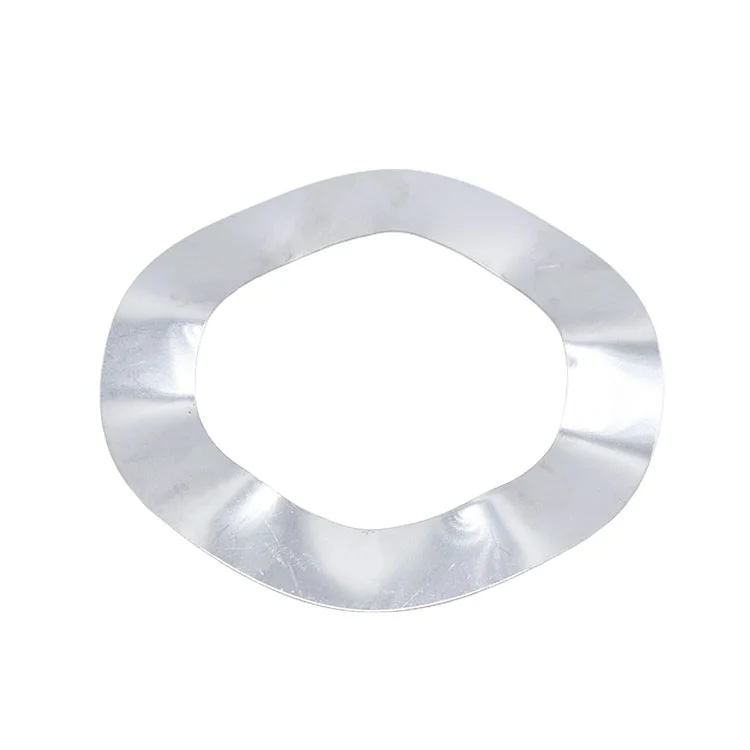
The term can describe different washer designs. A curved spring washer may have a single-wave profile that provides limited elastic deflection under an axial load. Other curved washer designs may feature a broader curved bearing surface intended to fit a particular component or distribute force over a larger area. These designs are not interchangeable, so buyers should confirm the intended washer type before ordering.
In industrial fastening systems, the correct washer can influence how components contact each other, how force is transferred, and whether a small amount of movement can be accommodated. Its performance depends on the material, geometry, applied load, installation conditions, and compatibility with the mating parts.
Zhenhua's Industrial Curved Washers product page provides a starting point for buyers evaluating suitable washer components for their fastening requirements. For engineering or high-volume purchasing decisions, the precise dimensions, material grade, finish, and performance requirements should be confirmed with the supplier.
The operating principle depends on the specific curved washer design. Understanding the intended function is essential because a washer developed for light spring loading may not provide the same performance as one designed for a particular bearing surface.
The curved profile changes how the washer contacts adjacent components. In an application designed around a matching curved surface, the washer can provide a more suitable fit than a conventional flat washer. Correct geometry is important to prevent unwanted gaps, concentrated contact, or assembly interference.
Some curved washers act as light-duty spring elements. When axial force is applied, the curved section deflects and can exert a restoring force within its intended working range. This behavior may help accommodate limited axial play or maintain contact in suitable assemblies.
The available deflection and resulting force depend on material properties, thickness, curvature, dimensions, and loading conditions. Buyers should request load-deflection data when spring performance is a functional requirement.
When installed between compatible components, a washer transfers force through its contact surfaces. The effective contact area and profile affect how the force is transmitted to adjacent parts. A washer should be selected according to the actual mating geometry and applied load rather than by appearance alone.
Curved washers should not automatically be treated as substitutes for locking washers, structural bearing washers, or other specialized fasteners. Their suitability depends on the intended design function and verified performance characteristics.
A curved profile can be useful when an assembly requires a shaped contact surface or a particular fit. Selecting a washer that matches the mating components can help reduce installation difficulties and support more consistent assembly conditions.
For spring-type curved washers, elastic deflection can accommodate limited movement and provide a light restoring force. This can be valuable in selected mechanical assemblies where a compact spring element is required.
However, spring action alone does not guarantee resistance to bolt loosening under vibration. Joint design, preload, friction, operating conditions, and the specified fastening method must also be considered.
Curved washers can provide a functional profile within a relatively small installation space. This makes them worth evaluating in equipment assemblies where space is restricted and the washer must perform a specific mechanical role.
Depending on the product design, industrial washers may be available in carbon steel, stainless steel, spring steel, or other specified materials. Surface treatments may also be available to meet corrosion-resistance or appearance requirements.
The actual options should be confirmed against the supplier's product range. Material and finish selection must account for operating temperature, moisture, chemical exposure, contact with dissimilar metals, and required service life.
Consistent dimensions and controlled forming quality help ensure that washers fit the intended fasteners and mating parts. In high-volume manufacturing, this can support more predictable assembly operations and reduce the risk of problems caused by dimensional variation.
Industrial curved washers can be used in different sectors, provided that the washer design matches the application's mechanical requirements.
Application suitability should be verified before a washer is used in safety-critical or heavily loaded equipment. Factors such as fatigue, corrosion, temperature, vibration, and joint preload can influence long-term performance.
Before purchasing Industrial Curved Washers, buyers should identify the dimensions and performance characteristics that determine compatibility with the intended assembly.
| Specification | What to Verify | Why It Matters |
|---|---|---|
| Washer type | Curved bearing washer, curved spring washer, or another specified design | Clarifies the intended mechanical function. |
| Inside diameter (ID) | Hole diameter and applicable tolerance | Determines compatibility with the bolt, screw, or mounting feature. |
| Outside diameter (OD) | Overall diameter or specified bearing dimensions | Affects available contact area and installation clearance. |
| Thickness | Nominal material thickness and tolerance | Influences fit, stiffness, and mechanical behavior. |
| Curvature or free height | Specified profile, height, and geometric tolerances | Important for fitting and spring-type performance. |
| Material | Required grade, mechanical properties, and documentation | Helps establish strength, elasticity, and environmental suitability. |
| Surface finish | Plain, plated, coated, or another specified finish | Supports corrosion management and compatibility with the assembly. |
| Load-deflection performance | Specified force at a defined deflection, where applicable | Helps verify whether a spring-type washer meets functional requirements. |
| Applicable standard | Drawing, industry standard, or customer specification | Provides a clear basis for manufacturing and inspection. |
Purchasing note: These are general engineering checkpoints, not confirmed specifications for every Zhenhua product. Request the applicable product drawing, material details, tolerances, finish requirements, and performance data before approving an order.
Although these components may appear similar in a fastener catalog, their geometries and functions can differ significantly.
| Comparison Factor | Curved Washers | Flat Washers | Wave Washers |
|---|---|---|---|
| Basic geometry | Curved or single-arc profile, depending on design | Generally flat annular profile | Multiple waves or a formed wave profile |
| Primary function | Shaped contact or light spring action, depending on type | Load distribution and surface protection in suitable joints | Axial spring force and limited movement accommodation |
| Deflection behavior | Depends on the specific curvature and material | Generally not intended to provide substantial spring travel | Designed to provide elastic deflection within its working range |
| Typical selection factor | Matching profile and intended mechanical function | Dimensions, bearing area, and material compatibility | Required axial force, deflection, and available space |
| Key caution | Different curved designs may not be interchangeable | Does not automatically prevent loosening | Load capacity and fatigue performance must be verified |
The right choice depends on the function required by the assembly. A flat washer may be sufficient for basic load distribution, while a curved or wave washer may be appropriate when the design requires a particular profile or spring behavior. Engineers should verify the component's specified function rather than selecting it based on its name alone.
Effective procurement begins with a clear definition of the application and the required performance. The following steps can help buyers communicate their needs accurately.
Determine whether the washer must match a curved mating surface, provide light spring force, accommodate axial movement, or perform another defined task. This first step helps prevent confusion between products with similar names but different mechanical functions.
Specify the inside diameter, outside diameter, thickness, free height, curvature, and relevant tolerances. A technical drawing or physical sample can help the supplier identify the correct configuration.
Consider the mechanical load, required elasticity, corrosion exposure, temperature, and compatibility with adjacent materials. Stainless steel may be appropriate for certain corrosive environments, while specific spring steels may be selected for designs requiring defined elastic behavior. Final selection should follow the product requirements and engineering evaluation.
For spring-type washers, request load-deflection information and the relevant testing conditions. For other curved washer designs, confirm the intended bearing geometry, fit, and dimensional tolerances.
Industrial buyers should also consider:
Providing complete specifications helps the supplier assess manufacturing feasibility and prepare a quotation that more accurately reflects the required product.
Consistent washer quality is important for repeatable assembly and reliable operation. Quality checks should focus on the characteristics that affect the component's intended function.
Verify the inside diameter, outside diameter, thickness, free height, curvature, and other specified dimensions. For spring-type washers, dimensional inspection should be supplemented with functional testing when required.
Check the material grade and relevant documentation against the purchase specification. Inspect the finish for visible defects and confirm that any required coating or plating meets the agreed requirements.
Where performance depends on spring force or deflection, use an agreed testing method and acceptance criteria. Results should be evaluated under defined conditions so that different batches can be compared consistently.
For critical joints, the washer must be evaluated as part of the complete fastening system. Correct selection, installation, and inspection are all necessary to achieve the intended result.
Industrial Curved Washers are used in assemblies that require a shaped washer profile, suitable contact with mating components, or light spring action, depending on the design. Typical applications include selected machinery, automotive components, electrical equipment, and OEM fastening systems. The exact function should be confirmed from the product drawing and specification.
No. A curved spring washer commonly has a single curved or wave-like section, while a wave washer generally has a more pronounced multiple-wave or specified wave profile. Their load-deflection characteristics can differ. The correct component should be selected according to the required force, deflection, available space, and manufacturer data.
A curved washer may provide spring action in certain designs, but it should not automatically be considered a reliable locking solution for every bolted joint. Resistance to loosening depends on the complete joint design, preload, friction, vibration conditions, and the specified locking method. Follow the relevant engineering requirements.
Depending on the design and application, possible materials include carbon steel, stainless steel, and spring steel. The appropriate option depends on strength, elasticity, corrosion exposure, temperature, and compatibility with mating components. Buyers should verify available materials and request documentation when required.
Provide the washer type, drawing or sample, inside and outside diameters, thickness, curvature or free height, material grade, surface finish, quantity, and any required performance standards. If the washer provides spring action, include the required load-deflection conditions. Complete information helps clarify product suitability and quotation requirements.
Buyers can establish inspection criteria covering dimensions, material, surface finish, and any specified functional performance. For spring-type washers, request relevant load-deflection test data when required. The inspection plan should reflect the intended application and the acceptance criteria agreed with the supplier.
Industrial Curved Washers can support specialized fastening requirements by providing a suitable curved profile, controlled contact, or light spring action when the design calls for these functions. Selecting the right component requires attention to washer type, dimensions, material, surface finish, load conditions, and compatibility with the complete assembly. By defining technical requirements clearly and verifying product quality before installation, manufacturers and procurement teams can reduce fitment issues and improve assembly consistency. Zhenhua offers a product resource for buyers evaluating curved washer solutions for industrial applications. If you are sourcing curved washers for equipment manufacturing, OEM production, or a customized fastening project, contact us to discuss your drawings, material requirements, order quantities, and technical specifications and identify a suitable solution for your application.
✅ Get free sample!! Contact us today
✅ We will contact you within 24 hours
