
Bolts loosen. Under vibration, shock and thermal cycling, the preload in a bolted joint can relax, and the nut slowly rotates back. Solving that problem has occupied engineers for nearly two centuries, and the result is a remarkable family of lock washers, each generation more sophisticated than the last.
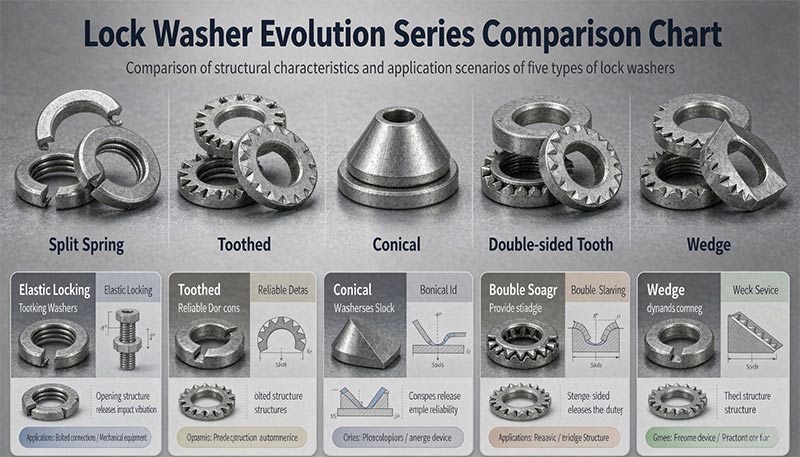
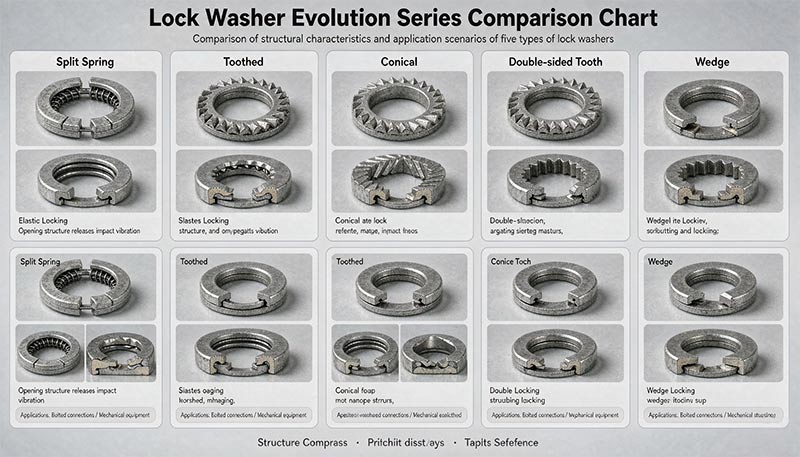
The first widely used lock washer was the split (helical) spring washer. Its simple idea: an angled gap creates spring pressure and a sharp edge that digs into the nut and workpiece, resisting rotation through friction. It was cheap, easy to stamp and effective enough for countless machines. Its limitation is well documented: under strong vibration, friction alone can be overcome, and the washer can relax or embed itself, allowing preload to drop.
The next leap was mechanical interlock. Serrated lock washers - such as DIN 6797 (tooth lock washers) and DIN 6798 (external, internal and conical serrated types) - carry sharp radial teeth that bite into the bolt head or nut and the mating surface during tightening. The teeth create a positive mechanical lock against rotation, not just friction. The DIN 6798 family added spring action: the curved or conical body compresses and delivers axial spring force while the teeth hold the joint, combining tooth bite with elastic preload.
Engineers also learned that joints lose preload even when the nut does not turn. Thermal expansion, creep and relaxation of the clamped materials change the effective length of the joint. Conical spring washers such as DIN 6796 and wave spring washers such as DIN 137A and DIN 137B were developed to store elastic energy and continuously push back, compensating for these dimensional changes and maintaining clamp force.
For heavy-duty and safety-critical joints, single-sided designs were not enough. DIN 9250 safety lock washers combine a conical disc with radial serrations on both faces, supplied as matched pairs. The teeth bite into both the fastener and the workpiece while the disc spring keeps preload working after the joint settles, creating a bi-directional mechanical lock against vibration and shock.
Meanwhile, the French standard NF E 25-511 (NFE 25-511) developed its own answer: a single-sided serrated conical washer supplied in narrow (N), medium (M) and large (L) width series, combining spring preload with tooth engagement and a wide bearing area.
The most advanced family - DIN 25201 wedge lock washers - works on a different principle entirely. The washers are supplied as matched pairs with interlocking cam surfaces and radial teeth on the outer faces. Installed with the cam faces together, any attempt by the bolt to loosen causes the steep cam surfaces to convert the loosening rotation into increased clamp force. Instead of fighting the loosening with friction, the wedge design uses the loosening motion itself to tighten the joint. This makes DIN 25201 pairs a preferred solution for high-vibration and dynamic-load applications in rail, wind power, construction machinery and heavy equipment.
| Approach | Representative types | Primary mechanism | Typical use |
|---|---|---|---|
| Friction | Split spring washer | Spring pressure and edge friction | General light-to-medium assemblies |
| Tooth bite | DIN 6797, DIN 6798 A/J/V | Serrations mechanically lock rotation | Flat surfaces, sheet metal, space-constrained joints |
| Spring compensation | DIN 137A/B, DIN 6796 | Elastic preload against creep and thermal change | Preload retention, gap compensation |
| Double-sided lock | DIN 9250 S/VS/L | Disc spring plus teeth on both faces | Heavy-duty, safety-critical joints |
| Single-sided serrated conical | NFE 25-511 N/M/L | Spring preload plus tooth bite, wide bearing area | Automotive, rail, power and construction |
| Wedge action | DIN 25201 pairs | Cam surfaces convert loosening into higher clamp force | High-vibration, dynamic-load joints |
Modern lock washer selection is not about picking the "best" generation, but the right mechanism for the joint. Vibration level, surface hardness, mounting space, corrosion environment and reusability all matter. Ningbo Yinzhou Zhenhua Stamping Co., Ltd. manufactures the full range - wedge lock washers, serrated lock washers, conical and wave spring washers and safety lock washers - and its engineers compare families side by side before recommending one, so customers do not have to guess.
Send Zhenhua your application details: bolt size, joint material, vibration level and any existing part numbers. We will confirm the right locking mechanism, material, finish and lead time before you commit.
✅ Get free sample!! Contact us today
✅ We will contact you within 24 hours
